A hospital can improve patient satisfaction by improving the way people work together. Missouri Baptist Medical Center, a 489-bed healthcare facility in St. Louis and part of BJC HealthCare, set out to solve a clear problem: a lack of teamwork and consistently low patient satisfaction scores.
The hospital defined three objectives for that work. It wanted to improve teamwork, raise patient satisfaction scores, and attract and retain high-performing employees. To pursue them, Missouri Baptist introduced the practices of the FISH! Philosophy to staff, creating a shared way to talk about how people show up at work and treat one another.
How did Missouri Baptist try to improve patient satisfaction?
From there, the hospital created an ongoing reward and recognition program so employees could recognize one another for living into the practices. Teams were encouraged to meet regularly to keep FISH! alive in their conversations and ways of thinking. Leaders were invited to embrace and live the philosophy rather than simply hand it off to employees.
The change was then reflected in surveys taken before and after the introduction of FISH!. The patient satisfaction results came from September 1999 and November 2000, while the staff attitude results came from September 1999 and May 2000. The patient questions focused on nursing care.
Patient satisfaction results reported by Missouri Baptist
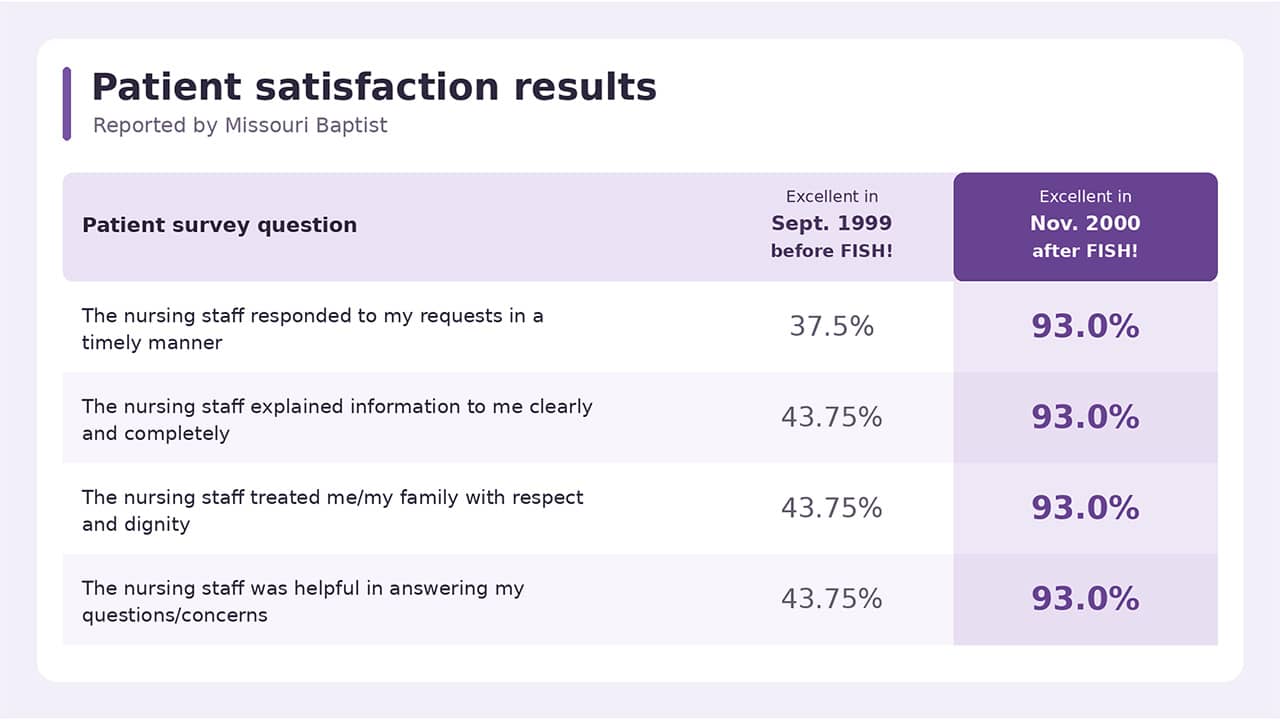
Patient satisfaction results reported by Missouri Baptist, before and after FISH!
Staff attitude results reported by Missouri Baptist

Staff attitude results reported by Missouri Baptist, before and after FISH!
For Cathy Flora, Neuro-Renal Clinical Nurse Manager, the change felt like a shift in how people worked together:
“We started feeling like a team working together instead of everybody doing their own thing.” —Cathy Flora, Neuro-Renal Clinical Nurse Manager
The case study also quotes Shari Bommarito, Clinical Nurse Educator:
“These numbers support the belief that when people have fun in their jobs they are motivated to do their best. We all have the power to choose our attitude and make a difference. Sometimes we just need to know it’s OK to do so.” —Shari Bommarito, Clinical Nurse Educator
Missouri Baptist was one of many organizations whose results with the FISH! Philosophy were documented. Its case gives readers a useful starting point: better patient ratings can appear alongside stronger teamwork, communication, support, and staff voice. The results were reported at the time of those surveys, so they should be read as a historical case study, not as current hospital performance.
How can a hospital improve patient satisfaction beyond a survey score?
Patient satisfaction and patient experience are related, but they are not the same. The Agency for Healthcare Research and Quality says patient experience covers the interactions people have with the healthcare system, including communication, getting information, care coordination, courtesy, and respect. Satisfaction asks whether expectations were met, while experience asks whether important parts of care actually happened.
That difference matters because a hospital cannot improve patient experience by focusing only on a final score. It has to improve the moments that create the score: a nurse responding to a request, explaining information clearly, answering a question, or treating a patient and family with dignity. Those are the same kinds of nursing interactions that appeared in the Missouri Baptist patient survey.
A useful way to begin is to listen for the exact experience behind the number. Review patient comments, ask where communication breaks down, and look for repeated concerns about delays, unclear information, or handoffs. Then choose one or two behaviors a team can practice and measure. A long list of goals can make improvement feel abstract; a small number of visible behaviors gives people something they can try on the next shift.

Example behaviors a nursing team can practice in response to what patients describe.
Why does nurse teamwork affect patient satisfaction?
Nursing care is connected work. One person may receive a request, another may follow up, and a third may need to know what happened. If the handoff is unclear, the patient may experience the team as slow or disorganized even when each person is working hard. When nurses share information, support one another, and keep the patient’s need in view, the care feels more joined up.
The National Academy of Medicine identifies shared goals, clear roles, mutual trust, effective communication, and measurable processes and outcomes as core principles of team-based healthcare. It also says leadership must support those principles in both words and actions. AHRQ’s TeamSTEPPS program makes a similar connection, describing teamwork tools designed to improve communication and teamwork skills so healthcare teams can optimize patient outcomes.
This explains why nurse teamwork can affect patient satisfaction. Teamwork does not stay inside the staff room. It reaches the patient through response time, explanations, care coordination, and the confidence that comes when people seem to know what the next step is.
FISH! gives this work a shared language. Be There means complete presence: physical, mental, and emotional attention to the person in front of you. In nursing communication, that can mean listening without preparing a reply, noticing when a patient or coworker is confused, and bringing your attention back when distractions pull it away. A team can discuss where presence is being lost and what would help people return to the conversation.
Choose Your Attitude adds personal responsibility without pretending that hard work or hard emotions do not exist. It asks people to notice the attitude they are bringing into a conversation and choose how they want to show up, including after a difficult interaction. Leaders should model this practice rather than use it to tell employees to “fix” their attitude.
How does staff recognition improve teamwork in healthcare?
Recognition helps people see that their work matters. It also shows the team which behaviors deserve to be repeated. A vague “good job” may feel pleasant for a moment, but specific recognition is more useful: name what the person did, explain the difference it made, and offer it in a form that feels genuine to that person.
Gallup’s research describes effective recognition as honest, authentic, and individualized. Its guidance also notes that recognition can reinforce the culture an organization wants to build. That fits Make Their Day, which turns ordinary interactions into meaningful moments by showing people that their effort, choices, and presence matter.
A staff recognition program does not need to depend on expensive rewards. A peer can thank a nurse for helping with a difficult handoff. A manager can recognize someone privately if public attention would make them uncomfortable. A day-shift employee can acknowledge work completed by a night-shift colleague. The test is whether the recognition is sincere, timely, and connected to a real contribution.
Recognition works best when it is part of normal team life instead of a once-a-year event. Teams can ask, “Who helped a patient or coworker today?” or “What behavior made the work safer, clearer, or kinder?” Those questions connect morale to patient experience without turning appreciation into a quota.
How can leaders build an engaged hospital culture?
Leaders shape culture through what they pay attention to and what they do themselves. If leaders ask staff to communicate, recognize one another, and stay connected to patients, they need to be visible examples of those behaviors. The CDC’s National Institute for Occupational Safety and Health says hospital leaders can support professional wellbeing by communicating with staff, modeling wellbeing, and ensuring a safe work environment. It also describes clear, consistent, two-way communication as essential.
That is why leadership participation tends to matter in workplace culture efforts. Leaders were invited to embrace and live the FISH! Philosophy. When leaders model the behaviors they ask of others, those behaviors become more credible and easier for a team to practice.
Regular team meetings can keep the conversation alive. A meeting does not have to become a performance or a new reporting burden. It can ask three practical questions: Where did we work well together? Where did a patient or family member have to work too hard to get help? What is one behavior we want to try before we meet again?

Three questions a hospital team can use to keep the conversation going between meetings.
Play can support this work when it means curiosity, energy, and creativity rather than disruption. In a hospital, play does not mean treating patient care casually. It can mean making room for a better idea, testing a kinder way to explain a delay, or finding a more useful way to share information. The other practices set the boundaries: play should be present, respectful, and aimed at making someone’s day better.
What should a hospital try first?
Start with one patient-experience problem that staff already recognize. If patients report that requests take too long, examine the communication and handoff behind that experience. If explanations are unclear, practice Be There and ask nurses to check what the patient understood. If morale is low, invite staff to identify the support and recognition they need instead of assuming a reward will solve it.
Then measure both sides of the work. Patient feedback can show whether the experience is changing. Staff questions about teamwork, communication, support, and having a say can show whether the working conditions are changing too. The Missouri Baptist case is a reminder that those two views belong in the same conversation.
A simple lesson from the Missouri Baptist case
Patient experience is built by people who work together, and teamwork is built through repeated choices. Be present. Notice good work. Make room for ideas. Choose the attitude you bring to the next conversation. When leaders join that work and teams keep talking about it, culture becomes something people practice rather than a slogan on a wall.
Try the FISH! Philosophy with your team
If your team wants a shared way to talk about patient experience, nurse teamwork, communication, and staff morale, try the FISH! Philosophy upgraded trial. It gives a team 30 days of access to the FISH! film and its digital guides, so you can begin exploring the practices and turning them into conversations your workplace can use.

Frequently Asked Questions
What is the difference between patient satisfaction and patient experience?
Patient satisfaction focuses on whether a person’s expectations were met. Patient experience looks at whether important parts of care, such as clear communication, respect, access to information, and timely help, actually occurred.
How can a hospital measure teamwork?
A hospital can use staff surveys that ask about communication, support, shared goals, trust, and whether people have a voice in team decisions. It can pair those results with patient feedback, safety reports, and observations of handoffs so leaders can see both the team’s working conditions and the patient’s experience.
What makes recognition meaningful to nurses and other staff?
Meaningful recognition is specific, sincere, and connected to a real contribution. It should also fit the person receiving it: some people prefer a private thank-you, while others appreciate public acknowledgment.
Can the FISH! practices work in a serious healthcare setting?
Yes, when Play means curiosity and creativity rather than careless behavior. The practices work together: Be There keeps attention on people, Make Their Day keeps respect at the center, and Choose Your Attitude helps people decide how they will show up during difficult work.
How can leaders improve patient experience without adding a large new program?
Leaders can start by choosing one recurring patient concern and one team behavior tied to it. They can discuss it in existing meetings, model the behavior, invite staff feedback, and review patient and staff measures over time rather than treating culture change as a one-time training event.