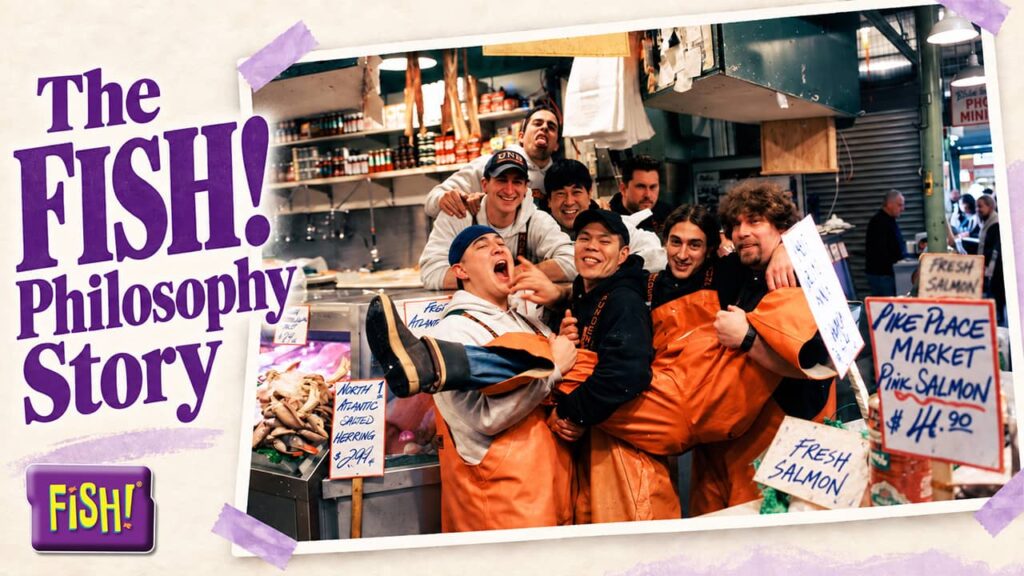
At Pike Place Fish Market, the fishmongers did not start throwing fish because they wanted to put on a show. They started because a sale required someone to walk 15 steps around the counter to get the fish and then 15 steps back to ring up the purchase. One day, tired of the long walk, a fishmonger threw the fish over the counter to a coworker. It was faster. The customers loved watching it, too, but that was a bonus.
That small solution became a symbol of something larger. Play at work can begin with a better way to solve a real problem. The FISH! Philosophy is a way of being, built around four simple practices that help people and the organizations they make up become more engaged in their work. Play is one of those practices, and it does not ask you to copy a fish market. It asks you to bring creativity, enthusiasm, and lightheartedness to the work you already do.
The fishmongers have a useful answer for anyone who gets stuck on the flying fish: there are a million ways to Play. It does not have to be throwing a fish.
What does Play mean in the FISH! Philosophy?
Play is a mindset more than an activity. It is the spirit you bring when you stay curious, try a new approach, and look for energy in the work. It can sound as simple as, “Let’s play with that idea.” You are still working toward a serious goal. You are simply giving yourself and your team more room to explore how you might reach it.
That is why Play can increase enthusiasm and reduce stress. When people enjoy the work along the way, they often bring more attention and imagination to it. Play may show up as a warm joke that includes someone, a fresh way to explain a difficult process, a thoughtful question, an unexpected customer connection, or a team experimenting with a new solution.
The FISH! Philosophy does not separate Play from results. The fishmongers work hard. Their lighthearted spirit helps them serve customers, solve problems, and create an experience people remember. Play means taking the work seriously without taking yourself so seriously that fear and stiffness shut down your best thinking.
Myths about Play at work
Myth: Play means games, parties, or special events.
Games and celebrations can open the door to Play, yet the practice reaches far beyond those events. A team can have a party and return to the same tense, rigid habits the next morning. Play is the attitude that can shape a meeting, a customer conversation, a planning session, or a routine task.
Instead of saving Play for a themed day, ask how you can bring curiosity and energy into ordinary work. A team might invite several possible solutions before choosing one. A service worker might find a more personal way to welcome a customer. A manager might use humor that helps people feel included rather than putting anyone on the spot. The aim is a more human way of working, where energy and curiosity have room to grow.
Myth: Play is unprofessional in a hospital, bank, or other serious setting.
Serious work needs care, judgment, and clear boundaries. It does not require a rigid environment. A nurse may use warmth and a light touch to help a patient feel less afraid. A bank team may use a creative question to find a better way to help a customer. A government office may invite staff to rethink a process without pretending that the public responsibility is a joke.
You can take your work seriously without making the environment stiff. In a hospital, Play may be a gentle conversation or a moment of shared humor that respects the patient. It may not be a loud game in a hallway. Play is personal, so people and settings will shape what fits.
Myth: You need to throw something to Play.
No. The fishmongers themselves say there are a million ways to Play. It does not have to be throwing a fish. Throwing fish works for that market because it grew from the work, fits the team, and delights customers without getting in the way of service. Copying the action without understanding the spirit would miss the point.
You can Play by trying a new way to welcome people, testing a better workflow, asking an imaginative question, or turning a brainstorm into a Playstorm where people offer many ideas before judging them. You can throw yourself into the work without throwing anything across the room.
Myth: Play wastes time.
Play can waste time when it is forced, distracting, or disconnected from the work. But a playful approach can also save time, as it did at Pike Place. The first fish toss was an efficiency idea before it became a customer experience.
When people are allowed to experiment, they may find a simpler process or spot a problem that routine thinking missed. A team that spends a short period generating possibilities may reach a stronger answer than a team that accepts the first familiar answer. The goal remains in view as Play brings more energy and imagination to the path toward it.
Myth: Everyone has to join in.
Forced Play does not work. People Play in different ways, and some may prefer a low-key form of participation or may not want to join a group activity at all. Invite rather than require. Make humor inclusive, not personal. Give people a way to contribute that fits their role and boundaries.
A leader who says, “Here is the challenge; what approach would you like to try?” creates more space than a leader who announces that everyone must act playful. Play grows through permission: people can contribute in ways that feel true to who they are, rather than performing a role.
Find your place on the Play spectrum
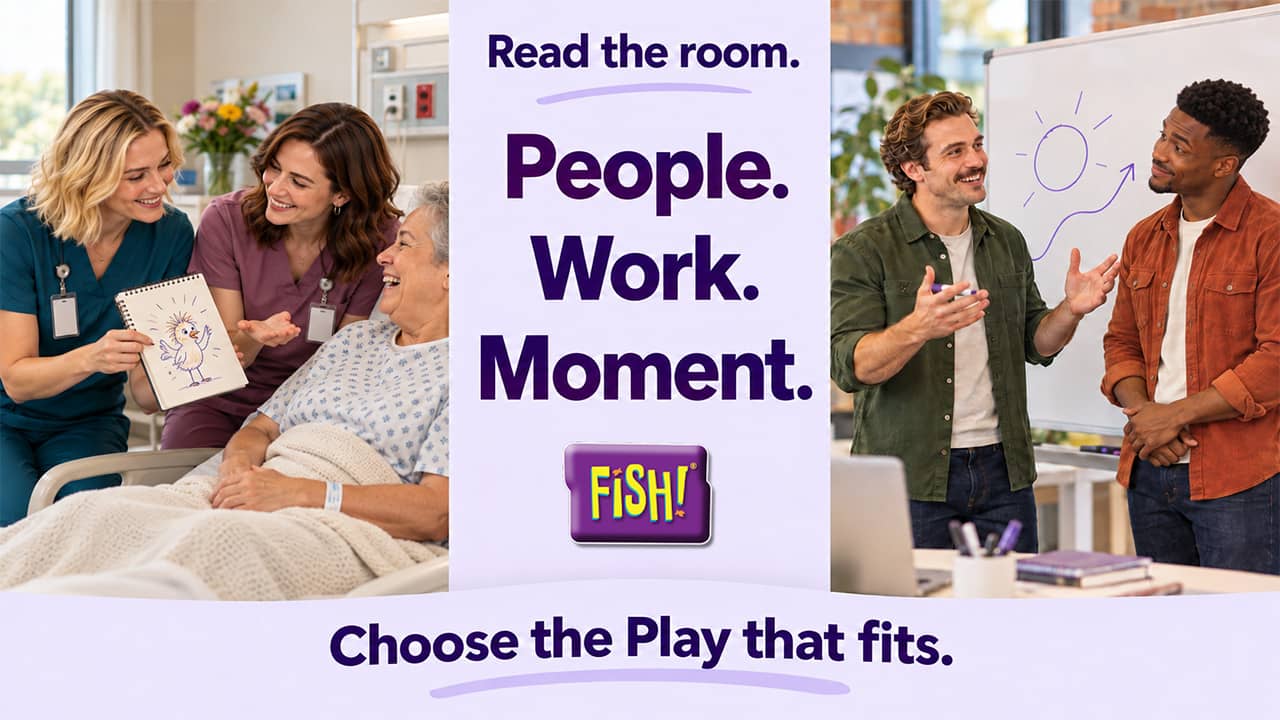
The right kind of Play depends on the people, the work, and the moment.
People fall at different points on a spectrum from mild to wild. One person may bring Play through curiosity, a welcoming tone, or a new question. Another may enjoy bigger gestures, lively storytelling, or an energetic team ritual. Neither approach is more correct.
If Play feels unfamiliar, start on the mild end. Change one routine question. Invite one unusual idea. Use humor that includes the whole group. Try a different way to explain a familiar task. If that feels natural, you may move farther along the spectrum. If it does not, you have still found a genuine way to Play.
The right level depends on the people, the work, and the moment. A team can define its playing field together: what is welcome, what could distract others, what could create a safety problem, and what would cross a line. The other FISH! practices help shape that field. Choose Your Attitude, Be There, and Make Their Day remind us to consider how our behavior affects other people. Play works best when it is respectful, useful, and open to everyone who is involved.
Play, creativity, and psychological safety
Play gives creativity room to move. When a team says, “Let’s play with that idea,” it does not have to accept the idea as finished or correct. It can examine it, add to it, test it, and learn from it. That freedom matters because useful ideas often begin as half-formed thoughts. If people believe every suggestion must arrive polished, they will keep many possibilities to themselves.
A Playstorm is one practical example. Like a brainstorm, it asks people to generate ideas. The difference is the spirit: offer crazy ideas and lots of them, defer judgment, build on what others say, and stay focused on the topic. A strange suggestion may not become the final answer, but it may lead to a workable one. The group gets farther when it does not shut down each idea at the door.
This is where Play connects with psychological safety. Psychological safety means people feel able to speak up, ask questions, experiment, and admit mistakes without expecting humiliation or punishment. Play does not create safety through jokes; it creates safety by making curiosity and learning welcome. When leaders encourage Play, they send a practical message: you may bring an idea before it is perfect, and we can learn from what happens next.
Imagine a manager who responds to a new suggestion with, “Let’s explore it. What would we need to learn?” The idea may prove impractical, but the employee has been invited to think. Other people may add details, raise useful concerns, or offer a better version. Over time, the team learns that trying is part of the work.
Now imagine a manager who responds with a laugh, a sharp correction, or a reminder that the old way is safer. The employee may stop offering ideas. Others notice and hold back, too. The team can still look busy, but its creative energy has moved out of the room. Mistakes become something to hide rather than information the team can use.
A playful leader does not ignore standards. The leader makes the boundaries clear, then gives people room inside them. What cannot be tried because of safety, privacy, legal, or customer needs should be clear. Within those limits, people can experiment with better questions, processes, and solutions. When an attempt fails, the team can ask what it learned and what it will try next.
That approach also helps people enjoy their work. Gallup’s 2026 State of the Global Workplace report found that employees who enjoy their work report stronger wellbeing and higher workplace engagement. The report also found that 50 percent of employees in the United States and Canada felt a lot of stress during much of the previous day. A playful mindset will not remove every pressure, but it can give a team more breathing room to think and support one another. As Rob Gregory, owner of Rochester Motor Cars, put it, “The simple principles in FISH! helped us to transform our culture from indifference to enthusiasm.”
Play when the work is hard
Hard days do not call for pretending that everything is fine. They call for a way to carry the difficulty without allowing fear to control every interaction. A lighter approach might be a shared laugh after a demanding shift, a short reset before solving the next problem, or an invitation to find one small improvement in a discouraging process.
The team still names the serious issue and does the work it requires. Play adds energy so people can keep going. It may help a group remember that a mistake is a chance to learn, that a colleague is a person rather than a role, and that a difficult customer is still someone to serve with care. During a crisis, even a little lightness can keep stress from taking all the oxygen out of the room.
How can a leader welcome Play without making it feel forced?
Start by modeling it. Ask an open question, show interest in an idea, or describe a small experiment you are willing to try. Invite people instead of ordering them to be playful, and notice the forms of Play they already use. A leader who stays curious gives the team a stronger invitation than a poster or a compulsory activity.
What if my team says Play is not for them?
Do not begin with the fish toss. Ask what already brings energy, curiosity, or connection to the work. One person may enjoy solving a process problem; another may bring warmth to customer conversations; someone else may prefer a thoughtful question in a meeting. Start there, then build from what feels natural.
How do we know whether a playful idea crossed a boundary?
Look at its effect on the people involved and the work they are doing. If someone is embarrassed, excluded, distracted, or put at risk, the idea needs to stop or change. The best Play is childlike in its curiosity, not childish in the way it treats people. Teams can define their playing field together and adjust it as they learn.
Try Play with your team this week
Play is a way to bring more creativity, enthusiasm, and lightheartedness to serious work. This week, invite your team to choose one routine challenge and ask, “What could we try if we were willing to play with the possibilities?” Let people offer ideas without judging them too soon, then choose one safe experiment. You may not discover a flying fish, but you may find a better way to work.
Ready to see Play in action? Try the FISH! Philosophy upgraded trial with your team. You will get 30 days of access to the FISH! film and its digital guides, so you can explore the four practices together, see how Play works in a real workplace, and start practicing it.