
The cost of employee turnover can reach far beyond a recruiting bill. It can include orientation, lost productivity, weaker team connections, and the effect of constant staffing changes on patients. Carolina Specialty Hospital, a 35-room hospital in North Carolina, put that issue at the center of its work with the FISH! Philosophy.
What happened at Carolina Specialty Hospital?
Susan Davis, CEO of Carolina Specialty Hospital, and members of her team attended a FISH! Deep Dive training experience held at Ranken Jordan Children’s Specialty hospital in St. Louis, Missouri. After the Deep Dive, the team began using the FISH! practices inside its own hospital.
Davis connected the change to a problem that hospital leaders know well: replacing people is expensive. She said orienting one employee cost “in excess of $20,000.” That made staff retention a financial issue, not only a human resources goal.
Davis reported that staff turnover decreased from 33% to 8.6%. She also reported that Human Resource counseling slips for tardiness, complaints from patients, and absences were down more than 67%. Patient satisfaction scores “greatly improved,” and the hospital reported that its beds were full. In Davis’s words, “We used to run 30-31, now we run 35-40 with 35 rooms.”
Here is how Davis described the change:
“I can tell unequivocally that we would not be where we are today without FISH! This is the best money I’ve ever spent as a CEO of a hospital. It has been almost a year now since we kicked it off and I am still fascinated and amazed.
With the costs to orient one employee in excess of $20,000, retention of staff is critical to the bottom line. After implementing The FISH! Philosophy our staff turnover decreased from 33% to 8.6%, our Human Resource counseling slips (tardy, complaints from patients, absences) are down more than 67%, our patient satisfaction scores have greatly improved and the beds are full. We used to run 30-31, now we run 35-40 with 35 rooms.
If you are just looking at the bottom line, it’s worth it. Any way you look at it, money or quality ‒ it makes sense.
The FISH! Philosophy has had a massive impact on the quality of care and the patient experience. Once it becomes your culture, it is effortless.”
Carolina Specialty Hospital is one of many organizations whose results with the FISH! Philosophy have been documented. Its experience offers a useful question for any healthcare leader: What does employee turnover really cost, and what could improve if more people chose to stay?
What is the real cost of employee turnover?
The clearest cost is the money spent to fill an open role: job postings, recruiting support, interviews, hiring administration, and leader time. SHRM has reported an average cost per hire of nearly $4,700.
Some employers estimate total hiring costs at three to four times the position’s salary, while SHRM says replacement costs can range from 50% to 200% of annual salary, depending on the employee’s level. These are broad estimates, so leaders should measure their own costs.
The next cost is getting the new employee ready to work. Orientation and training take the time of educators, supervisors, peers, and the new hire. During that period, experienced staff help the new person learn the job instead of doing all of their usual work.
Carolina Specialty Hospital’s reported figure of more than $20,000 to orient one employee makes this part of the calculation concrete for that hospital. That figure is separate from SHRM’s broader estimates.
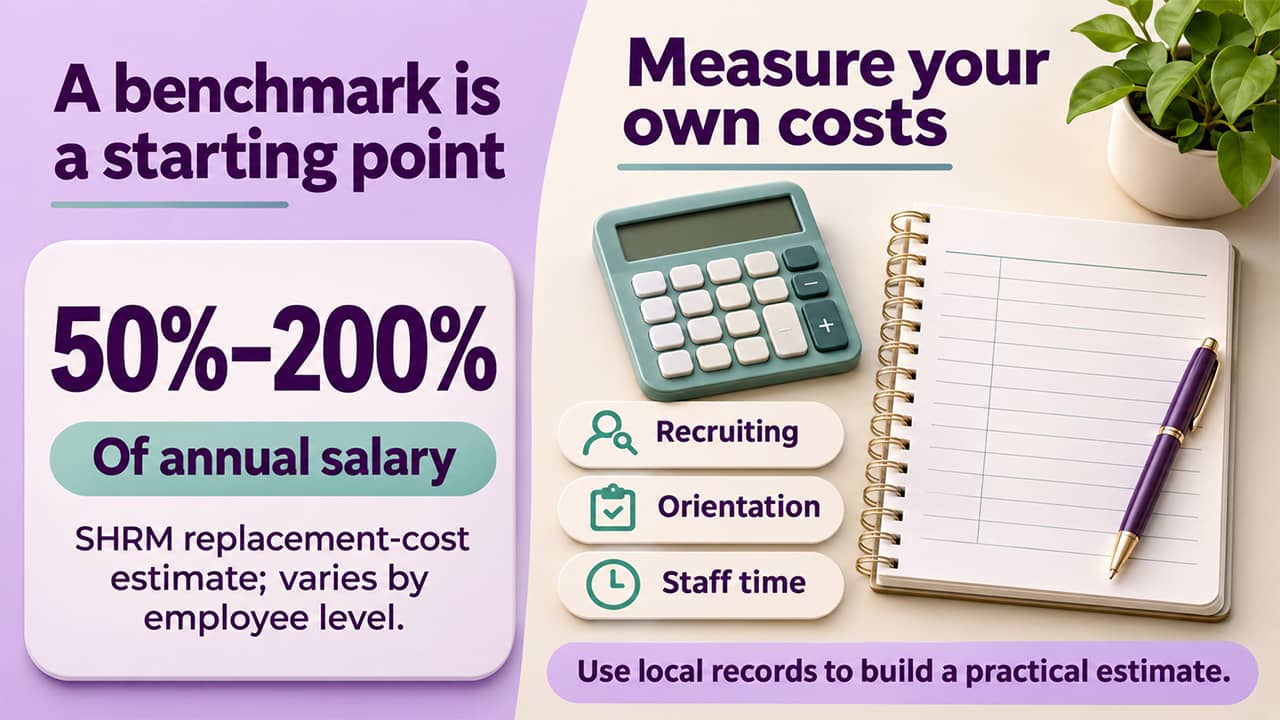
SHRM estimates replacement costs at 50% to 200% of annual salary, depending on the employee’s level, but a hospital gets a more useful number from its own recruiting, orientation and staff-time records.
Some costs do not appear on a purchase order. An open position can leave a unit short, increase pressure on the people who remain, and slow work across departments. A 2023 systematic review by De Vries and colleagues notes that earlier research has linked healthcare worker turnover with financial burdens, lower productivity, loss of knowledge, lower morale, and problems connected with patient health, length of stay, and quality of care.
The review also summarizes earlier research connecting turnover with disrupted continuity of care and patient dissatisfaction.
That is why turnover is a leadership issue. Leaders shape what gets rewarded, whether people can speak honestly, and how much support teams receive during hard periods. Pay and schedules matter, but so do daily experiences of respect, trust, purpose, and belonging.
How can you calculate employee turnover cost?
Start with a baseline: divide the number of employees who leave during a set period by the average number of employees during that period. That gives the turnover rate. Next, sort each departure into cost categories so the estimate reflects the job being measured.
Include recruiting and hiring costs such as advertising, agency fees, screening, interviews, background checks, and HR and leader time. Add orientation and training, including educators, preceptors, required courses, administration, and the new employee’s paid learning time.
Finally, estimate less visible costs: vacancy time, overtime or temporary coverage, time to normal productivity, delayed work, lost knowledge, and pressure on the team. SHRM points to manager time and disruption to team flow as costs that are often missed.
A useful working formula is: cost per departure = separation costs + recruiting costs + orientation and training costs + vacancy and coverage costs + lost-productivity costs. Multiply that estimate by the number of departures.
Keep the categories visible, label assumptions clearly, and update them as the hospital learns more. A practical estimate helps leaders see where retention work could protect people, care, and finances.
Carolina Specialty Hospital gives leaders another measurement idea. In addition to turnover, the hospital tracked Human Resource counseling slips tied to tardiness, patient complaints, and absences, along with patient satisfaction and the number of beds in use. Taken together, these measures show why a broader dashboard can reveal more than the turnover rate alone.
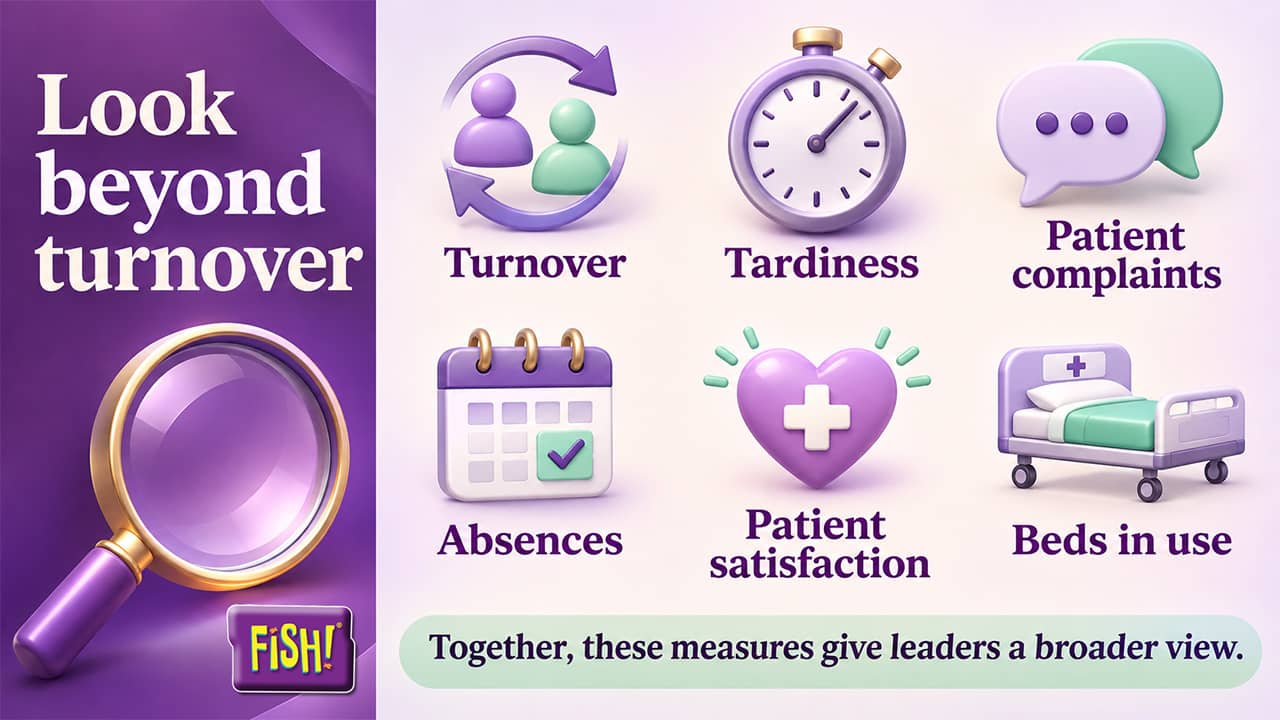
Carolina Specialty Hospital tracked more than its turnover rate, following tardiness, patient complaints, absences, patient satisfaction and the number of beds in use, which together give leaders a broader view.
How can a hospital reduce turnover?
A hospital can ask employees what helps them stay and what makes the work harder than it needs to be. Those conversations should lead to action, because listening without follow-through can damage trust. Leaders can watch results through retention, absenteeism, tardiness, patient feedback, engagement, and quality measures.
The FISH! practices give teams a shared way to work on the human side of those measures. Choose Your Attitude means noticing the attitude a person is bringing and choosing how to approach the next situation. Serious problems still need to be faced; the practice asks people to decide how they will approach them.
Leaders have special influence because their example gives the team a model to follow.
Be There means complete physical, mental, and emotional presence. A manager can show it by listening to an employee’s concern without preparing a defense. Presence helps people feel that their concerns matter, so they are more likely to speak while a problem can still be solved.
Make Their Day turns recognition into a daily part of work. It should be genuine and fit the person, such as a specific thank-you for helping a patient or supporting another department. Fair pay, safe staffing, and a workable job remain essential; recognition adds a visible sign that effort and care are seen.
Play brings curiosity, energy, and creativity to work. In a hospital, the practice supports careful problem-solving rather than carelessness. People need room to look for a better way, solve problems, and learn from an attempt that did not work.
Clear boundaries and room to think can help employees feel trusted and useful.
These practices work together in daily interactions. Presence helps a leader notice when someone needs support, which makes genuine recognition possible. Choosing an attitude can help a team face pressure without passing it along, while Play can help it find a better response.
With practice, the habits can become part of the workplace culture.

Play in a hospital means careful problem-solving, where clear boundaries and room to think help employees feel trusted and useful.
How does staff retention affect patient satisfaction?
Patients experience care through people. They notice whether staff members listen, explain, respond, and work together. Stable teams have more chances to build shared knowledge and strong working relationships.
Frequent departures can leave remaining staff carrying extra pressure while new employees learn, and that pressure can reach the patient experience.
The reported results do not establish that one culture program caused every outcome. Still, the hospital places its retention result beside improved patient satisfaction, fewer counseling slips, and fuller beds. Broader healthcare research also gives leaders reason to track these outcomes together with staff retention, instead of viewing retention as an isolated HR number.
The most practical next step is to choose a small set of measures and review them with the people doing the work. Ask what the numbers may be showing, listen for what they miss, and use the four practices as a common language for improving daily interactions.
Davis said that when a culture takes hold, the work can feel “effortless.” Building it still takes attention, but the habits can become more natural over time.
A better way to think about turnover
The cost of employee turnover includes what a hospital loses in knowledge, trust, time, continuity, and patient connection, along with what it pays after someone leaves. Retention improves when leaders treat culture as part of the operating system and make everyday behavior match the kind of workplace they want.
Try one small action with your team this week: ask, “Who are we being while we are doing what we are doing?” Then listen to the answer and choose one change you can make visible.
Try the FISH! Philosophy with your team
If your team is looking for a practical way to connect culture with retention, patient experience, and the cost of employee turnover, try the FISH! Philosophy upgraded trial. It gives a team 30 days of access to the FISH! film and its digital guides, so your people can begin putting these ideas into practice together.

Frequently Asked Questions
What is a good turnover rate for a hospital?
There is no single rate that fits every hospital, role, unit, or labor market. Compare your rate with your own history and with relevant healthcare benchmarks, then look at what is happening alongside it, such as vacancies, overtime, patient feedback, and employee concerns.
Should a hospital focus on voluntary or total turnover?
Track both, because they answer different questions. Total turnover shows the full staffing burden, while voluntary turnover can point more directly to workplace conditions that leaders may be able to improve.
What is a stay interview?
A stay interview is a structured conversation with a current employee about what helps them remain and what might cause them to leave. Holding these conversations before a resignation gives leaders a chance to understand concerns while there is still time to respond.
What should a leader do when an employee is thinking about leaving?
Listen without turning the conversation into a defense of the organization, ask what would make staying more workable, and follow up on what can be changed. When the underlying problem involves pay, workload, safety, scheduling, or policy, culture practices work best alongside a real solution.
Why do healthcare employees leave?
The reasons vary by role and workplace, but common concerns include workload, scheduling, safety, compensation, limited growth, and the quality of management. Exit interviews and stay interviews can help a hospital identify which issues matter most to its own healthcare workforce.