
Two hospitals can have the same equipment, policies, and skilled clinicians and still feel completely different. The difference is often healthcare culture: the shared values, behaviors, and ways of communicating that shape how staff work together and how patients and families experience care. A frightened parent at 2 a.m. can feel the culture of a unit in a nurse’s attention, a doctor’s tone, and the way the team responds when the night takes an unexpected turn.
Clinical skill and safe procedures are essential. So is the human experience around them. Patients want to understand what is happening, feel respected, and know that someone sees the person behind the chart. Staff members need a workplace where they can ask questions, raise concerns, and bring their full attention to demanding work. Those experiences grow from daily choices across the care team.
What is healthcare culture?
Healthcare culture is the pattern a team creates together over time. It includes what people value, how they speak to one another, how leaders respond to mistakes, and what happens when the unit is busy. It appears in formal policies, yet it also lives in small moments: whether a new nurse can ask for help, whether a family’s question gets a patient answer, and whether one shift leaves useful information for the next.
Culture is different from a slogan on a wall. It is what people experience repeatedly from coworkers, nurse leaders, managers, physicians, and support staff. Because it is built through repetition, it can change through repeated, visible actions.
Why does culture matter in healthcare?
Culture influences patient experience, teamwork, safety, and staff retention in healthcare because it shapes how people act when work is hard. A team that communicates clearly is more likely to notice a change, share a concern, and coordinate care. A team that treats questions as interruptions may leave important information unspoken. These are everyday conditions that affect how reliably people work together.
Patients and families also read the room. A team can complete every task correctly while leaving a family confused or alone. Another team can provide the same clinical care while explaining the next step, listening without rushing, and finding a small way to bring comfort. Patient-centered care includes those human signals because trust helps people take part in their care and communicate what they need.
Culture affects staff in the same way. People are more likely to stay engaged when they feel respected, supported, and connected to a meaningful purpose. Shared habits and relationships can help them handle the strain together and support nurse engagement and staff retention.
What does a positive healthcare culture look like?
A positive culture in healthcare is visible in ordinary interactions. Staff greet one another, share information across shifts, and ask for help before a problem grows. Leaders are present enough to understand the work, and they follow through when employees raise concerns. Patients receive clear explanations, and families are treated as people whose questions deserve attention.
A healthy team can hold high standards and human warmth at the same time. It takes safety seriously, makes room for learning, and gives people permission to recover after a difficult interaction. Humor and lightness may have a place, especially with children or during a long shift, when they fit the person and the moment.
An unhealthy culture often feels guarded. Staff may avoid speaking up, pass frustration from one shift to another, or assume that leaders will not listen. Recognition may be rare, while blame travels quickly. These patterns show where a team’s shared habits need attention.
How do psychological safety and just culture support a culture of safety?
Psychological safety in healthcare means people can ask questions, admit uncertainty, and raise concerns without being humiliated or punished for speaking honestly. It does not mean every action is acceptable or that standards disappear. It means the team makes it possible to surface information early, when it can still help a patient, a coworker, or the whole system.
Just culture adds a fair way to examine mistakes and near misses. Leaders look at what happened, what decisions were reasonable with the information available, and what system conditions shaped the event. They respond to reckless choices differently from a good-faith human error or a process that made an error more likely. The purpose is accountability with learning, so staff can report problems and the organization can improve its systems.
These ideas become real through the response to the first difficult report. A manager who thanks a staff member for speaking up, gathers facts, and shares what the team learned sends a strong message. A manager who reacts with anger teaches people to hide the next concern. That is why a culture of safety depends on daily leadership behavior as much as on reporting forms and policies.
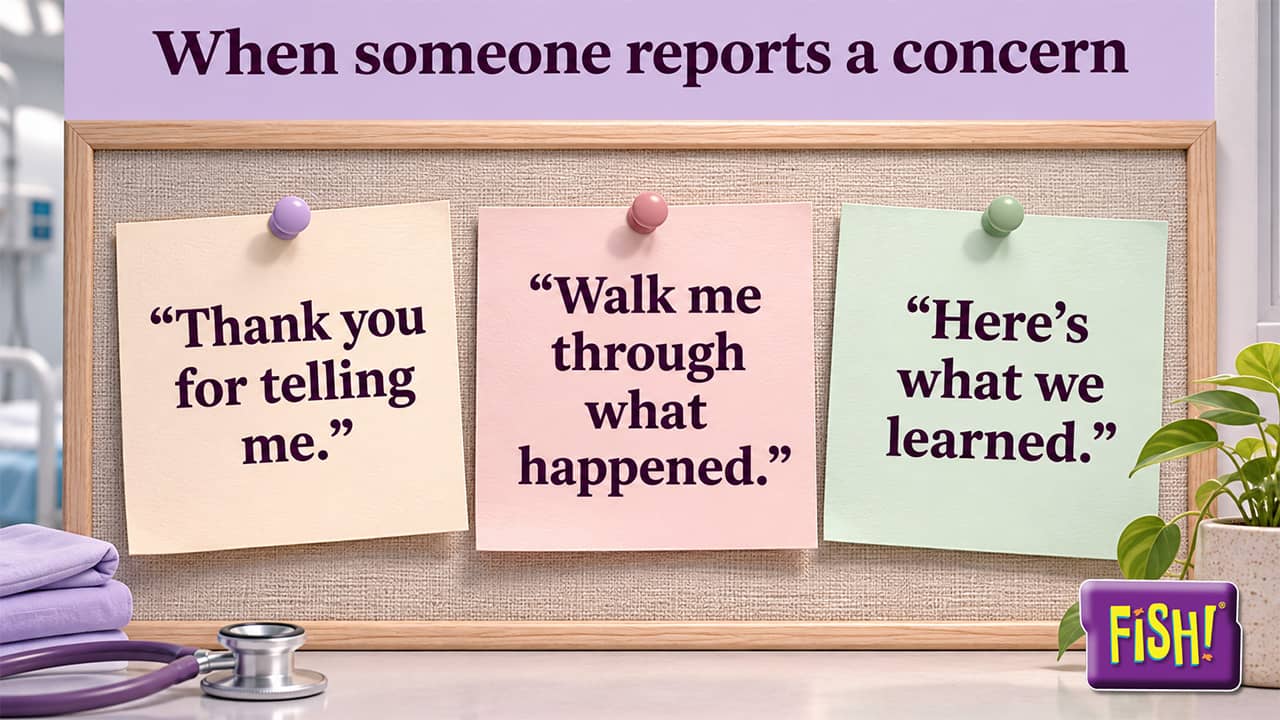
How a leader responds to the first reported concern decides whether people speak up next time, so thanking the person, gathering the facts, and sharing what changed turns one report into a habit of safety.
How do nurse leaders and managers shape nursing culture?
Nurse leaders and managers set the emotional and practical tone of a unit. Staff watch what leaders do when a patient is upset, a schedule changes, or a colleague makes a mistake. A leader who stays curious, listens fully, and takes responsibility gives the team a model for doing the same.
The FISH! Philosophy offers a simple language for this work. Be There means complete presence: physical, mental, and emotional attention to the person in front of you. For a nurse manager, that may mean putting down the phone during a staff concern or setting a real time to talk when an emergency makes full attention impossible. Keeping that promise shows that people matter.
Choose Your Attitude helps leaders notice what they bring into a room and make a deliberate choice before a hard conversation or after a difficult event. It is not a command to pretend everything is fine. Todd Wilkins learned this distinction through painful experience. After his son Michael died, Todd said he had struggled because he was trying to be positive and had been “masking reality.” Choose Your Attitude helped him face his grief and decide how he wanted to move forward.
Leaders also build culture by inviting participation. FISH! is meant to be explored and lived, rather than imposed as a script. A manager can ask, “Who do we want to be for patients and for one another on this unit?” The answers can guide concrete agreements about handoffs, escalation, welcome, and support.
What can a healthcare unit do to improve its culture?
Culture grows through small actions that a team repeats and discusses. A unit can begin with one area that matters most, then use the following practices to make progress visible.
Open huddles with the human picture. Along with staffing, safety issues, and patient needs, ask how people are arriving for the shift and what support may be needed. The question should invite honesty without forcing anyone to disclose private details. It helps the team notice capacity and offer practical help before a coworker reaches a breaking point.
Make handoffs a moment of care. A reliable handoff passes along clinical information and context that helps the next team understand the patient and family. It also includes a clear invitation to ask questions. When the incoming nurse can clarify something without embarrassment, the unit gains another layer of safety.
Recognize specific actions across shifts. Make Their Day is the FISH! practice of creating a meaningful moment that shows someone their effort and presence matter. Recognition works best when it names the action and its effect: “You stayed with that family until they understood the plan, and it helped them settle.” A shared board, a note between shifts, or a brief mention in huddle can make good work visible.
Make speaking up easy and expected. Leaders can model phrases such as, “I may be missing something,” or, “Can we pause and look at this together?” Invite questions during rounds and thank people who raise concerns. After a near miss, explain what changed because someone spoke up. That follow-through turns psychological safety into a team habit.
Use Play with judgment. Play does not require loud games or a cheerful performance. It can be a light moment with a child, a warm story that lowers tension, or a little creativity that helps a team reconnect during a long day. The practice belongs where it serves the patient, family, and care team. Respect for the situation guides the choice.
Create short reflection loops. At the end of a shift, ask what helped the team be present, where communication broke down, and what one small change would help tomorrow. These conversations keep culture active. They also give leaders a way to see patterns that metrics alone may miss.
What can healthcare leaders learn from Todd Wilkins?
Todd’s story shows how culture can be felt by a family in a vulnerable moment. His four-year-old son, Michael, was treated for neuroblastoma at Children’s Memorial Hospital in Chicago, now Lurie Children’s Hospital. During an overnight shift, Todd was feeling nervous and unprepared. He could not believe what he was seeing when he saw nurses tossing a stuffed fish, so he asked what they were doing, and his confusion turned into curiosity.
The head nurse gave Todd her full attention. She explained that the nurses were training in the FISH! Philosophy as a way to stay focused on patients and families. She described Be There, making the day of people who are fearful and uncertain, bringing joy through Play when it helps, and Choose Your Attitude so staff could give their best in pediatric oncology. Then she noticed that Todd had come with a question of his own. She told him they could share more the next day, but first they would take care of him.
That response mattered. In the days that followed, Todd watched the nurses and doctors become even more focused and comforting. He recalled that doctors listened more attentively and helped him and Michael feel cared for and at ease. The culture showed up in the way staff handled a parent’s question, not only in the training they had received.
Michael died two years later, at age six. Todd has spoken about the depression and grief that followed, and about how Choose Your Attitude helped him face his pain rather than hide it. He began a daily “pre-flight checklist”: wake up, choose his attitude, think about whose day he would make, think about how to be playful, and think about being there for his family, team, and community.
Todd later brought FISH! into his business leadership and coaching. In meetings, his team passes a stuffed fish from person to person as a reminder that everyone will be heard. He says the practice helps people share values, be there for one another, choose their attitudes, and make the conversation safe enough for honest listening. The shared commitment gives the simple object meaning.
His questions can help a healthcare team reflect: Which situations are most likely to challenge our attitude? Who around us may be struggling, and how can we be there for them? When stress fills the unit, where might a respectful moment of joy help people reconnect? These questions do not solve every problem. They open the conversation that lets a team decide what care should feel like here.
A culture of care is built one interaction at a time
Healthcare culture lives in the gap between a task completed and a person cared for. It grows when leaders listen, staff speak up, teams recognize one another, and patients feel seen during uncertain hours. Start with one huddle question, one better handoff, or one sincere thank-you. Then keep talking about who your team wants to be while doing the work.
Try the FISH! Philosophy with your team
If your unit is ready to turn those conversations into daily habits, try the FISH! Philosophy upgraded trial. Your team gets 30 days of access to the FISH! film and its digital guides, giving you a shared starting point for exploring Be There, Make Their Day, Play, and Choose Your Attitude in your own care setting. Use the time to discuss what a healthier healthcare culture would look like on your unit and choose one practice to bring to life together.

Frequently Asked Questions
How does healthcare culture affect patient experience?
Patients experience culture through communication, respect, responsiveness, and the way staff work together around them. A team that listens and explains clearly can help patients and families feel more informed and supported during stressful care.
What is the difference between culture and patient satisfaction?
Patient satisfaction is feedback about a person’s experience, while culture describes the shared conditions and behaviors that help create that experience. Satisfaction data can reveal a concern; conversations with staff and observation can help explain the cultural pattern behind it.
How can a small clinic improve its culture with limited resources?
Start with repeatable behaviors that cost little, such as a brief check-in, a reliable handoff, specific peer recognition, and a clear response to concerns. Small teams can also choose one shared question, such as “Who needs us to be fully present today?” and use it in regular meetings.
How should leaders discuss cultural competence with their teams?
Leaders can invite staff to learn how culture, language, beliefs, and past experiences may shape a patient’s communication and preferences. Pair that learning with respectful questions and listening, so care is adapted to the individual rather than based on assumptions.
How do you know whether a culture improvement effort is working?
Look for changes in everyday behavior: more questions, better follow-through, stronger cross-shift communication, and clearer examples of support. Combine staff and patient feedback with safety learning and observations from leaders, because no single measure captures the full culture.