
A customer service philosophy gives your team a clear answer: How do we want people to feel when they interact with us? It connects employee experience with customer treatment. When people feel valued and supported, they are more likely to listen well, solve problems with care, and create an experience that brings customers back.
That idea is at the heart of the FISH! Philosophy, which began with the fishmongers at Seattle’s Pike Place Fish Market. Their work is demanding, while customers experience energy, attention, and warmth. The lesson is useful for any business because great service grows from what people practice in each interaction and carry into their daily work.
What is a customer service philosophy?
A customer service philosophy is a short set of beliefs that guides how a business treats customers and how employees make decisions. It should be easy to remember and specific enough to shape behavior.
A philosophy is different from a policy. A policy tells people what they must or must not do, such as when a refund is allowed. A philosophy explains the purpose behind the decision, such as treating a disappointed customer with fairness and respect. It is also different from a script. A script offers exact words for a common situation, while a philosophy helps someone respond when the situation is new, emotional, or too complicated for a script.
Customers do not always follow the expected path. Someone may ask for help outside the usual return window or be upset about a delay no employee caused. Rules still matter, while a shared philosophy helps the employee ask, “What response fits our values and helps this person?”
Why does a customer service philosophy matter?
A clear philosophy gives employees a steady point of reference. Instead of guessing what a manager would want or hiding behind a rule, they can make a thoughtful choice. That creates more consistent service without forcing every interaction to sound the same.
It also helps connect the employee experience to the customer experience. People who are rushed, ignored, or treated as problems at work may struggle to offer patience all day. A team that feels trusted and supported has more room to be present, creative, and kind. The workplace still needs to acknowledge hard days while giving people the support and shared language needed to show up well during difficult moments.
Customers remember whether someone listened, took responsibility, and made them feel respected. Those moments can influence whether they return.
What are the principles of good customer service?
Strong customer service philosophies vary by industry, but they usually share several principles. These principles describe what good service means to the business and what customers should experience.
- Listen before solving. Give the customer your full attention so you understand the real issue behind the first request. Listening may mean asking one more question or repeating the concern in your own words.
- Show empathy. Treat the customer’s feelings as part of the situation. You do not have to agree with every claim to recognize that a delay, mistake, or confusing process has been frustrating.
- Take ownership. Help move the problem forward instead of passing the customer from person to person. Ownership may mean solving the issue yourself or making a clear handoff and staying accountable for what happens next.
- Be consistent. Customers should receive the same basic care whether they visit a store, send an email, or speak with a new employee. Consistency builds trust, while a philosophy still leaves room for a human response.
- Anticipate needs. Look for the question the customer may ask next. A helpful employee explains the next step, checks that the solution works, or points out an important detail before the customer has to ask.
- Bring care to the interaction. Small choices can make ordinary service feel personal. Use the customer’s name when appropriate, notice when someone is confused, and thank them for their time.
These principles work best as shared habits. A manager can ask, “What would ownership look like?”
What can the Pike Place Fish Market teach us?
The fishmongers at Pike Place offer a memorable example because their approach shapes the whole interaction. In a busy market, a fishmonger gives the person being served focused attention and notices others who may need help.
Their famous fish toss also shows how a service experience can grow from creativity. It began as a practical way to move fish more efficiently between coworkers. Customers enjoyed it, so an ordinary work task became part of a lively experience. Businesses can find their own ways to bring curiosity, energy, and creativity into the work while respecting the customer.
The FISH! Philosophy describes this way of being through four simple practices: Choose Your Attitude, Be There, Make Their Day, and Play. Choose Your Attitude means noticing what you bring into an interaction and choosing how you want to show up, including resetting after a difficult conversation. Be There means complete presence: physical, mental, and emotional attention to the person in front of you. Make Their Day means creating a sincere moment that shows someone their presence, effort, or choices matter. Play brings curiosity and creativity to work without asking people to act silly.
Together, the practices explain why Pike Place works. Presence helps a fishmonger notice a customer’s mood, attitude helps them stay open when the customer is impatient, and a sincere gesture can make the visit memorable. Trust lets the team serve with energy.
How do you write a customer service philosophy for your team?
Start with the experience you want to create, then connect it to behaviors your team can control:
- Describe the customer feeling you want to create. Choose words such as welcomed, understood, confident, cared for, or relieved.
- Ask your team what great service looks like. Invite examples from real interactions. Customers may value a fast answer, a calm explanation, a flexible solution, or simply being remembered.
- Choose three to five service values. Listening, empathy, ownership, consistency, and anticipation are a strong starting point, but your team should decide which ones matter most in your setting.
- Turn values into visible actions. “Be caring” is hard to use. “Listen without interrupting, explain the next step, and follow through” gives people something they can practice.
- Test it against hard situations. Ask what it means when a customer is angry, a request falls outside policy, or the team is busy. If it cannot guide a decision, make it clearer.
- Say it in language people will remember. Use words your team would naturally say and recall.
A customer service philosophy template
“We serve [who we help] by [the experience we create]. We do that by [behavior one], [behavior two], and [behavior three], especially when [a difficult situation].”
Customer service philosophy examples
- Dental practice: “We help every patient feel heard and at ease by listening carefully, explaining choices clearly, and treating concerns with patience.”
- Online retailer: “We make buying simple and dependable by taking ownership of problems, communicating early, and making the next step clear.”
- Neighborhood restaurant: “We welcome every guest with warmth, notice what they need, and create a meal experience they will be glad to remember.”
- Software support team: “We meet customers where they are, solve the real problem, and turn questions into confidence through clear, human help.”
Ask employees what the statement sounds like on a call, at a front desk, and after a mistake. Those examples make it part of the customer experience.
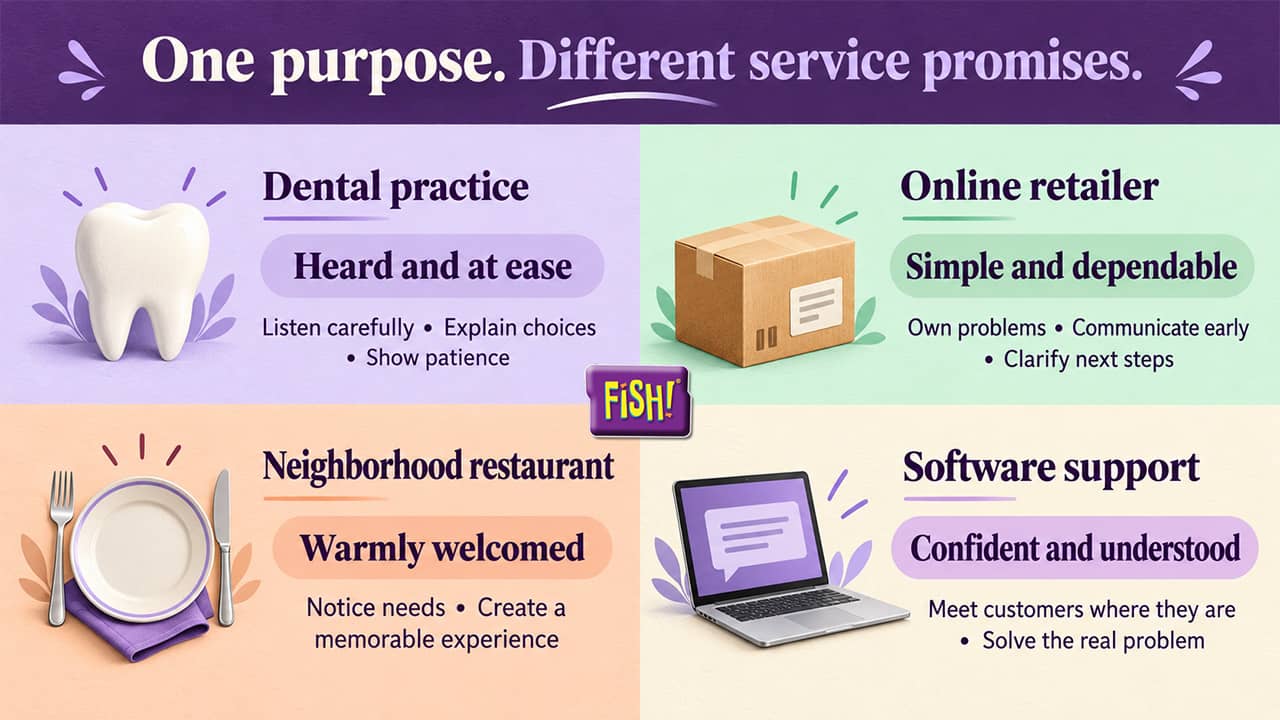
Each business describes the feeling it wants customers to have and names the behaviors that create it.
How do you answer “What is your customer service philosophy?” in an interview?
Keep your answer short, specific, and connected to the job. State your belief, name the actions that show it, and give a brief example. Choose two or three values you can explain naturally.
You can use this structure: “My customer service philosophy is [belief]. I show that by [specific behaviors]. For example, [brief situation, action, and result].”
Here are sample answers you can adapt:
For a retail role: “My customer service philosophy is to make people feel welcome and never make them feel like a problem. I listen first, ask what they need, and offer the clearest next step. In my last job, a customer was looking for an item that had sold out, so I checked nearby locations and helped arrange a pickup instead of sending them away.”
For a support role: “Good customer service means taking ownership from the first question to the final solution. I stay calm, explain what I know, and keep the customer updated if I need help from another team. Once, I could not fix a billing issue myself, but I opened the right case, explained the timeline, and followed up so the customer did not have to start over.”
For a hospitality role: “My philosophy is that small details can change how a guest remembers the whole visit. I try to be present, notice what each person needs, and respond with genuine warmth. At my previous job, I noticed a guest was anxious about an event schedule, so I wrote out the timing and checked in later to make sure everything was clear.”
If you are new to customer service, use an example from school, volunteering, caregiving, or another setting where you helped someone. Show what you did and what changed for the other person.
How do you answer “What does good customer service mean to you?”
This interview question asks you to describe good service from the customer’s side. The philosophy question asks how you approach the work; this question asks what the customer should see, hear, and feel because of that approach. A strong answer includes the customer’s needs, the behaviors that meet them, and a short example that proves you have practiced those behaviors.
You might say, “Good customer service means making the customer feel heard and confident about what happens next. I listen carefully, explain the solution clearly, and follow through. In a previous role, I helped a confused customer compare two options, then checked that they understood the next step before we finished.”
For a hospitality or front-desk role, you could say, “To me, good customer service means noticing what a guest needs before a small problem becomes stressful. I stay present, communicate early, and offer practical help. At my last job, I saw that a guest was unsure about the day’s schedule, so I walked through it with them and wrote down the key times.”
Keep the answer focused on the customer’s experience rather than a long list of personal qualities. Use an example where your actions helped someone feel respected and supported.
How do you get a team to live its customer service philosophy?
Use the philosophy in repeated choices and conversations after the launch. During hiring, ask candidates how they handled an upset person or a situation with no clear rule. Look for listening, ownership, judgment, and respect.
During training, connect the philosophy to real cases. Let employees practice a routine request, a mistake, an angry customer, and a situation needing a creative solution. Discuss what made each response helpful. Leaders should model the same behaviors with employees; a manager who is never present with the team cannot credibly ask employees to be present with customers.
Keep the philosophy part of team conversations and debriefs. Ask where the team lived it, where a process made it difficult, and what could improve the next interaction. Use Make Their Day when you recognize specific behavior, naming what the person did and the difference it made. Recognition should be genuine and appropriate to the person.
Finally, give employees a safe playing field. Policies and boundaries protect customers and the business, while people need room to use judgment outside the script. When leaders invite ideas, learn from mistakes, and adjust the system, employees bring more energy and creativity to service.
Put the philosophy into practice
Good customer service becomes real through the small choices people make with customers and with one another. Ask your team: “Who do we want to be while we are serving our customers?” Their answers can turn a general belief into a practical philosophy and daily behaviors customers remember.
Try the FISH! Philosophy with your team
To explore presence, attitude, creativity, and meaningful customer moments, try the FISH! Philosophy upgraded trial with your team. It gives your team 30 days of access to the FISH! film and digital guides, so you can connect these ideas to your customer service philosophy and practice them together.

Frequently Asked Questions
Should a customer service philosophy include a promise to customers?
It can, as long as the promise is specific and realistic. “We make every interaction clear and respectful” is more useful than a claim that your team will always exceed expectations.
How long should a customer service philosophy be?
Keep the core statement short enough to remember, usually one sentence or brief paragraph. Employees should be able to repeat the central idea without searching for it.
Can a customer service philosophy work with strict policies?
Yes. Policies create boundaries, while the philosophy helps employees apply them with care. When a policy cannot change, an employee can explain it clearly, acknowledge frustration, and look for the best next step.
How often should a team review its service philosophy?
Review it when the business, customers, or team changes. A short conversation every few months can reveal needed process or training updates.
How can we tell whether the philosophy is working?
Listen for customer comments, employee examples, repeat business, and team debriefs alongside scores. Stories behind the scores show whether customers experience the behaviors your philosophy describes.