
The best good customer service examples often begin with a small choice: someone pays attention when a customer is confused, rushed, or ready to give up. That choice can solve the immediate problem and change the way the person feels about the whole business.
The FISH! Philosophy gives teams a useful way to notice customers more fully and respond to what they need in the moment.
“Boy, is your wife going to be happy with you.”
Summer is time for home improvement. One of our colleagues related how one employee used The FISH! Philosophy to turn a routine shopping excursion into a memorable customer service experience:
One Saturday morning, Harry walked into a large home improvement store. He intended to fulfill a long-delayed promise to his wife to put up gutters. Not being much of a handyman, he was nevertheless confident he could get the job done.
Harry asked an employee where the gutters were, but he just pointed toward the far end of the store and kept on walking. He eventually found the right aisle, but his confidence was replaced by a feeling of intimidation: There were so many gutters and gutter materials that it looked like an Iowa cornrow extending forever.
Overwhelmed, Harry quickly decided to put off the gutter project indefinitely. As he began to walk away, defeated, a friendly voice said, “Sir, it looks like you need a little help.”
Harry turned around to see a man in a wheelchair, wearing a bright vest and a big smile, rolling towards him. He reached out his hand and said, “I’m Bill. Is there anything I can do for you?”
Harry told him about the promise to his wife to put up gutters. Bill asked if the paper in Harry’s hand had the measurements of the roofline and his eyes lit up when Harry said yes. Bill looked over the sketch and said, “Let’s play around with a few ideas.”
As they talked, a small group of other would-be gutter put-er-up-ers gathered to hear Bill describe how to put up gutters. Bill acknowledged them but he never lost his focus on Harry. He helped Harry select just the right gutters and all the materials he needed to do the job. Bill even went to another part of the store to get the proper nails so Harry wouldn’t have to search for them.
After checking Harry’s list a final time to make sure he had everything he needed, Bill looked up at Harry with a twinkle in his eye and said, “Boy, is your wife going to be happy with you.”
Harry later recalled, “Because Bill chose to “Be There” for me, he saw the opportunity to playfully and creatively make my day. I have a feeling Bill had created many similar positive customer service experiences, and that those experiences made it easy for him to choose a positive attitude and have more fun at work. Bill showed me how easy it is to live The FISH! Philosophy, and how big a difference that can make to a customer.”
Who will you Be There for today?
What does this story show about good customer service?
This customer service experience shows how several FISH! practices can work together in one ordinary interaction. Bill chose his attitude by bringing energy and willingness to help to the moment in front of him. He practiced Be There by giving Harry his full attention and staying focused on the person who needed help. He made Harry’s day by helping him feel capable and by ending the exchange with a warm, personal comment. He also used Play when he invited Harry to “play around with a few ideas,” bringing curiosity and creativity to a practical problem.
The lesson is useful because none of these choices requires a special title or a large budget. A customer may need information, but they also need to feel seen. When an employee notices the person, listens closely, and thinks with them, the interaction becomes more human and more useful.
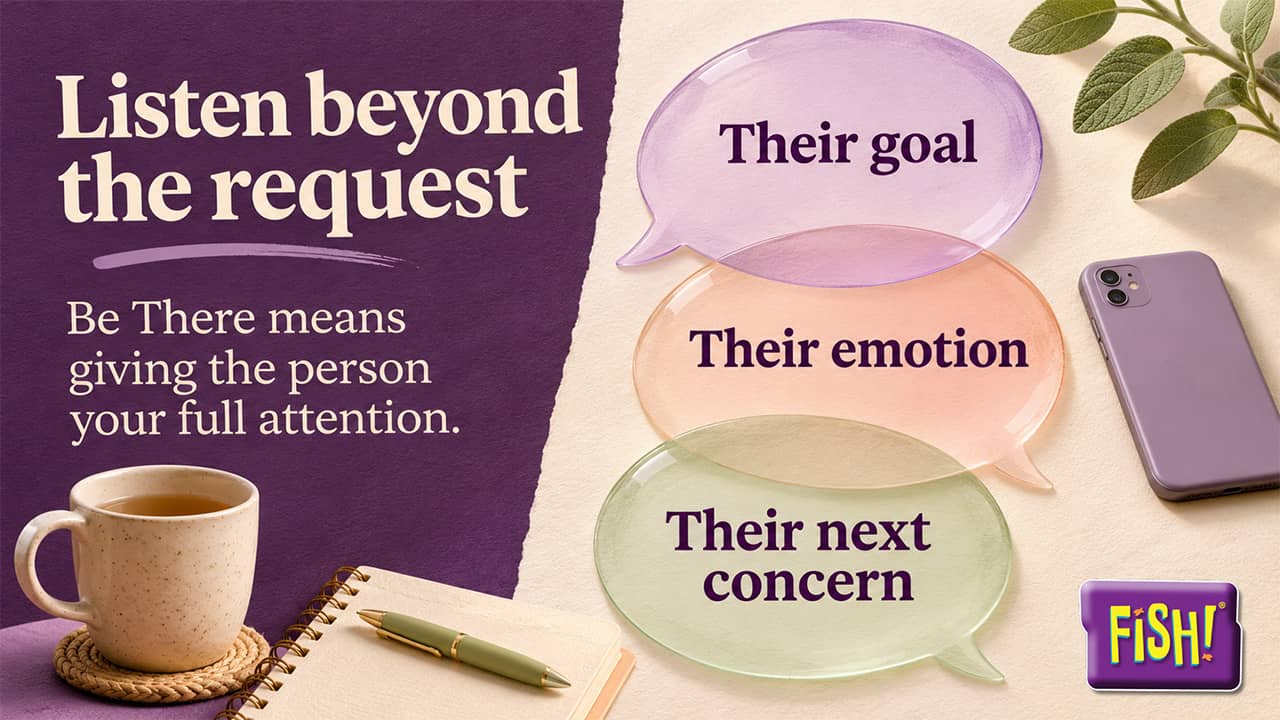
A customer’s question is only the starting point. When you listen for their goal, how they feel, and what they will worry about next, the help you give fits what they really need.
Try one of these actions this week:
- Before your shift or next customer conversation, choose the attitude you want to bring and name it to yourself.
- Put away the mental multitasking. Listen for the customer’s real goal, emotion, and next concern.
- Look for one small way to leave the person better off, such as finding the missing item, explaining the next step, or offering sincere encouragement.
- Ask, “Who are you being while you’re doing what you’re doing?” Then use curiosity to find a better way to help.
These habits turn the FISH! Philosophy into behavior a customer can feel.
What makes customer service good?
Good service starts with noticing. An employee sees that a customer is searching, hesitating, or becoming frustrated and offers help at the right time. The offer should feel respectful, so the customer still has room to explain what they need.
Next comes listening. The employee gives the person enough attention to understand the actual problem, rather than rushing toward the first answer. Good listening may uncover a deadline, a missing detail, or a worry that was never stated in the first question.
Then comes a useful solution. That may mean finding a product, correcting an error, explaining a process, or bringing in someone with the right knowledge. The employee takes ownership of the next step and keeps the customer from being passed around unnecessarily.
Finally, good service leaves the person better off. The customer has an answer, a clear path, and a stronger feeling about the interaction. Excellent customer service can be efficient and still feel personal because the employee treats the person as more than a transaction.
What do customers remember about the first employee and Bill?
The first employee gave Harry a direction. Bill gave him attention, practical help, and confidence. That simple difference explains why customers remember people who go beyond the minimum.
A short answer may technically complete a request, yet it can leave the customer alone with the harder part. A present employee stays engaged long enough to understand what success looks like for that person. Bill’s approach shows that memorable customer service comes from the whole experience, including tone, effort, and the feeling the customer carries away.
People remember whether the employee seemed interested in helping them and made a confusing task feel manageable.
What are some good customer service examples?
These examples of good customer service come from different settings. Each one works because it combines a practical solution with attention to the person receiving it.
1. Retail: walking with a shopper to the item
A shopper asks where a product is, and the employee walks with them instead of pointing across the store. This works because the employee reduces the customer’s effort and may learn what else the shopper needs.
2. Restaurant: adapting to a real need
A server notices that a guest is struggling to read the menu and offers to describe a few dishes clearly, then checks for allergies before taking the order. The service feels thoughtful because it responds to the guest’s situation without making them feel embarrassed.
3. Healthcare: explaining the next step
A receptionist sees that a patient is anxious about a referral and explains what will happen next, who will call, and what the patient should do if no call comes. This helps because clear information can lower stress even when the employee cannot solve the medical issue personally.
4. Call center: listening before transferring
A support agent repeats the customer’s main concern, handles the part within their role, and gives the next agent a complete handoff if a transfer is needed. The customer feels heard because they do not have to start the story from the beginning.
5. Hotel: remembering a preference
A front-desk employee notices that a returning guest prefers a quiet room and checks available options before the guest asks. Personalized service works here because a small remembered detail signals that the guest’s experience matters.
6. Bank: making a complex process clear
A banker breaks a complicated form into plain-language steps and checks that the customer knows what will happen after signing. This builds trust because the customer can make an informed choice instead of feeling hurried.
7. Delivery service: communicating a delay early
A driver or delivery team contacts the customer as soon as a delay becomes clear, gives a realistic update, and offers the next available option. The early notice respects the customer’s time and gives them a chance to adjust their plans.
8. Library or public service desk: finding the real request
A visitor asks for one form, and the staff member asks what they are trying to complete before sending them away. The extra question can uncover a better resource and helps the visitor finish the task with fewer trips.
9. Technical support: checking the outcome
A technician fixes a device, then asks the customer to try the task that originally failed. This matters because the employee confirms that the actual problem is solved rather than stopping at the first apparent repair.
10. Internal service: helping a coworker succeed
An IT teammate restores a presentation file before an important meeting, stays long enough to confirm that it opens, and wishes the presenter well. Internal service shapes employee engagement because coworkers carry those moments into the work they do for external customers.
How can teams turn examples into everyday habits?
Start with real moments from the team’s work. In a short weekly conversation, ask where a customer or coworker needed more attention, where the handoff worked, and where someone had to repeat information. Keep the discussion curious and specific so people can learn without feeling blamed.
Create a shared picture of what “better” looks like. A team might agree that employees will offer to walk with a confused shopper, repeat the customer’s goal before solving a problem, or give a clear next step before ending a conversation. These behaviors make values visible.
Leaders can reinforce the habit by recognizing specific actions. “You stayed with that customer until the form was complete, and it kept her from making another trip” teaches more than “Good job.” Recognition is part of Make Their Day, and it shows the team which choices improve the customer experience.
Give people room to use judgment within clear boundaries. Play invites curiosity, energy, and creative problem solving, so employees need a safe way to suggest a better response when a script does not fit. Teams can decide together which promises, policies, and privacy rules define the playing field, then give employees freedom inside it.
Let the habits travel across departments. Shared notes, thoughtful handoffs, and quick thanks between coworkers make exceptional service easier to deliver.
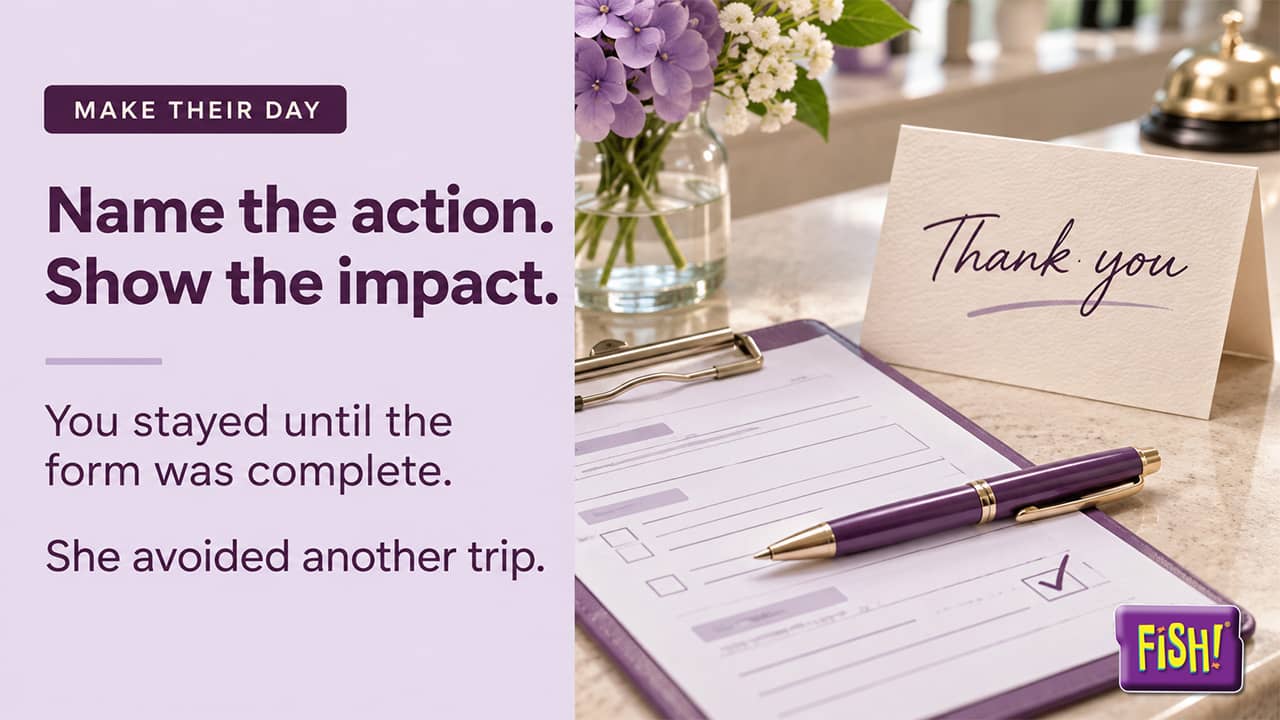
Specific recognition teaches more than “Good job.” Naming what an employee did and how it helped the customer shows the whole team which service choices to repeat.
How do you describe a good customer service experience in an interview?
Use a simple story structure: explain the situation, describe what the person needed, show the actions you took, and state the result. Include one detail that proves you listened and one detail that shows how the customer was better off afterward.
For example: “A customer was overwhelmed by a large project and was about to leave without what they needed. I asked a few questions, reviewed the information they had, helped choose the right materials, and found one item in another part of the store. The customer left with a complete plan and felt confident enough to finish the project.”
Then add what you learned. You might say that good service starts with being present, because the real need can be different from the first question. This kind of answer shows customer service skills through behavior instead of listing adjectives such as friendly or helpful.
What can your team try next?
Choose one customer interaction from this week and study the moment when the experience could have gone either way. Ask what the employee noticed, how they listened, what solution they offered, and how they helped the person leave better off. Then invite each teammate to choose one small act of presence or recognition to try before the next meeting.
Memorable service grows from repeated choices. When people bring attention, creativity, and care to ordinary work, customers feel the difference and coworkers gain a stronger example to follow.
Try the FISH! Philosophy with your team
Invite your team to try the FISH! Philosophy upgraded trial, which gives you 30 days of access to the FISH! film and its digital guides. Use the film and guides to discuss the choices behind good customer service examples, then turn one idea into a habit your team can practice in real customer and coworker interactions.

Frequently Asked Questions
How can I improve customer service when I have very little time?
Use the time you already have with more attention: make eye contact when possible, listen for the real request, and give a clear next step. A brief interaction can still feel excellent when the customer does not have to repeat themselves or guess what happens next.
What should I do when I cannot give the customer the outcome they want?
Acknowledge the customer’s goal, explain the part you can control, and offer the most useful next option. Be There helps you stay engaged with the person, while Choose Your Attitude helps you respond with steadiness during a difficult conversation.
How can a manager coach customer service without making employees sound scripted?
Coach the behavior and the purpose behind it, then let employees use natural language. Review real examples, ask what the customer needed, and recognize judgment, listening, and follow-through rather than requiring one exact phrase.
Can FISH! practices help with remote customer service?
Yes. Remote teams can practice presence through focused listening, accurate notes, timely replies, and vocal warmth. They can also use team debriefs to notice where customers had to repeat themselves and design a better handoff.
Where can I learn more about building a people-centered workplace?
The FISH! film and digital guides offer activities and shared language for discussing attitude, presence, recognition, and creativity at work. Teams can use those materials to keep the conversation going as their customers, coworkers, and challenges change.