


Customer service skills shape how people feel about a business long after a conversation ends. Product knowledge and problem solving matter, but the moment often turns on something more human: whether the customer feels seen, heard, and worth the employee’s time. The FISH! Philosophy offers a useful way to practice that kind of service in ordinary interactions.
The archery story below gives us a simple lens for looking at the skills behind a memorable customer experience.
A FISH! Tale: The Archery Story
A nine-year-old boy, shopping with his father, approached the counter of the archery department at a large sporting goods retailer. He proclaimed to the salesman standing behind the counter, “I want to shoot bows and arrows.”
The salesman, who had been talking with a coworker, glanced over his shoulder at the boy and said in an annoyed tone, “Come back when you’re a little older and I’ll show you some bows.” He turned back to his colleague and resumed their conversation.
Later that same day the boy and his father were at another sporting goods story. Undaunted by his earlier exchange, the boy approached a salesman standing near the archery equipment and again said, “I want to shoot bows and arrows.”
The salesman got down on one knee. His eyes lit up as he said to the boy, “I was about your age when I got my first bow!” He told the boy the story of his first bull’s eye while shooting targets with his Dad in their back yard. He let the boy feel the weight of an adult-sized bow in his hands and invited him to take some shots with a youth bow on their indoor target range. The boy’s father purchased the youth bow and some targets.
The first salesman saw the boy as a kid interrupting his work. The second salesman saw him as a boy with a dream to shoot “bows and arrows.” The FISH! Philosophy helps you see that every interaction is important, not just the ones you want to be important.
What does the archery story show about the FISH! practices?
The first salesman made a choice in the moment he glanced over his shoulder at the boy and turned back to his coworker. His attention stayed with his previous conversation, so the boy’s request became an interruption. That moment shows how Choose Your Attitude affects customer service: the employee’s attitude decides what kind of welcome the next person receives.
The second salesman made a different choice. He got down on one knee, shared the memory of getting his first bow, and invited the boy to try the target range. Those actions show Be There through physical, mental, and emotional presence. He gave the boy his attention, connected with the excitement behind the request, and responded to the person in front of him instead of treating him as a distraction.
They also show Make Their Day. The second salesman created a meaningful moment by recognizing the boy’s interest and helping him take part in it. His personal story made the interaction feel genuine, while the invitation to try a youth bow gave the boy a clear next step. The customer experience grew from the way he chose to see and meet the person in front of him.
Try three things this week: notice when your attention is pulled away and bring it back to the customer, ask what matters behind the person’s request before answering, and look for one sincere next step that leaves the customer more confident or encouraged. These small choices bring the second salesman’s example into everyday work.
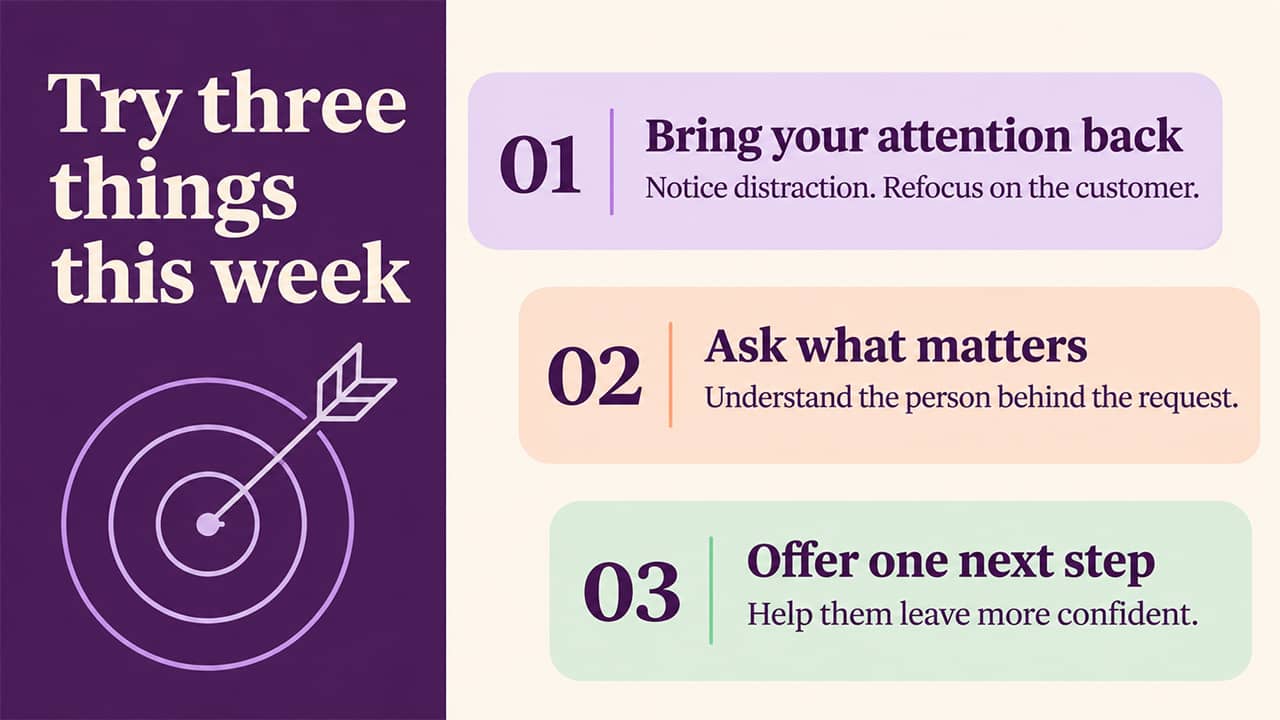
The second salesman’s example comes down to three habits anyone can practice: notice when your focus drifts, ask about the person behind the request, and help them leave more confident.
What are customer service skills?
Customer service skills are the behaviors and abilities employees use to help customers, solve problems, and create a good customer experience. They apply in stores, call centers, offices, health care, hospitality, technical support, and any role where people depend on a business for help.
These skills have two connected parts. People skills for customer service shape the relationship. They include attention, active listening, empathy, patience, clear communication, emotional awareness, and a positive attitude. Practical skills shape the solution. They include product knowledge, accurate systems work, problem solving, and handling complaints within company policies.
A person can know every product detail and still leave customers frustrated if they seem distracted or defensive. Another person may be warm and patient but need more training to give an accurate answer. Strong service brings both sides together. The employee understands the task and stays present with the person completing it.
What are the most important customer service skills?
Here is a customer service skills list that connects everyday service behaviors to the choices highlighted by the archery story.
1. Attention and presence
Attention means giving the customer enough focus to understand the real request. Be There asks for complete presence, which includes listening to the words, watching for cues, and staying emotionally available. Put down avoidable distractions, make the conversation your current task, and confirm the detail that matters most.
2. Active listening
Active listening involves letting the customer finish, asking a useful follow-up question, and reflecting the need back in clear language. Instead of rushing to a standard answer, try, “Let me make sure I understand what you need.” This helps prevent wrong assumptions and shows the person that their request matters.
3. Empathy
Empathy is the effort to understand what the customer may be feeling and why the issue matters to them. It does not require agreeing with every demand. A simple statement such as, “I can see why that would be frustrating,” recognizes the experience and creates room for problem solving.
4. Patience
Patience helps customers who need more time, more explanation, or a second attempt. It also protects the employee from answering with irritation when a conversation becomes repetitive. A calm pace, plain language, and a short pause can make a difficult interaction feel manageable.
5. Clear communication
Clear communication uses direct words, organized steps, and a tone that fits the situation. Avoid jargon when a customer may be unfamiliar with the product or process. After explaining the next step, ask whether it makes sense and tell the customer what to expect next.
6. A positive and chosen attitude
A positive attitude is more useful when it is grounded in a conscious choice rather than forced cheerfulness. Choose Your Attitude invites employees to notice what they are bringing into the interaction and adjust when needed. Customers can tell when a smile is covering impatience, so aim for genuine respect, steadiness, and willingness to help.
7. Product knowledge
Product knowledge lets an employee give accurate guidance and recommend an option that fits the customer’s goal. Keep learning products, policies, and common questions. When you do not know an answer, say so, find the information, and return to the customer instead of guessing.
8. Problem solving
Problem solving combines curiosity, judgment, and follow-through. Define the issue, identify what the customer needs most, check the available options, and explain the solution. Play can support this skill by making it safer to look for a better approach when the usual process does not fit.
9. Handling complaints
Handling complaints calls for empathy, patience, and clear action. The LAST method is a useful memory aid: listen, apologize for the impact, solve what you can, and thank the customer for raising the issue. The apology recognizes the customer’s experience, while the solution shows that the conversation is moving somewhere.
10. Follow-through and attention to detail
A customer’s trust grows when an employee does what they said they would do. Record the correct details, check the order or account carefully, and close the loop when another team must help. Make Their Day often appears in these quiet moments because reliable follow-through tells a person that their time and concern were worth remembering.
How can you improve your customer service skills?
Improvement starts with observation. After one interaction each day, write down what the customer needed, where you stayed present, and where your attention drifted. Choose one behavior to practice next, such as asking a better question or summarizing the request before offering a solution.
Build a personal reset before difficult work. Take a breath, name the attitude you want to bring, review the facts, and decide what helpful action comes first. If a customer becomes upset, slow your pace and use the LAST steps. When the conversation ends, note what worked so the next difficult interaction gives you a little more confidence.
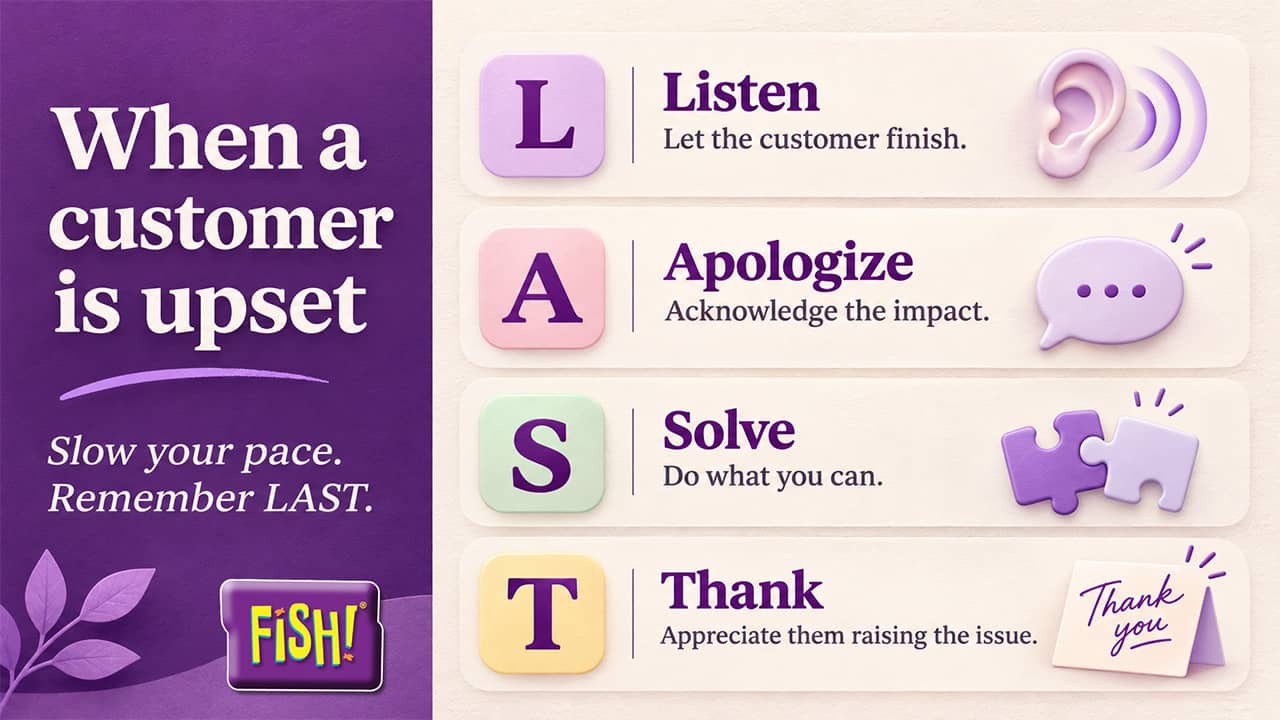
When a customer is upset, slowing down and following LAST helps. Let them finish, acknowledge the impact, do what you can, and thank them for raising the issue.
Strengthen practical skills through small learning blocks. Review one product or policy, practice explaining it in plain language, and ask an experienced teammate to listen. Role-play a complaint and try again with a calmer opening. Treat mistakes as information and invite suggestions for unusual cases.
Look for genuine chances to make someone’s day, such as thanking a customer for useful information, recognizing a helpful teammate, or offering a clear next step before someone asks. These actions turn good customer service skills into habits.
How can managers help a team build customer service skills?
Managers build skills through example, practice, and conversation. Employees watch how a manager responds to an upset customer, a mistake, or a busy period, so the manager’s attitude teaches more than a poster. Be There also applies to the team: give employees full attention, or schedule a time when you can do so.
Use short coaching conversations after real interactions. Ask what the customer needed, what the employee noticed, which skill helped, and what could make the next interaction easier. Keep feedback specific. “You stayed calm while checking the order, and that gave the customer room to explain” teaches more than “Good job.”
Practice common situations together. One employee can play a customer with a complaint while another uses active listening, empathy, and the LAST method. Switch roles and discuss the outcome. Include product questions, unclear requests, handoffs, and cases where policy limits the solution.
Finally, recognize the behaviors you want to see. Make Their Day depends on sincere, specific recognition, so name the action and its impact. Notice careful documentation, a patient explanation, a helpful handoff, or a creative solution across shifts and roles.
How do you show customer service skills on a resume or in an interview?
For customer service skills for a resume, connect each skill to an action and a result. “Used active listening to clarify customer requests and reduce repeat contacts” is stronger than “good communication.” Other examples include resolving order issues through product knowledge or handling complaints with empathy while following policy. Use accurate results from your work, such as response time, repeat business, quality scores, or positive feedback.
In an interview, tell a short story using the situation, your action, and the outcome. Explain how you listened, solved the issue, and what you would repeat. You can also describe how you choose your attitude during a busy shift or help a teammate deliver a better experience.
A simple way to put these skills to work
Customer service skills grow through repeated choices. Give the person in front of you attention, learn enough to solve the real problem, and leave a clear next step. Then look for one sincere way to make the experience better.
Try these actions with your team this week: choose one service behavior to notice, discuss one recent customer interaction without blame, and recognize one person for a specific action that helped someone else. Small conversations create a shared standard, and that standard becomes visible in the customer experience.
Try the FISH! Philosophy with your team
Invite your team to try the FISH! Philosophy upgraded trial, which gives you 30 days of access to the FISH! film and its digital guides. Use the film and guides to start conversations about attention, attitude, creativity, and the small choices that help customers feel valued, then connect those ideas to the customer service skills your team wants to practice.

Frequently Asked Questions
How do you handle a customer who is angry but has a valid complaint?
Let the customer explain the issue without interruption, acknowledge the impact, and state the next step you can take. If the request exceeds your authority, explain the limit clearly and involve the right person while keeping ownership of the handoff.
What should you do when you cannot give a customer the answer they want?
Be honest, explain what you can do, and offer the closest helpful option. Customers usually respond better to a clear boundary and a real next step than to a vague promise or an answer that later proves wrong.
How can remote teams show presence in customer service?
Reduce multitasking, read the full message or case history, and respond to the specific details the customer shared. In calls, use an engaged tone, confirm key points, and tell the customer when you will follow up.
How long does it take to improve customer service skills?
You can begin with one conversation, while lasting improvement comes from repeated practice and feedback. Choose one behavior, review real examples each week, and add another skill as the first one becomes more natural.