The FISH! Philosophy book opens on a cold, gloomy Monday in Seattle, where Mary Jane Ramirez is trying to understand a struggling department. The operations group on First Guarantee Financial’s third floor is known for unanswered calls, slow work, and unhappy coworkers. About five weeks into her new role as manager, Mary Jane hears laughter during a lunch break and finds something she did not expect: fish flying through the air, customers joining the fun, and a worker named Lonnie giving her his full attention.
That is the turning point in the story. During a quick break from work, Mary Jane follows the laughter at Pike Place Market, nearly turns away from the crowd, and stumbles onto the fish market by chance, with the troubles at work still weighing on her. What she finds is a fresh way to think about the choices people make at work—and how those choices shape the day for everyone around them.
What is the FISH! Philosophy book about?
Mary Jane is trying to understand why her department feels so lifeless and what might help it change. The third floor does important work, but because it happens behind the scenes, many people notice it mainly when something goes wrong. Staff members feel stuck in dull routines, while other departments dread dealing with them.
At Pike Place Fish Market, Mary Jane sees a very different kind of workplace. The fishmongers draw a crowd with their energy and playful salesmanship, yet Lonnie gives her his full attention when she talks with him. Their conversation helps her see how people’s approach to work can shape the experience, even when the work itself is repetitive.
Read Mary Jane’s journey as a business parable: it offers a vivid way to think about how you and your team bring energy and care to the work you already have. The story gives you a place to start reflecting on your workplace, rather than a formula for making every office look like a market stall.
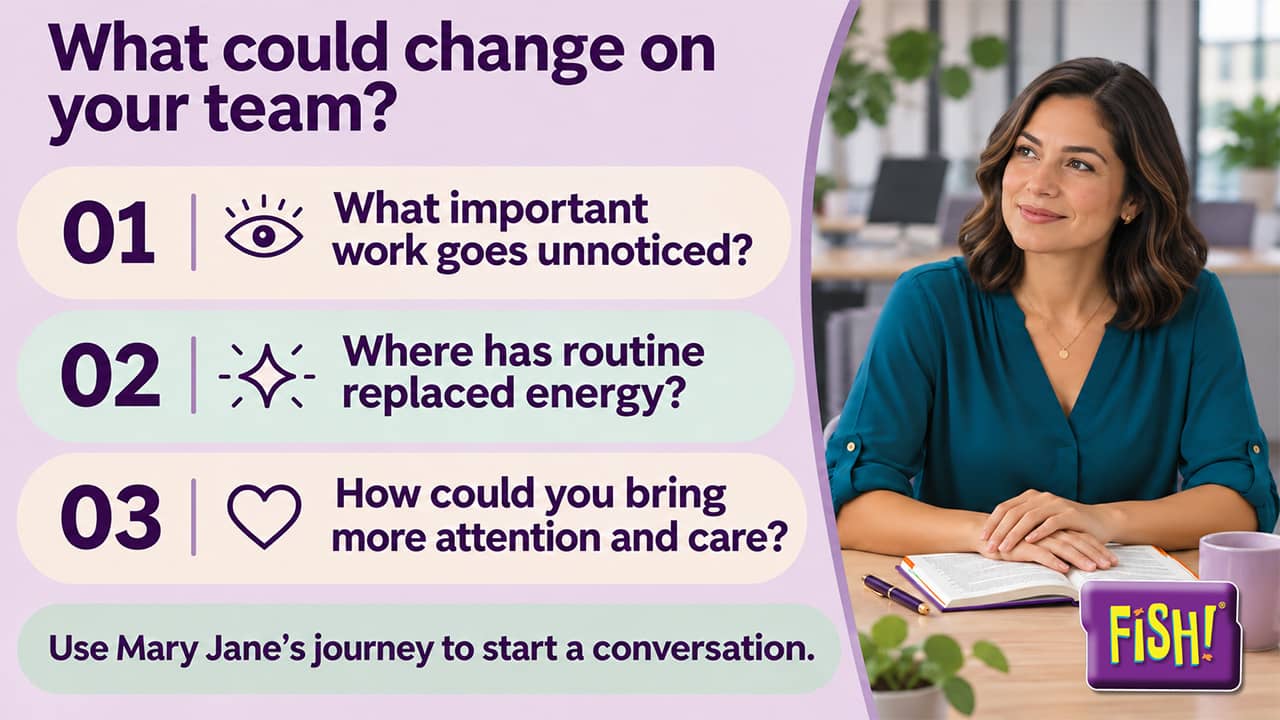
Mary Jane’s story can open a conversation about what your own team notices, values and wants to change.
What are the main lessons of the FISH! book?
As you follow Mary Jane’s story, you encounter four connected practices: Choose Your Attitude, Be There, Make Their Day, and Play. They are not steps to follow in a fixed order. Together, they give you and your team a shared language for talking about how you treat one another and what your workplace feels like.
Choose Your Attitude is about noticing how you feel and deciding how you want to show up. In Mary Jane’s story, the fishmongers help her see that people may not always be able to choose their task, yet they have some choice in how they approach it. At work, that might mean preparing for a difficult shift or taking a moment to reset after a frustrating interaction; it does not require pretending a problem is fine.
Be There means giving someone your attention. When Lonnie listens to Mary Jane, he stays with her conversation even as the lively market carries on around them. At work, being present can help a coworker feel heard or a customer feel that their problem matters, because it involves listening without rushing to judge or plan your reply.
Make Their Day is about finding genuine ways to leave someone feeling valued. The fishmongers notice the people around them and turn ordinary exchanges into moments of connection. At an office, that could mean a sincere thank-you for a careful piece of work, or help offered when a teammate is struggling; small gestures matter most when they are honest and suited to the person receiving them.
Play means bringing curiosity, creativity, and energy to the way you work. At Pike Place, the fish tossing is memorable, while the wider lesson is to make room for fresh ideas and different ways of solving problems. Play can mean trying a new approach without fearing that every imperfect attempt will be punished, and it can look different for different people.
Each practice can change the feel of work because it changes how people meet one another. When you and your coworkers listen, notice effort, try new ideas, and choose how you want to respond, the work can feel less like a set of tasks and more like something people do together.
Who wrote the FISH! book, and how far has it traveled?
Stephen C. Lundin, Harry Paul, and John Christensen first published FISH! A Remarkable Way to Boost Morale and Improve Results in 2000. The revised and expanded edition was prepared for the book’s twentieth anniversary, with new stories about how leaders had used the philosophy and a guide to putting it into practice on a team.
More than six million copies have sold in thirty-five languages. People and organizations in more than one hundred countries have drawn on the philosophy, with tens of thousands of examples. Those numbers suggest that teams across many settings have found the ideas useful enough to adapt to their own work.
Is the FISH! book based on a real fish market?
Yes. Pike Place Fish Market is a real market in Seattle. A video John Christensen made about its fishmongers inspired the FISH! story and its lively picture of service and teamwork.
Mary Jane’s workplace gives you a way to explore how those ideas might apply on your own team. Read her journey as a business parable, and use the market as inspiration rather than expecting your workplace to copy its fish tossing or atmosphere.

Your team can take the spirit of the fish market without copying the fish tossing.
Who is the FISH! leadership book for?
This book may fit you if you lead a team, work with customers, or want your workplace to feel more alive and human. Mary Jane is a manager facing a hard challenge, while the ideas are useful to anyone who works with customers, coworkers, students, patients, or the public.
Think about your own work: do you feel stuck in a routine, or has your team grown tired, distant, or discouraged? The four practices can help you start a conversation about workplace morale and employee engagement through everyday moments: how you listen, recognize effort, and respond when something goes wrong.
Why do some readers doubt the book?
Some people receive the book from an employer and worry it is a polite way of saying, “Act cheerful, no matter what.” That reaction is understandable, especially if a workplace asks staff to smile while ignoring real problems. A manager can misuse the idea of choosing your attitude by turning it into an order to “fix your attitude.”
The practice is about noticing how you feel and deciding how you want to respond. It leaves room to name stress, disappointment, or a hard day instead of pretending everything is fine. You choose how you show up; you do not have to fake happiness or deny hardship.
The other practices matter here, too. Being there means listening when people raise concerns, and making someone’s day depends on genuine care rather than empty praise. Play needs trust and room to learn, while leaders have a part in creating those conditions.
That is one reason the ideas still speak to workplaces today. People still do routine work, serve customers, support one another, and face pressure to get results. The practices are simple to describe, yet they ask for real attention and action; serious workplace problems still require honest attention.
Is the FISH! book still worth reading?
Consider what you want from a management book. If you want a detailed guide to solving every workplace challenge, this short business fable may leave you wanting more depth and evidence. Its story makes the central ideas easy to remember and gives you concrete situations to discuss with your team.
Ask yourself whether an accessible starting point would help you talk about enjoying your work, improving service, or changing the mood of a team. The story brings the four practices to life and can help you notice small choices you might otherwise overlook. As you weigh a FISH! book review, consider whether its questions—how are we treating each other, and what kind of workplace are we creating?—are useful for your team.
How can a team read the book together?
You can read FISH! a section at a time, then talk about a moment from the story that felt familiar. Keep the conversation open: the goal is to understand what work feels like now, and to hear what different people notice. Begin with curiosity rather than a list of instructions.
Try asking: When do we feel most connected to the people we serve? What makes it hard to give someone our full attention? What kind of recognition feels genuine on this team, and where could we try a new approach safely?
Each person may have a different answer, and those differences can help your team see what it needs.
Then choose one small idea to try and check back on it later. A sincere thank-you, a more attentive handoff, or a little room to test a new process may be more useful than a grand promise to transform the culture overnight. Keep the conversation going as your team learns what works for its people and its work.
A small question to carry with you
The heart of FISH! is the attention people bring to their work, their choices, and one another. As you reflect on your own workday, notice how you show up and what kind of energy your choices bring to the people around you. One question from the philosophy can travel with you: Who are you being while you’re doing what you’re doing?