Staff morale grows when people feel they can do good work without hiding who they are. When employees must wear a mask to fit in, they spend energy managing that mask instead of serving customers, solving problems, and helping their coworkers. When they can bring their real personalities, ideas, concerns, and sense of humor to work, they have more energy left for the work itself. That is why authenticity, daily connection, and a shared sense of purpose can do more to raise staff morale than a forced smile or a one-time morale booster.
What is staff morale?
Staff morale is the shared feeling people have about their work, their team, and the organization around them. It includes confidence, trust, enthusiasm, and the belief that the effort people make matters. Morale includes more than cheerfulness. A team can have low morale while everyone is smiling, and a team with healthy morale can still have hard days, disagreements, and serious work to do.
Morale also affects motivation and performance. When people feel respected and connected to the purpose of their work, they are more likely to bring effort and care to it. When they feel ignored, unsafe, or constantly drained, productivity, customer service, attendance, and retention can suffer.
What are the signs of low staff morale?
Low morale rarely arrives as one dramatic announcement. It tends to collect in small changes that leaders and teammates may overlook. You may notice that people stop offering ideas, avoid conversations, or respond to questions with silence and short answers. Meetings become cautious. The same few people do all the talking while others wait for the meeting to end.
Other signs include more mistakes, missed handoffs, rising absences, increased turnover, and a drop in customer care. Employees may still complete tasks, but with less initiative or curiosity. In remote or hybrid work, low morale can look like distracted calls, generic replies, delayed responses, or a reluctance to speak beyond the assigned task.
What causes low morale at work?
Low morale has many causes, but most send the same message: “What you bring does not matter here.” People lose heart when recognition is rare, expectations are unclear, workloads are unreasonable, growth seems impossible, or leaders appear only when something goes wrong.
Forced positivity can make the problem worse. Telling people to “bring better energy” while ignoring understaffing, broken processes, disrespect, or unfair treatment leaves the real problem in place and pressures employees to hide what they are experiencing. Authenticity works better because it makes room for honest observations while still asking people to choose constructive actions.
The quality of ordinary interactions is another major cause of rising or falling morale. Research reported in Harvard Business Review found that the most reliable source of energy on a team was the quality of interactions between coworkers. A conversation can leave someone supported and ready to work, or anxious and depleted. Those effects add up across meetings, messages, handoffs, and quick questions all day long.
How do you improve staff morale?
Start by making the workday more honest, more human, and more connected. The FISH! Philosophy is a way of being, built around four simple practices that help individuals and the organizations they make up become more engaged in their work. You can begin with the next conversation, decision, or team meeting.
Let people bring more of themselves to work
People who feel they must perform a narrow version of “professional” often lose energy. They may stop sharing humor, questions, personal insight, or a different way of solving a problem. Healthy authenticity keeps workplace boundaries in place and leaves room for people to be genuine while treating others with respect.
Leaders set the tone by sharing appropriate truths about their own work. Say when you are still learning. Explain what you do not know. Admit when a decision missed the mark. When a leader owns a mistake and apologizes without excuses, employees learn that honesty will not automatically be punished. That sense of safety makes it easier to report problems early and offer useful ideas.
Authentic service benefits customers, too. Give employees clear standards and room to use judgment, so they can meet the customer in front of them instead of hiding behind a script.
Listen in a way that proves people matter
Authenticity is often described as speaking openly, but every person who shares needs someone willing to listen. Be There, a practice in the FISH! Philosophy, means complete presence: physical, mental, and emotional. Put down the phone, stop composing your reply before the other person finishes, and pay attention to what they are actually saying.
Presence can include setting a specific time to talk when you cannot focus immediately. Keeping that commitment is more trustworthy than nodding while checking email.
Listening raises morale because it tells people they are more than a result, schedule, or problem to solve. It also gives leaders information they cannot get from a dashboard. Ask what is making the work harder, which customer problems keep repeating, and what the team would change if it had more room to act. Listen for patterns, then close the loop by explaining what will happen next.
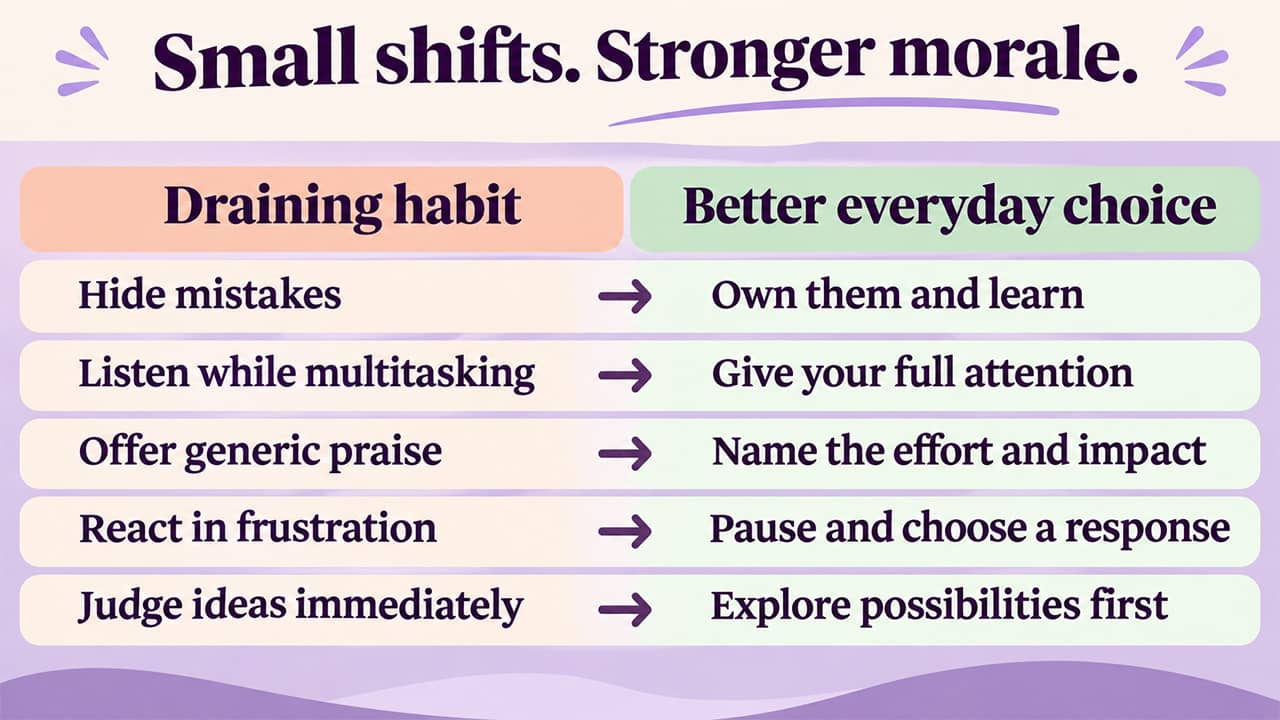
Small changes in everyday habits add up to stronger staff morale.
Make recognition specific and personal
Recognition is evidence that someone noticed the effort and understood its effect. Make Their Day means creating moments that leave another person better off, and recognition is one of its most useful forms at work.
Instead of saying, “Great job,” name the behavior and the difference it made: “You stayed with that frustrated customer long enough to find the real issue, and your notes helped the next shift finish the repair.” Some people appreciate public praise; others prefer a private message. Match the gesture to the person, and make sure recognition reaches quiet contributors, overnight teams, support staff, and people whose work is not captured by a simple number.
Coworkers can do this without waiting for management. Thank the person who made a clean handoff, helped you learn a system, covered a difficult shift, or made a meeting easier for everyone. Small, sincere moments matter because morale is shaped by the people employees encounter most often.
Replace “that’s just me” with a better choice
Authenticity includes choosing how to respond to emotions. Anger can be real without being a good guide for what you say next. You may feel offended, rushed, or disappointed, but you still have a choice about whether your response matches the person and teammate you want to be.
This is the heart of Choose Your Attitude. The practice makes room for hard feelings and honest problems. It asks people to notice what they are feeling, identify the outcome they want, and choose a response that helps move toward it. A short pause, a walk, a breath, or a sentence such as “I am frustrated, so I need a minute before I answer” can prevent one reaction from draining an entire team.
Johnny Yokoyama, the owner of Pike Place Fish Market, learned this lesson personally. He had become an intimidating, angry boss and explained that he was that way because of how his father had raised him. Then he saw that his behavior was hurting his business, his employees, and himself. He decided that “that’s just me” was not a reason to stay the same. He changed.
Make room for ideas before judging them
People cannot be fully themselves if every new idea is rejected before it can be understood. Play, in the FISH! Philosophy, is a curious and creative way of working, rather than a requirement to turn every task into a game. Play gives people enough trust and room to test a better way, learn from what happens, and try again.
When a team faces a problem, separate idea-making from idea-testing. For a few minutes, let people suggest possibilities without immediate criticism. Ask questions such as, “What would this solve?” or “What would we need to make this workable?” Later, the group can decide what fits the team’s values, resources, and customers.
This helps people who are less comfortable speaking up. It also challenges leaders’ habits: curiosity may reveal a useful part of an idea, even when the original version needs work.
Energize the ordinary workday
Special events can be enjoyable, but a pizza party cannot repair months of draining interactions. The most reliable morale boosters are often ordinary: a thoughtful handoff, a patient explanation, a useful check-in, or a teammate who stays present when work becomes difficult.
The research on workplace energy offers four practical directions that fit naturally with the FISH! practices. Show people they matter by listening and recognizing their contributions. Offer a positive vision by describing what the team is trying to create alongside an honest look at what went wrong. Learn together by solving problems, sharing skills, and treating mistakes as information. Focus on the basics by improving the small interactions that happen every day.
People who energize others often perform better themselves because coworkers want to collaborate with them, share information, and support their work. You do not have to be loud or naturally outgoing to have that effect. Introverts can energize a team by being fully present, asking a thoughtful question, and giving another person their undivided attention.
What can leaders do to boost employee morale?
Leaders can begin with consistency. Make expectations clear, remove reported obstacles, and give people useful tools, reasonable autonomy, and a visible connection between their work and the customer or community it serves. Talk about skills employees want to build and give them chances to practice.
Measure the employee experience alongside work output. Use brief pulse questions, one-on-one conversations, retention and absence patterns, customer feedback, and the number and quality of ideas being raised. Ask whether people feel heard and able to do their best work, then share what you will change. A survey that disappears into a drawer can lower morale further.
How can coworkers raise each other’s morale?
Coworkers raise morale when they make support visible. Share information, include people affected by decisions, give credit, and ask an overwhelmed teammate what help would actually be useful.
Be careful with the energy you bring into quick interactions. Before sending a sharp message or correcting someone in public, ask whether your approach will help them solve the problem. You can be direct without being humiliating. You can disagree while staying curious. Those choices create a workplace where authenticity and accountability can exist together.
How do you know whether morale is improving?
Look for movement in behavior and results. Are more people speaking up? Are meetings more balanced? Do handoffs improve, do people ask for help sooner, and do customers experience more natural service? Track absence, turnover, errors, and engagement over time, but do not rely on one score alone.
A more authentic way to raise staff morale
Staff morale is built in the space between formal programs. It rises when people can be real, when leaders listen and own their mistakes, when coworkers recognize one another, and when difficult emotions are handled with intention instead of being used as an excuse. It gains strength when teams learn together and protect the quality of daily interactions.
Try one small experiment this week: ask your team which routine interaction most often drains their energy, then work together on one change. The answer may point to a meeting, handoff, approval step, or habit that has been quietly wearing people down. Improve that ordinary moment, and you may do more for morale than another one-off event.
Try the FISH! Philosophy with your team
If you want a shared way to turn authenticity, presence, recognition, constructive attitudes, and curiosity into daily practice, try the FISH! Philosophy upgraded trial. Your team gets 30 days of access to the FISH! film and its digital guides, giving you a practical starting point for conversations and actions that can raise staff morale from the inside out.

Frequently Asked Questions
How long does it take to improve low morale?
There is no fixed timetable because morale depends on the depth of the problem and the consistency of the response. Small improvements can appear quickly when leaders listen and act, while trust develops through repeated experiences and follow-through.
Should employee morale be the manager’s responsibility alone?
Managers have a special duty because their behavior shapes the team’s environment, but morale is also created peer to peer. Every employee can make interactions more respectful, share useful recognition, and help create a safer place for ideas.
Can a team have good morale during a busy or stressful season?
Yes. Healthy morale does not require low pressure or constant happiness. People can handle demanding work better when expectations are honest, support is available, effort is recognized, and the team believes its work has purpose.
What should a leader do when an employee’s behavior hurts morale?
Address the specific behavior and its impact directly, then listen to the employee’s perspective and agree on a better way forward. Authenticity must still include respect for shared standards. Accountability helps protect the trust that morale depends on.
Are team-building events enough to boost employee morale?
Events can create a welcome break or a meaningful memory, but they cannot replace respectful daily interactions, fair workloads, recognition, and clear leadership. Use them to support a healthy culture rather than cover for problems that need to be fixed.