
Call center morale can fall fast when call volume rises and staff feel they have little control over what comes next. Plymouth City Council faced that pressure when its customer service team was already handling up to 3,000 calls a day and weekly waste-related calls rose from 2,000 to 16,000 after a re-zoning of waste services. The council’s experience shows how a team can work on its attitude, its relationships and its customer interactions even when it cannot reduce the work coming through the phones.
What happened at Plymouth City Council?
Morale in the council’s customer service team had dipped after a period of change and consolidation. The rise in waste-related calls pushed it lower. The team was also dealing with calls about council tax, housing benefit and social care, so the extra demand landed on an already stretched contact center.
Ian McPherson, a Customer Service Manager for Plymouth City Council, said the team needed a way to address its low morale.
“We were overstretched already, handling up to 3,000 calls per day on issues such as council tax, housing benefit and social care. To address the low morale, we looked at what other councils were doing and decided to use a training program called FISH! which instills a workplace philosophy that encourages greater motivation.”
FISH! centers on four practices: Choose Your Attitude, Be There, Make Their Day and Play. Together, they give a team a shared way to talk about how people show up at work, how they listen, how they treat others and how they bring energy and creativity to the job.
McPherson first provided training for the council’s 70 customer services staff. He did not see himself as a trainer, but the program came with advice on delivering the training, a DVD of techniques and examples, and customizable PowerPoint slides and documents. “It’s very easy to follow the guidelines,” he said.
The ideas then spread beyond the contact center. Four other departments, including HR and Revenues & Benefits, asked for their staff to be trained. By then, 355 people had been trained, plans were in place to train a further 100, and four more departments had requested the training. All directors and assistant directors had been invited to attend a session.
The council also used simple reminders and recognition to keep the ideas alive. For six weeks, participants received a weekly email about the key messages from the film. Each team voted monthly for the person who had shown the best “FISH! behavior,” and the winner received a cuddly toy fish and a certificate. McPherson said the toys were “extremely sought-after” and that people were proud to win them.
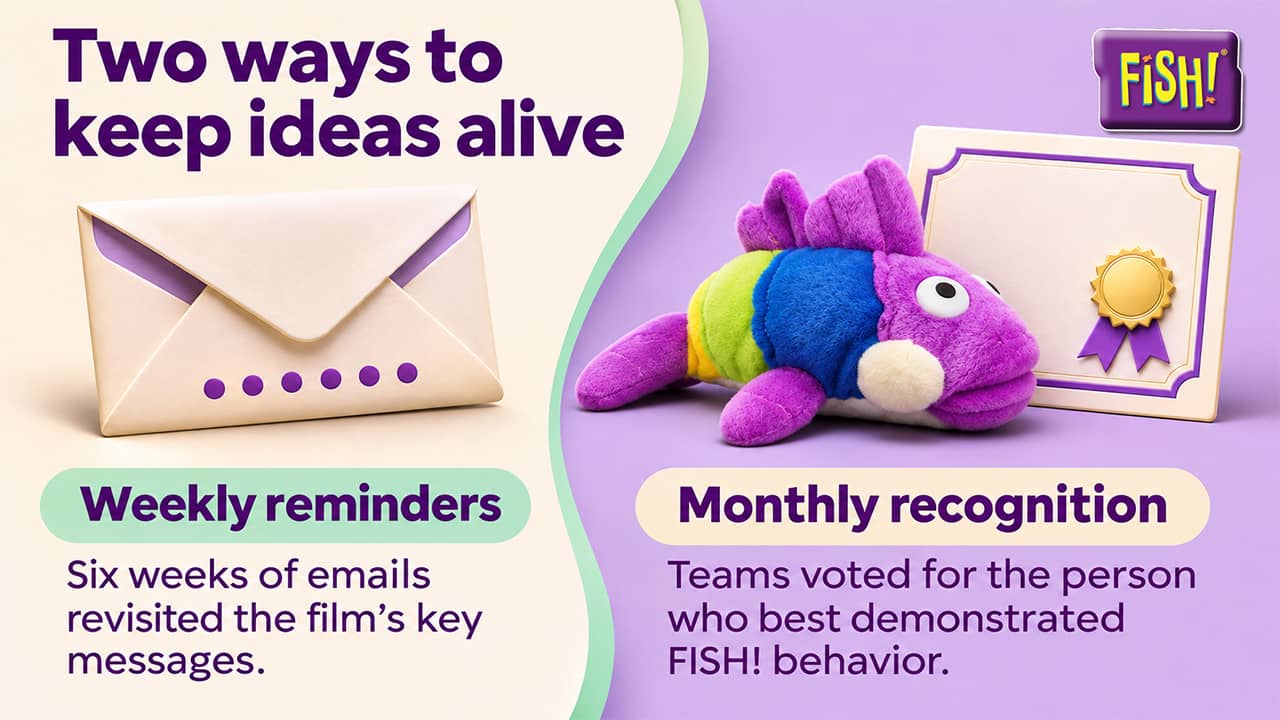
Plymouth City Council kept the FISH! Philosophy in front of its team after training, with six weeks of emails revisiting the film’s key messages and a monthly team vote for the person who best showed FISH! behavior.
The reported result was a sharp drop in complaints about how customers had been treated.
“We used to get four or five calls per month from customers complaining about how they’d been dealt with,” McPherson said. “For the last four months, we haven’t had a single complaint.” He added that investigating the complaints had taken a great deal of manpower, so the reduction had more than paid for the cost of the program.
He also reported that staff were generally happier, having more fun in the office, and building a more congenial and supportive work environment.
“Despite these difficult times for the public sector, our motivation is very high and working relationships, particularly those with the management team, have blossomed,” he said. Plymouth City Council is one of many organizations whose results with the FISH! Philosophy have been documented, but its story is especially useful because the workload itself was not the part the team could change.
How do you keep call center morale up when call volumes spike?
A call center cannot always control demand, and a sudden change can bring a flood of calls before staffing or systems catch up. Research on contact centers links high demands and low control with stress and lower wellbeing. The peer-reviewed study by Gonçalves-Candeias and colleagues, “Is Stress in Contact Centers Inevitable?”, found differences between companies, suggesting that some stressful conditions can be reduced.
That is where Choose Your Attitude can be useful, as long as leaders do not turn it into “just be positive.” The practice makes room for pressure and hard days while asking people to notice the attitude they are bringing. They can then decide how they want to approach the next interaction and make that choice again after a difficult call.
A team lead can help by naming the part of the situation the team can influence. Workload, policy and call volume may sit outside the team’s control, while the way agents speak to callers, support one another and reset after a hard conversation is closer to home. Leaders should model that choice themselves; their tone gives the team a living example.
Practical management still matters too. Flexible scheduling can spread pressure more fairly, coaching can help agents solve unusual problems, and employee voice can reveal broken processes. Career paths can connect contact-center work with growth and longer-term goals, giving people more resources and control while adequate staffing remains essential.
Why does the way staff treat callers drive complaints?
Customers judge a service through the interaction as well as the answer. The tone and attention an agent brings can make a difficult process feel easier to manage or leave a caller feeling dismissed. In public sector customer service, the caller may be dealing with money, housing or care, so the emotional weight can be high.
The Local Government and Social Care Ombudsman’s guidance for councils says complaint handlers should use plain language, be approachable, remain open-minded and treat colleagues and complainants with the same level of courtesy. It also says customer-facing staff should know the complaints process and actively encourage people to raise concerns. Those principles put respectful treatment at the center of service quality.
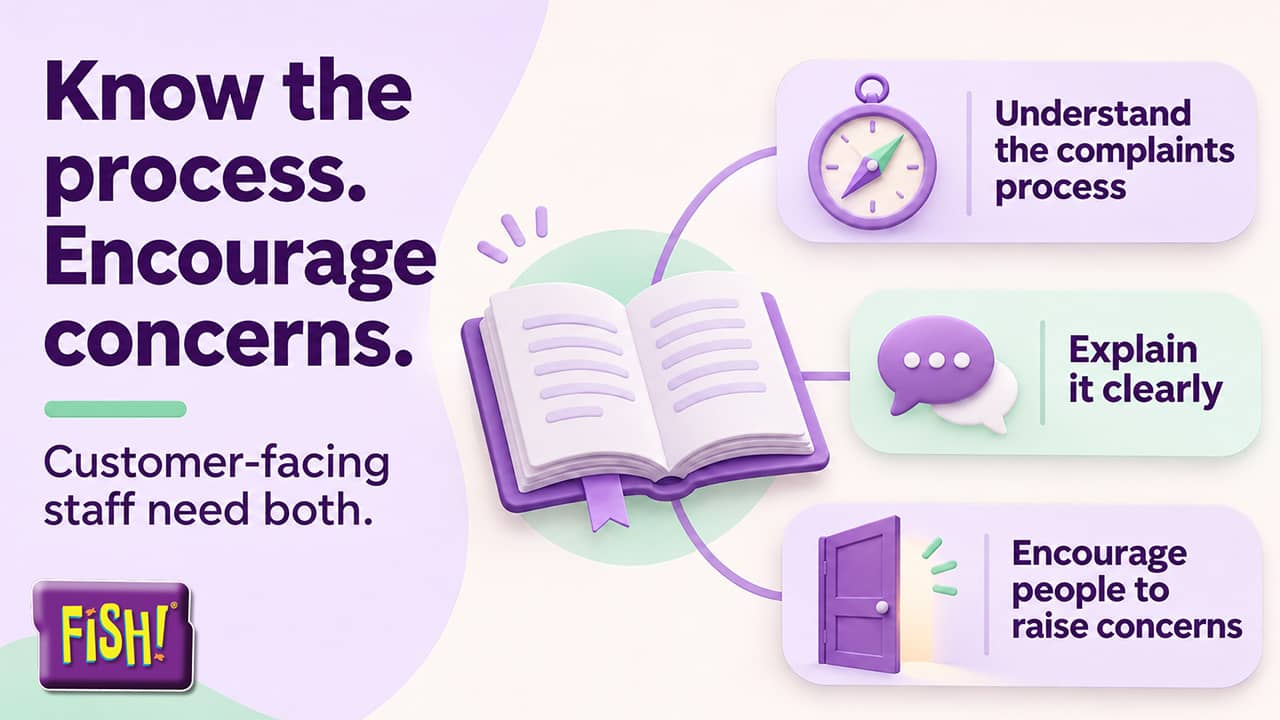
Council complaint guidance asks customer-facing staff to know the complaints process and encourage people to raise concerns, which works best when agents also give each caller their full attention.
Be There gives agents a practical way to apply that idea. Complete presence keeps an agent’s attention on the person and the conversation, with room to listen for the real question and acknowledge frustration. On a call, the agent can avoid a defensive response and tailor the answer to the caller’s situation.
Make Their Day starts with small moments of sincere attention, help or recognition. The goal is to leave another person better off. For a caller, that may be a clear explanation or a genuine effort to find the next useful step, and Gallup’s workplace analysis says recognition works best when it is honest, authentic and suited to the individual.
How can peer recognition improve contact center motivation?
Recognition works best when it points to behavior people can understand and repeat. “Good job” is pleasant but vague. “You stayed patient while the caller explained the problem, and your clear summary helped them understand what would happen next” tells the team what good service looked like.
That is the useful lesson in Plymouth’s monthly team vote: the vote made FISH! behavior visible, while the cuddly toy fish and certificate gave the recognition a form people valued. A contact center could adapt the idea without copying the prize, with agents nominating a colleague for patient listening, a helpful handoff, a creative solution or support after a hard call. Recognition can be public or private, depending on what the person prefers.
Gamification can make progress visible and invite participation when it highlights the right behaviors. If the score rewards only speed, it can push agents away from careful service, so recognition should keep customer treatment and teamwork in view.
Leaders should watch who gets missed. The team should agree on clear examples of helpful behavior and make room for quieter contributions, including work that may not appear in a call-handling number.
What can leaders do to make morale last?
A single training session rarely changes a culture. People need reminders, chances to practice and leaders who use the same language in real situations. Plymouth’s weekly emails over six weeks and monthly vote kept the conversation going.
Be There matters because agents need to feel that managers see more than their numbers. A team lead can ask what is making a queue harder to handle, listen without defending the process and be clear about what can happen next.
Play adds energy, curiosity and creativity, but it should never mean making fun of a caller. In a contact center, it might mean inviting agents to suggest a better handoff or test a clearer explanation. People should feel safe to offer ideas, while the work remains respectful and accurate.
Senior managers can strengthen that environment by taking part, as they did in Plymouth’s FISH! sessions. People enjoyed laughing and joking with them because it showed the senior team was human. Other departments asked for the training after word spread, showing how a practice can travel when people see value in it rather than experience it as a distant order.
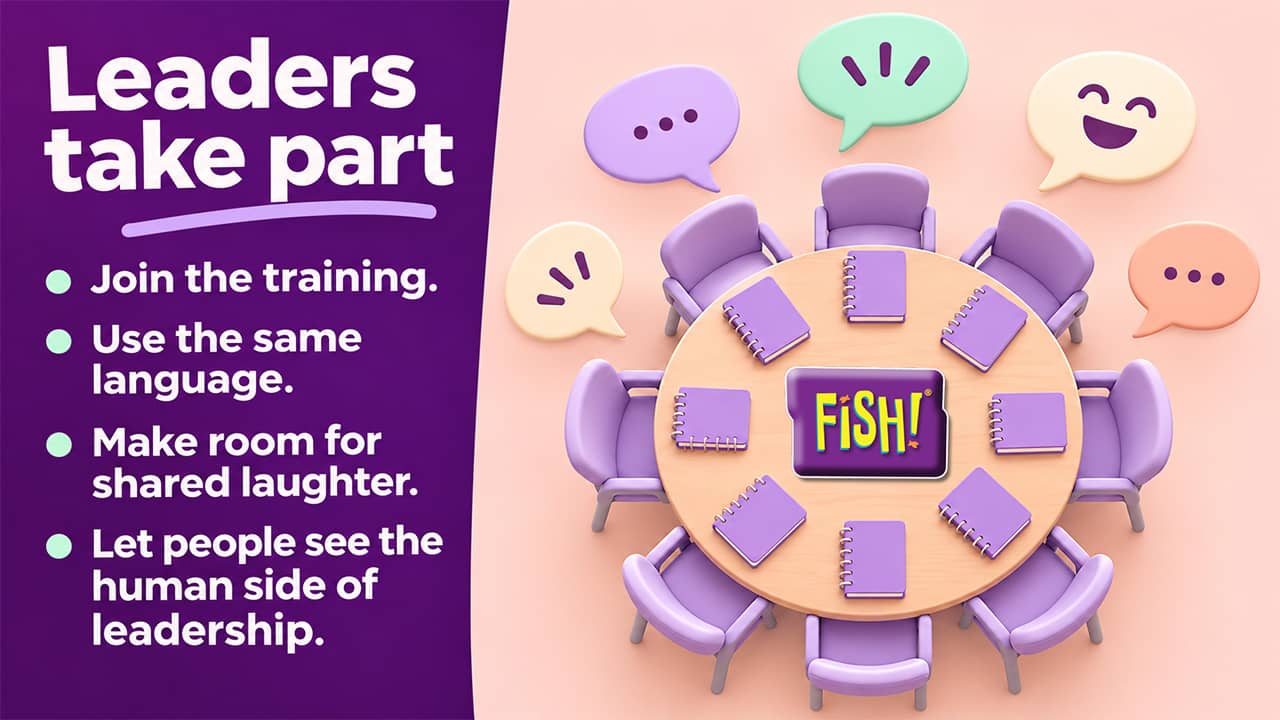
At Plymouth City Council, senior managers took part in the FISH! Philosophy sessions, and staff enjoyed laughing and joking with them because it showed the senior team was human.
What should a council contact center try first?
Start with a short team conversation about a pressure the team cannot remove and a behavior it can choose. Ask what callers should experience, what colleagues should experience and what leaders need to do to support that standard. Then choose one small practice to try for a week, such as specific peer recognition or a reset question after a difficult call.
Keep the conversation connected to real work. Look at how flexible schedules, coaching, employee voice, development and recognition can reduce avoidable strain. Track customer complaints and ask what the team is learning from them; a lower complaint count matters, while the deeper goal is a workplace where agents stay present, treat callers with care and keep improving through difficult work.
What can your team try next?
Plymouth City Council’s lesson is clear: when call volume is outside a team’s control, the team can still shape the experience it creates. Choose Your Attitude, Be There, Make Their Day and Play give people shared words for that work, while reminders, recognition and visible leadership help turn an idea into a habit. Try one conversation with your team, and make it specific enough that someone can practice it on the next call.
Try the FISH! Philosophy with your team
If your team is facing heavy call volume, low energy or rising customer complaints, the FISH! Philosophy upgraded trial gives you 30 days of access to the FISH! film and its digital guides. Use the time to start a shared conversation about attitude, presence, recognition and creative ways to support callers and one another.

Frequently Asked Questions
How can contact center leaders support agents after difficult calls?
Leaders can build in brief chances to reset, invite agents to share what made a call difficult, and offer coaching that focuses on the next useful step. Be There also means noticing when someone needs support rather than treating every hard call as a performance problem.
How can a contact center measure whether morale is improving?
Use more than one signal: short anonymous pulse questions, absence and turnover patterns, coaching themes, recognition and customer feedback. Measures should help the team learn, not become another source of pressure.
How can a public agency make customer service feel more human?
Use plain language, listen closely, and explain what will happen next. Be There and Make Their Day help agents bring attention and care to interactions that might otherwise feel like transactions.
What if agents dislike playful workplace programs?
Invite participation rather than forcing a performance. Play can mean curiosity, better problem-solving and a lighter way of working, so agents do not need to copy the fish market or act in a way that feels unnatural to them.