The importance of play for adults becomes clear when life starts to feel like one long list of duties. Work, family, errands, and screens can fill every open space, leaving little time for curiosity or delight. Play gives your mind room to breathe, helps you connect with other people, and invites you to approach problems with fresh energy. In the FISH! Philosophy, Play is one of the practices that helps people bring curiosity, creativity, and life to the way they work and live.
For adults, play can look like a board game, a song in the kitchen, a pickup game, or time with a pet. It can also look quieter: testing a new idea, taking a different route through a problem, or laughing at your own mistake. The common thread is willing engagement: interest in what might happen and freedom to explore.
What does play mean for adults?
Adult play is an activity or way of thinking that you choose because it feels engaging, enjoyable, or worthwhile in itself. It may include fun, yet it also includes curiosity, imagination, movement, practice, and creative problem solving. If work is what we do, the FISH! practice of Play asks us to consider how we do it.
That mindset has a childlike curiosity while treating people with adult care and respect. A designer may play with layouts, a manager may build a rough model with a team, or a friend may turn a walk into a photo hunt. Each example gives people permission to notice, experiment, and respond to what they discover.
Play can be visible or quiet. One person may bring energy and humor to a room. Another may show Play by asking an unusual question or finding a kinder way to handle a difficult task. Both forms count. Authentic Play should feel natural to the person taking part, so adults do not need to perform a certain personality to benefit from it.
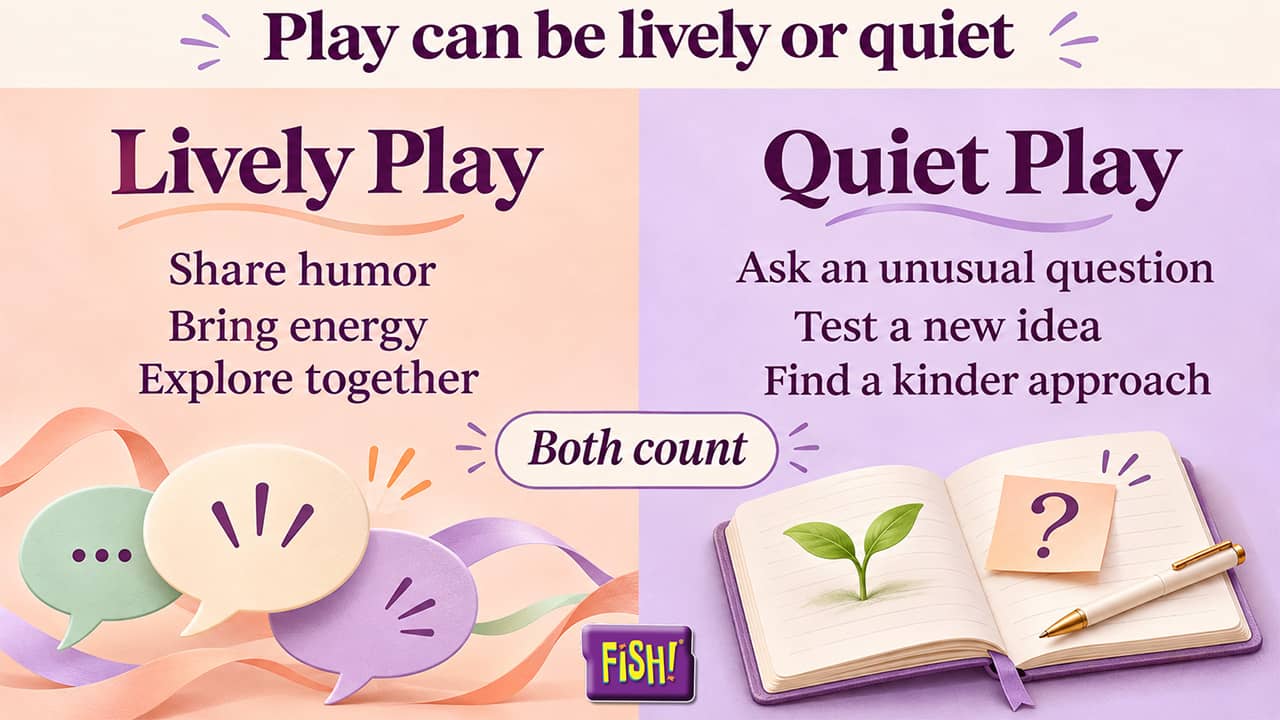
Play does not have to be loud to count, because asking an unusual question or finding a kinder way through a task is as much a part of Play as shared laughter.
Why do adults stop playing?
Many adults gradually learn to treat play as something earned after the important work is finished. The work keeps expanding, so the reward keeps moving farther away. Some people also connect adulthood with seriousness and assume that games, imagination, or silliness will make them look unprofessional.
Other barriers come from experience. A person may have been teased for trying something new, criticized for a mistake, or given so many rules that experimentation feels unsafe. Caregiving, financial pressure, health concerns, and demanding schedules can also shrink the time and energy available for play. Under long strain, even choosing an activity can feel like another task.
The way back can start small. Notice what holds your attention without forcing it. Choose an activity that fits your energy today, and invite someone who helps you feel comfortable. A short experiment, song, puzzle, or walk can reopen a closed door.
What is the importance of play for adults?
Play supports several parts of adult wellbeing at once. Regular opportunities for play can help people feel more engaged with life and more connected to others.
Play and mental health
Play can give attention a break from repetitive worries and create a more pleasant focus in the present moment. Enjoyable activity may ease everyday tension and lift mood, especially when it includes movement, laughter, creativity, or supportive company. Play also lets people practice flexibility: an idea changes, a game takes an unexpected turn, or a plan needs to be adjusted.
That flexibility matters because mental health includes the ability to respond to changing situations. Play creates low-stakes chances to try, learn, and begin again. It can help someone remember that a difficult moment is one part of life rather than the whole story. Play and mental health also connect through social contact. Shared games, music, sports, and creative projects give people a reason to spend time together and a natural way to communicate. Those moments can strengthen belonging and make it easier to ask for support later.
Play supports wellbeing, though it cannot replace professional care. If sadness, anxiety, hopelessness, or another concern is making daily life difficult, a qualified mental health professional can help. Play may be one supportive part of a broader care plan.
Benefits of play for adults’ relationships
Play helps relationships grow through shared attention. Cooking, trading jokes, building something, or exploring a neighborhood creates memories and shows people how each other thinks. A playful activity can also create a warm point of connection before a serious conversation.
Respect keeps that connection healthy. In the FISH! Philosophy, Play works alongside Be There and Make Their Day. That means paying attention to how others are receiving the moment, choosing humor that includes people, and letting everyone decide how much they want to join. A joke that embarrasses someone or an activity that pressures a coworker misses the purpose of Play.
Creativity and play
Creative thinking grows when people have permission to explore more than one path. A playful approach may involve sketching rough ideas, rearranging materials, making a silly first draft, or asking, “What else could work?” The first answer does not have to be perfect, so the mind has space to make connections.
This is one reason play can help adults keep their thinking flexible as they age. New activities ask us to notice patterns, use skills in unfamiliar ways, and adjust when the first attempt falls short. Over time, those small acts of exploration can make learning feel more available.
Play at work
Adult play at work can support energy, collaboration, and problem solving. A team that can test a small idea without fear may find a better way to serve a customer or complete a project. A team that can laugh together with care may build trust that helps people speak honestly when a problem appears.
The FISH! approach describes this environment as a playing field. People need clear values and responsibilities, along with enough latitude to use judgment. When the boundaries are understandable, the field can expand as trust grows. Leaders support Play when they respond to an unusual idea with curiosity, ask what the team might learn, and treat a useful failed attempt as information.
The same idea applies to serious work. Play does not require constant jokes or a party atmosphere. In a demanding setting, it may mean finding a humane solution, trying a new method, or giving someone room to make a meaningful choice. Curiosity and care can exist alongside responsibility.
What are examples of play for adults?
Play for adults can fit many personalities, cultures, abilities, and schedules. Try options that feel inviting rather than forcing yourself into someone else’s idea of fun.
- Games: Play cards, board games, word games, puzzles, or cooperative video games with friends, family, or colleagues. Choose games with clear invitations and flexible stakes.
- Music: Sing, dance, learn an instrument, make a playlist for a mood, or tap along while you work through a household task.
- Building and crafting: Draw, paint, knit, garden, cook, repair something, make a model, or experiment with a camera. The finished product can matter less than the process.
- Sports and movement: Walk with a friend, shoot baskets, swim, join a recreational league, stretch to music, or try a new physical activity at a comfortable pace.
- Improv and storytelling: Take an improv class, invent a story from three random words, or ask a group to add one sentence at a time. These activities build listening and quick thinking.
- Playful problem solving: Give a familiar task a new constraint, brainstorm ten possible answers, draw a map of a process, or ask how a child, artist, or customer might see the problem.
- Time with pets: Toss a toy, teach a trick, make an enrichment activity, or simply follow your pet’s curiosity during a walk.
- Small daily experiments: Change a recipe, take a new route, use a playful email signature, or find one ordinary moment to approach with extra attention.
At work, these examples can become an idea sprint, customer-story exercise, low-stakes prototype, team playlist, walking meeting, or hobby demonstration. Participation should stay voluntary and serve the team’s purpose.
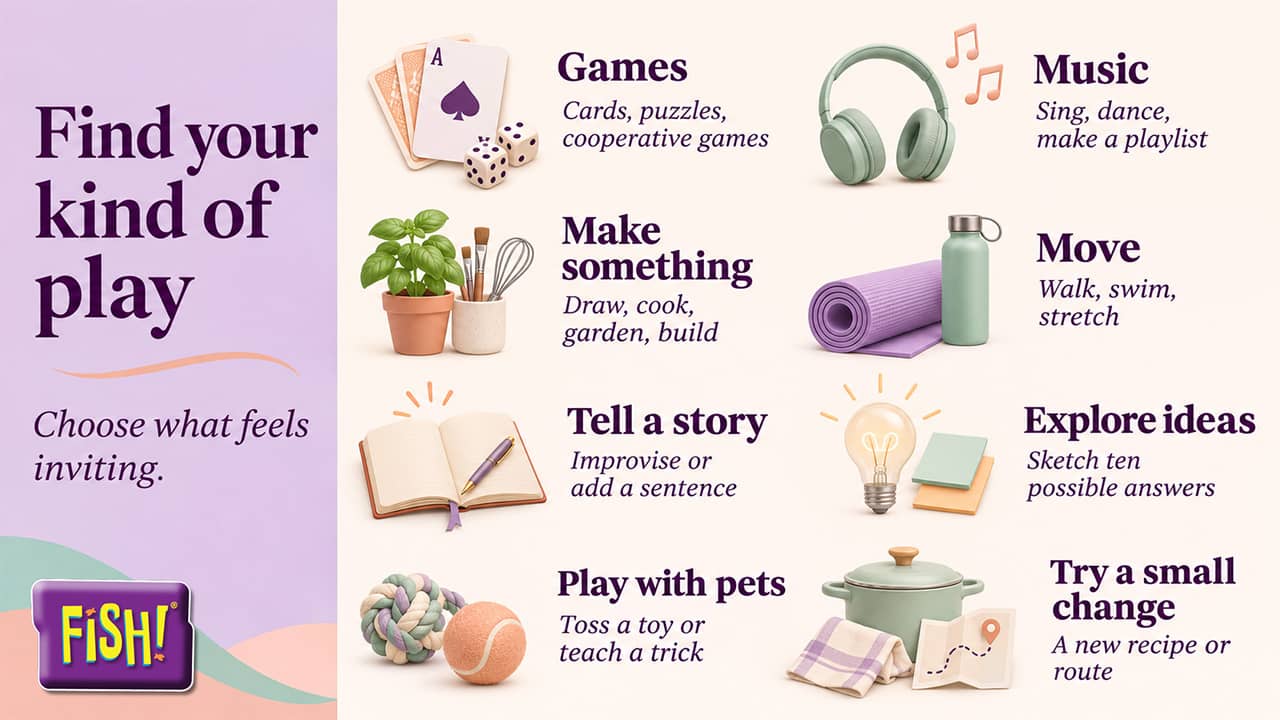
Adult play can fit any personality or schedule, so start with the activity that feels most inviting today, whether that is a card game, a new recipe, or a walk.
How can teams make room for play at work?
Teams can make Play part of ordinary work through small choices in leadership, meetings, and problem solving. The goal is to create room for curiosity while protecting respect, time, and focus.
1. Define the playing field together
Ask the team which values should guide its work. Then name behaviors that fit those values and behaviors that cross a boundary. This shared conversation makes expectations easier to understand and gives people a voice in shaping the environment.
Revisit the field when the team, customers, or work changes, and ask what new freedom or clarity would help people do their best work.
2. Make experimentation smaller and safer
Invite people to run a short pilot, test a draft with a small group, or try a different process for one week. Decide in advance what the team will watch and when it will review what happened. A limited experiment gives an idea a fair chance without demanding certainty.
When the result falls short, ask what the team learned and what it will adjust. That response shows that thoughtful experimentation has value.
3. Lead with curiosity
When someone offers an unconventional idea, pause before judging it. Questions such as “What are you noticing?”, “What might we learn?”, and “How could we make this safer?” keep the conversation open. A quick dismissal, sarcastic comment, or worried expression can close that space faster than a formal rule.
Leaders also model Play by admitting when an assumption was wrong, trying something unfamiliar, and sharing what they learned. Everyone sees that curiosity belongs to the whole team.
4. Include different ways to participate
Some people enjoy visible games and lively conversation. Others prefer quiet brainstorming, hands-on work, movement, or time to think before speaking. Offer choices, avoid forced performance, and make activities accessible for different bodies, cultures, communication styles, and comfort levels.
Use the FISH! practices as a check. Does the activity help you Be There for others? Does it Make Their Day? Does it reflect the attitude you want to bring? If the answer is unclear, change the activity or leave it out.
5. Connect Play to the work
A team is more likely to protect Play when it can see its purpose. Use a game to practice a skill, a creative exercise to understand a customer, or a quick prototype to explore a service problem. Leave space for people to explain what they noticed and how the activity could improve the work.
What can you learn from recess about adult play?
School recess offers an early lesson: unstructured time gives people room to choose, negotiate, imagine, and recover attention. Children learn from each other while deciding what to play and how to handle changing rules. Adults need smaller versions of that freedom in their days too, whether through a creative break, a shared activity, or time to explore an idea.
Questions to reflect on
- What did you learn during childhood play that still helps you work or relate to people today?
- Where in your current workday could you make room for curiosity, movement, humor, or experimentation?
- Which kind of play helps your mood most: making something, moving, solving a problem, spending time with people, or being with animals?
- What would help your team feel safe enough to try a new idea?
A simple way to start
The importance of play for adults becomes easier to understand through practice. Choose one small activity this week that invites curiosity without needing to earn its place through productivity. Then ask someone what kind of play helps them feel more present and engaged. This supports the FISH! Philosophy question: who do we want to be while we are doing what we do?
Try the FISH! Philosophy with your team
Play becomes more useful when a team has shared language and support for putting it into practice. Try the FISH! Philosophy upgraded trial, which gives your team 30 days of access to the FISH! film and its digital guides. Use the experience to explore Play, along with Choose Your Attitude, Be There, and Make Their Day, and start building a workplace where curiosity, trust, and respect have room to grow.

Frequently Asked Questions
Can play help adults who feel disconnected from their hobbies?
Yes. Start with a low-pressure activity that matches your current energy, such as listening to music, taking a short walk, or making something with your hands. Repetition matters more than intensity because enjoyment and confidence often return gradually.
How much time should adults spend playing?
There is no single amount that works for everyone. A few minutes of an engaging activity can be useful, and longer periods may be possible when your schedule allows. Look for regular openings that leave you feeling more connected or refreshed.
Is playful behavior appropriate in every workplace?
Play should fit the team’s responsibilities, values, customers, and boundaries. Respectful experimentation, creative thinking, and inclusive connection can work in many settings, while activities that distract, embarrass, exclude, or compromise safety should be changed or avoided.
How can a manager support play without making it feel forced?
Give people choices, model curiosity, and protect time for small experiments rather than requiring everyone to join a particular game. Ask what helps the team think and connect, then use the answers to shape opportunities that feel useful and voluntary.
What if play brings up difficult feelings?
An activity can remind someone of loss, exclusion, or a stressful time, so people deserve room to pause or choose another option. Support from a mental health professional may be appropriate when difficult feelings persist or interfere with daily life.