How can a dealership make work fun when fun is part of what it sells?
If you are wondering how to make work fun, start with a simple question: What experience does your business promise? At California Harley-Davidson/Buell (CHDB), an independent motorcycle dealership just outside Los Angeles, the answer was more than a motorcycle.
President and General Manager Mark Ruffalo told employees that nobody needed what the dealership sold. Motorcycle buying was a recreational indulgence, so “what CHDB really sells is fun.”
That made workplace culture part of the customer experience. Yet staff were not working well across departments, employees were unsure how much fun was allowed, and management struggled to get its message across. CHDB set four goals: make the dealership fun to work and shop in, improve customer satisfaction, improve employee retention, and increase employee satisfaction.
The dealership found a way forward through the FISH! Philosophy. After seeing a ChartHouse Learning presentation at the annual Harley-Davidson Dealer Operations nationwide training event, Ruffalo believed FISH! was what CHDB needed. He asked Peter Boam, Communication Manager, to implement it. Boam read the FISH! books, spoke with ChartHouse sales guides, and held employee focus groups for feedback.
In March 2004, management closed the dealership for a day and took all employees off-site to a meeting room at a local bowling alley. During the first half of the day, the group discussed the four FISH! practices: Choose Your Attitude, Be There, Make Their Day, and Play. In the afternoon, employees could choose whether to take the afternoon off or bowl a few games together.
Play was invited, not forced, and employees could take part in a way that felt right for them. From there, the practices became part of daily life: trained employees received a framed “fishploma,” the dealership added several hundred fish-related decorations, and motorcycle buyers received a Pete the Perch.
The team also built recognition and celebration into ordinary work. Management held impromptu root beer float and sno-cone parties to celebrate an accomplishment or recognize people working extra hard. A prize wheel served customers and employees.
Customers who completed a satisfaction survey could spin for a prize worth up to $400, while employees gave one another tickets for “fishy” behavior. Once a week, employees whose tickets were drawn could spin the wheel for a prize.
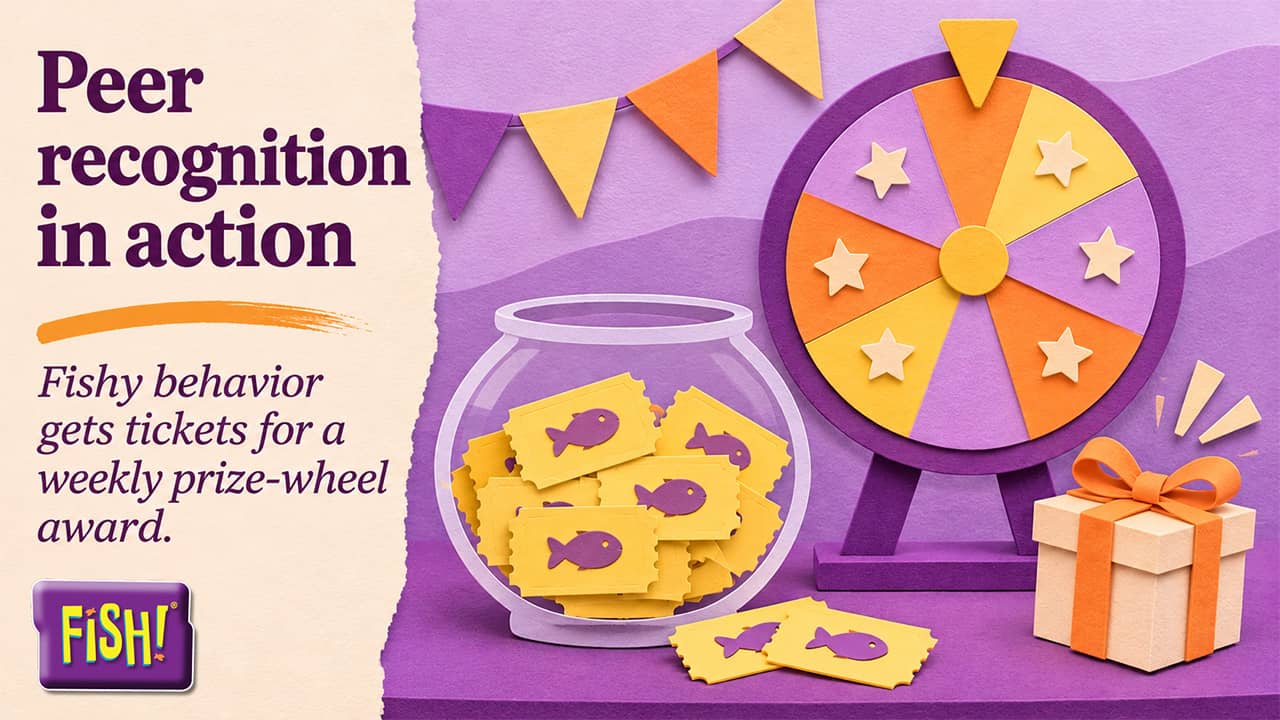
Employees gave one another tickets for “fishy” behavior, and once a week the employees whose tickets were drawn could spin the prize wheel.
The dealership held a cookout every Saturday from April through September for customers and employees, and many customers returned just to hang out with the staff. The service manager also took his management team to breakfast once a week and invited a guest from another department. New employees were introduced to FISH!, and the receptionist had “Choose Your Attitude” printed on her personal checks.
The change did not happen because everyone welcomed the idea at once. Ruffalo said the parts manager was “totally against the premise of having fun at work.” While he was on vacation, the staff decorated his office with fish and nets. When he returned, Ruffalo told him to leave the decorations up for six months and then decide. More than one year later, they were still up, and the parts manager was an active FISH! supporter.
CHDB reported several results. Employee retention improved by almost 15 percent since FISH! was introduced. The dealership had started with a 35 percent turnover rate, described as an industry average, and later reported a turnover rate of nearly 20 percent. It also reported a substantial profit increase.
Customer experience rankings improved as well. Before FISH!, CHDB ranked 120 out of 660 Harley dealerships on 30-day customer purchase experience surveys. It later ranked 8 out of 660. On 18-month customer ownership experience surveys, it had ranked 481 out of 660 two years earlier and later ranked 91 out of 660. Those surveys covered a customer’s total experience with the dealership for the 18 months after a purchase, including interactions with service, parts, and other departments.
In an employee survey, the average answer to “how much fun” employees had at work was 4.15 on a 1-to-5 scale. Also, 100 percent of respondents said FISH! was somewhat or very relevant to their work. In February 2005, Dealer News named CHDB one of the top 100 power sports dealers in North America, and the dealership’s use of FISH! was part of its application. CHDB was one of only two Harley-Davidson dealerships in California to receive the honor.
Ruffalo summed up the change this way: “FISH! has become a key part of how we do business and we’ll never go back. Our profits are up, our customer satisfaction has improved and we’re having a lot of fun. FISH! has a lot to do with all those things. The return on investment has been tenfold over just the impact on our bottom line.” California Harley-Davidson/Buell is one of many organizations whose reported results with the FISH! Philosophy have been documented.
How to make work fun without forcing it
A fun workplace gives people room for different personalities, real problems, and quiet energy. Forced fun can feel like another task, especially when it has little connection to the work.
CHDB’s choice to let employees bowl or take the afternoon off offers a useful lesson. Ask employees what they want, explain the purpose, and leave room to say no.
A person may find Play in a team game, while another finds it in trying a new way to solve a problem, helping a customer with extra care, or making a routine task more creative. The FISH! practice of Play means bringing curiosity, energy, and creativity to work. It does not require everyone to be loud.
Managers can make fun more natural by removing the frustrations that make work miserable: confusing handoffs, repeated delays, wasted effort, and tools that do not work. A birthday event cannot make up for a broken process.
Teams also need real breaks. Choose Your Attitude asks people to notice how they are showing up and choose how to approach what comes next, rather than pretending every problem is positive.
Why does a fun workplace affect customers?
Customers feel the difference between a scripted welcome and a person who is fully present. Be There asks employees to give physical, mental, and emotional attention to the person in front of them. That can mean listening without preparing a reply, noticing confusion, or bringing in a teammate before a small problem becomes a large one.
Employee enjoyment can show up in customer satisfaction because people carry their experience of work into customer interactions. Make Their Day turns attention into a small, sincere action: a specific thank-you, a thoughtful handoff, or a moment that helps someone feel seen.
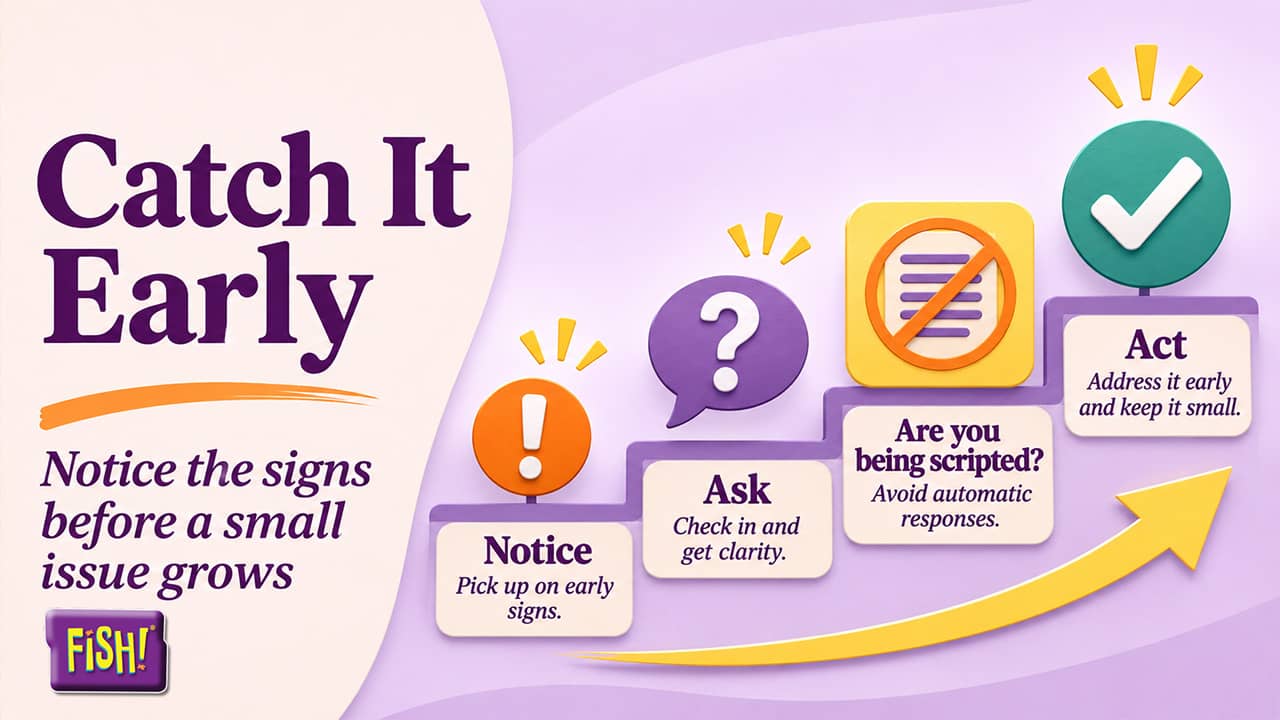
Being fully present helps a team notice confusion and bring in help before a small problem becomes a large one.
CHDB’s cookouts and prize wheel show what visible workplace fun can look like. The deeper lesson is to create a place where customers and employees feel welcome. The dealership’s reported movement from 120 to 8 on 30-day purchase experience surveys, and from 481 to 91 on 18-month ownership experience surveys, shows why the full relationship matters.
How do peer recognition and celebrations build a fun workplace?
Recognition works best when it is specific, sincere, and close to the action. “Good job” is easy to miss. “You stayed with that customer until the service question was clear” tells a person what mattered and helps others repeat it.
Peer recognition is powerful because coworkers see contributions that managers may miss. CHDB’s tickets for “fishy” behavior gave employees a way to notice one another, while impromptu root beer floats and sno-cone parties connected celebrating wins to real effort.
Use recognition as an invitation rather than a quota. Checklists and forced praise can make a meaningful practice feel fake.
Build simple social traditions instead. Let teams suggest cookouts, shared breakfasts, birthday or milestone moments, or small ways to mark a completed project.
Keep the invitation open and make sure recognition is not reserved for the loudest people. Some employees prefer public praise; others would rather hear a private thank-you. Both count.
How can cross-department relationships improve employee retention?
People often experience a workplace through handoffs between departments. If teams hear from each other only when something is wrong, distrust grows; if they help and acknowledge one another, silos weaken.
CHDB’s weekly breakfast, where the service manager invited a guest from another department, offers a practical pattern. A similar routine can help people understand one another’s work without becoming another meeting for its own sake. The goal is Be There across department lines: listen, learn what another group needs, and make it easier to support the customer together.
That connection can support employee retention because people are less likely to feel alone inside a difficult system. A helpful handoff, a note of thanks, or a quick offer to solve a problem can build a stronger team culture.
How do you win over skeptical employees?
Do not force belief through slogans. Give skeptical employees a clear playing field: what the team values, what behavior is out of bounds, and where people can experiment. Let the practices earn credibility through daily experience.
Leaders should respond to doubt with curiosity. Ask what concerns the person and what small test could show whether the idea helps.
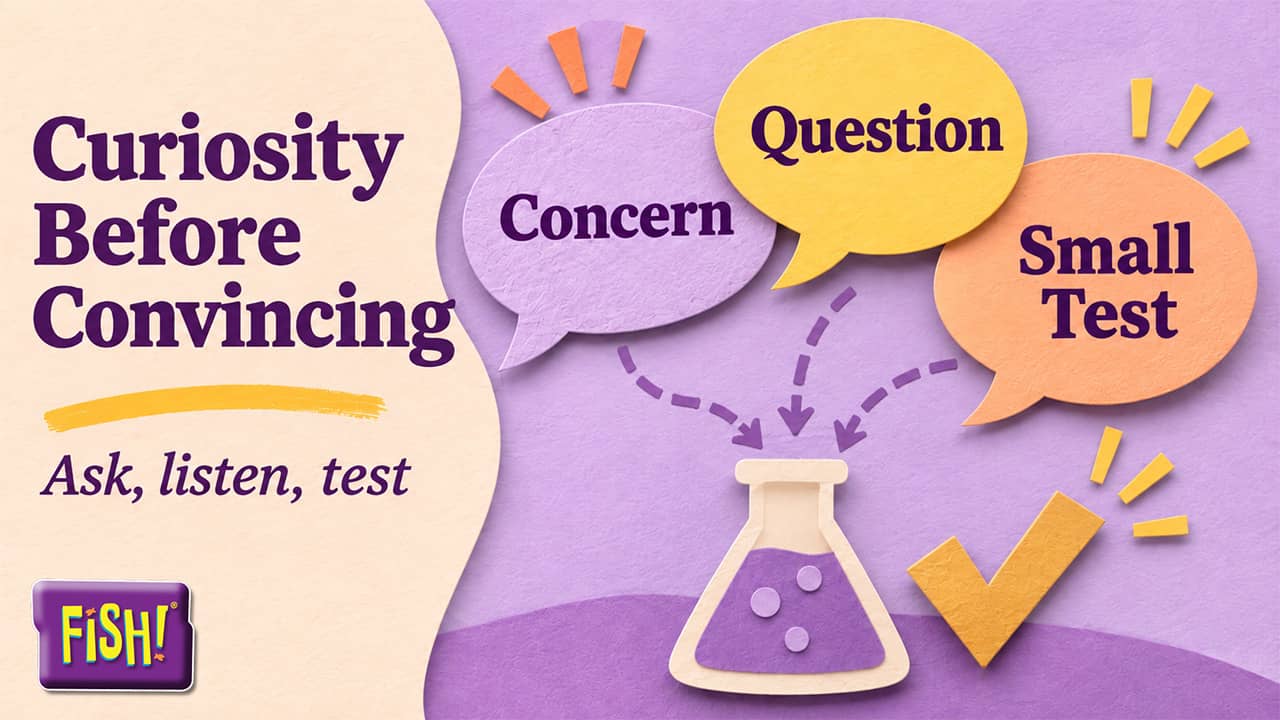
Leaders can respond to doubt by asking what concerns a person and what small test could show whether an idea helps.
Model the behavior instead of demanding it. Choose Your Attitude includes the leader’s example, and Play needs safety for trial and error.
CHDB’s parts manager did not begin as a supporter. In the dealership’s case study, the staff helped him come around, and he later became an active participant.
The larger lesson is to allow time, choice, and evidence. A fun workplace lasts when people can see that it makes work more human and does not ask them to pretend.
What can a manager try this week?
Ask, “What makes a good day here, and what gets in the way?” Then choose one small improvement, such as a better handoff, a real break, or peer recognition.
Invite one optional experiment with a clear purpose and boundaries. Ask afterward what helped and what felt forced. That cycle keeps the practices connected to learning, listening, sincere care, and personal responsibility.
Fun at work grows through the way people handle a difficult job. It helps them bring energy, attention, creativity, and care to the day.
Try the FISH! Philosophy with your team
If you want to explore how to make work fun with a shared language, try the FISH! Philosophy upgraded trial. Your team gets 30 days of access to the FISH! film and its digital guides, so you can introduce the practices, discuss what they mean in your workplace, and start putting the ideas into action together.

Frequently Asked Questions
How can a manager tell whether a team activity is genuinely inclusive?
Ask employees how the activity felt, who had an easy way to participate, and what would make it better next time. Pay attention to quieter feedback as well as visible enthusiasm, because genuine inclusion leaves room for different personalities and ways of taking part.
What is the difference between Play and taking time off?
Time off helps people recover, while Play describes how people bring curiosity, creativity, and energy to the work itself. Both have a place, and neither should be forced or treated as the only acceptable way to participate.
What should a leader do when a fun activity makes someone uncomfortable?
Stop and listen rather than treating discomfort as a bad attitude. Revisit the team’s boundaries, keep participation voluntary where possible, and make sure Play helps people Be There and Make Their Day instead of embarrassing or excluding them.
Can fun at work help with employee turnover?
It can support retention when it is part of a healthy work experience that includes respect, useful systems, recognition, and a voice in how work gets done. Fun alone cannot repair every workplace problem, but genuine connection can give employees more reasons to stay engaged.