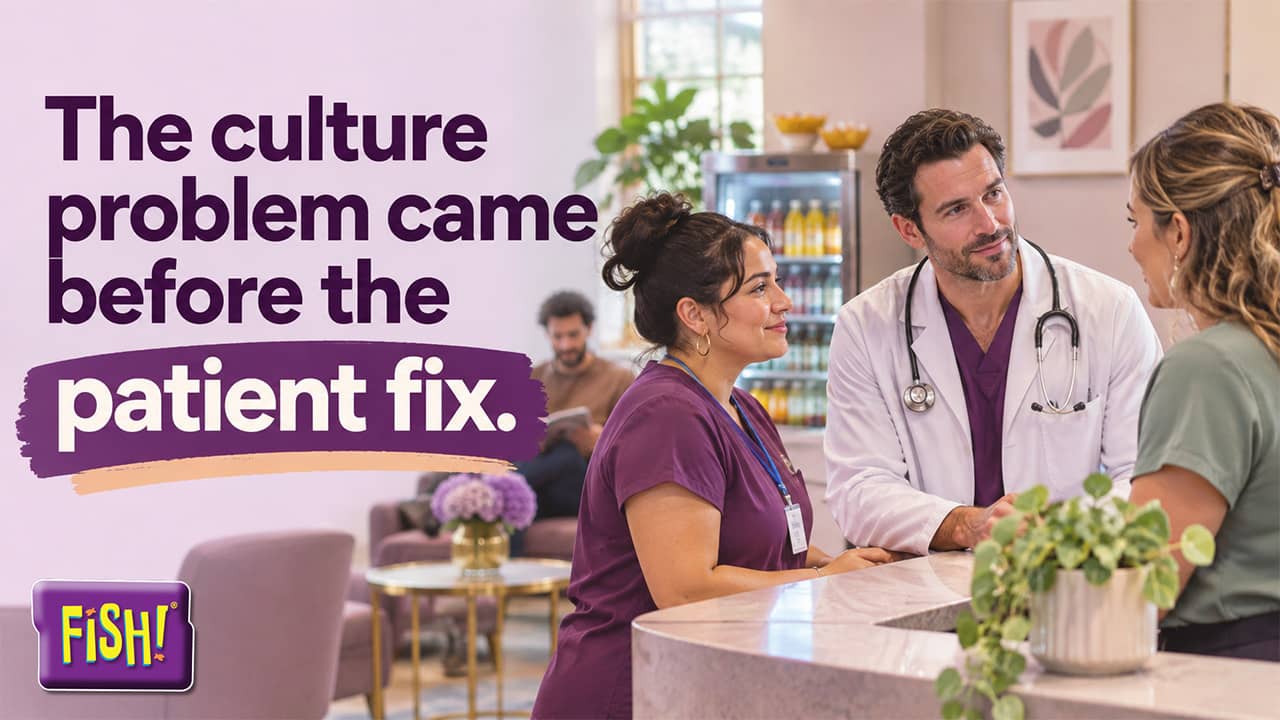
A practice can provide strong clinical care and still need to improve patient experience. Novus Clinic, an eye and skin care clinic in Tallmadge, Ohio, learned that patient experience is shaped by more than the care delivered in the exam room. It is also shaped by the tone of the workplace, the way doctors speak to staff, the wait for an appointment, and whether patients feel that the people serving them are truly present.
Novus used the FISH! Philosophy to work on those parts of the experience. Its story offers a practical answer to a question many practices ask: How can a practice improve patient experience while also improving employee engagement?
What problems was Novus Clinic trying to solve?
Novus offers a full range of eye and skin care, including eye exams, cataract and LASIK surgery, and facial cosmetic procedures. Several years ago, its clinical services were strong, but employee retention, staff morale, and patient referrals were low. Doctors sometimes handled frustration by yelling at staff.
In January 2002, the clinic was “in crisis,” according to a letter from Kim Hoch. The organization had very low morale, negative attitudes, high turnover, loss of direction, and a lack of pride. Patients were unhappy with the service and frequently complained about the staff’s bad attitude. Employee and patient retention had reached an all-time low.
Hoch, the clinic’s vice president, believed the FISH! Philosophy could help improve the culture. The goals were to increase morale, retention, and teamwork; improve relationships between physicians and staff; create a warm, responsive experience that would lead patients to recommend Novus; and grow the business.
What did Novus Clinic change to help patients feel cared for?
The physicians began with their own behavior. They realized that if they wanted employees to change, they had to start with themselves. “They saw that by changing their tone, especially in stressful situations, and looking for positives, staff went above and beyond to help them,” Hoch says.
Hoch introduced FISH! in a series of two-hour meetings, focusing on one practice a month, beginning with Choose Your Attitude. Staff-led committees looked for ways to bring the practices into daily interactions with patients and colleagues.
The clinic also acted on specific patient concerns. When patient wait times were too long, physicians agreed to pay fines when they arrived late. Staff used that money to buy a refrigerator with juice, beverages, and snacks for patients who had to wait.

Novus physicians agreed to pay fines when they arrived late, and staff used the money to buy a refrigerator with juice, beverages and snacks for waiting patients.
Surveys showed that patients felt they did not get enough quality time with doctors. Novus found that most doctors stood during exams. To Be There for patients, doctors began sitting with them eye to eye. They did not spend more actual time overall with patients, yet later surveys showed that patients felt doctors were spending much more time with them.
Other changes focused on small moments and relationships. Staff collected gift cards to make patients’ days on birthdays and other special occasions. New employees were assigned a veteran staff member to mentor and Be There for them when they needed help. This also prepared staff to move into manager positions.
Novus displayed the FISH! Philosophy in every exam room to tell patients what the staff was committed to. Patients who saw staff living the practices could describe what happened on a card and place it in a fishbowl. Those cards were read at staff meetings so employees could be recognized and thanked, and the clinic created gift bags for them. When interviewing new employees, Hoch explained, “This is our culture and what we believe in here.”
What results did Novus report?
Novus reported that patient satisfaction and referrals soared. Employee satisfaction and retention increased, and the clinic opened two new locations in response to its growing patient load. In her letter, Hoch said employee turnover was “virtually non-existent” and described the patient load as “burgeoning.”
Her summary was simple:
“Fish! has become a way of life for us. Our staff is happier and our patients are happier. I can’t imagine where we would be today without Fish!”
Novus is one of many organizations whose FISH! results have been documented, but its experience connects culture changes with everyday patient interactions.
How can a medical practice improve patient experience?
Novus’s example points to a broad lesson: patient experience is built through repeated signals. A patient notices whether people sound rushed, whether a wait is explained, whether a doctor makes eye contact, and whether staff members treat one another with respect. Those details can make patient-centered care feel real or make it feel like a slogan.
Start by asking patients where the experience feels hardest. Surveys, comments, complaints, and conversations can reveal problems leaders do not see. Then choose changes that staff can practice and observe.
Novus used surveys to notice that patients did not feel they received enough quality time. Adding minutes was not the only possible answer; sitting eye to eye changed the interaction.
That is the heart of Be There. The practice means complete presence: physical, mental, and emotional.
In a clinic, that can include facing the patient, keeping eye contact, listening without preparing a reply, and responding to the concern rather than only completing the task. Sitting down with patients can help because posture and attention communicate that the person in front of you matters.
Presence also includes knowing when full attention is not possible. A doctor or manager can say that they want to give someone their full attention and set a time to talk. The important part is to follow through and be fully present then.
Why does the way doctors treat staff affect how patients feel?
Medical office culture travels. When leaders use a sharp tone or yell, employees may become guarded, distracted, or less willing to raise problems. That affects teamwork and can reach the patient through slower handoffs, a cold greeting, or a rushed answer.
When leaders show respect under pressure, they give staff a model for how to handle pressure with patients.
This is why physician leadership matters in any effort to improve patient experience. A leader cannot credibly ask staff to be warm while modeling frustration.
Choose Your Attitude asks people to notice what they are bringing into a difficult situation and choose how to respond, again and again. It does not require pretending that hard situations are easy, and it is not a command for an employee to “fix” an attitude. Leaders set the direction through their example.
How can a clinic reduce wait-time frustration?
Patient wait times affect satisfaction, but the clock is only part of the experience. Waiting feels worse when patients do not know what is happening or feel forgotten. A practice can explain delays, give updates, offer a comfortable place to wait, and provide water or refreshments when appropriate.
It can also review scheduling, handoffs, and late arrivals so the same problem does not keep repeating.
Novus addressed a long wait with both accountability and care: physicians agreed to pay fines when they arrived late, and staff used the money for a refrigerator stocked with drinks and snacks. Practices can adapt the idea to their own setting rather than copy the exact arrangement. The useful combination is examining delays and responding humanely to people experiencing them.
Care coordination and follow-up matter for the same reason. Patients feel more secure when they know what happens next, who will contact them, and where to ask questions. When family members are part of care, involving them appropriately can also reduce confusion.
How do recognition and onboarding improve patient care?
Employee engagement in healthcare grows when people can see that their effort matters. Make Their Day is about creating meaningful moments for patients, coworkers, and others. Recognition is one part of it, but the recognition works best when it is specific and sincere.
Novus gave patients a way to recognize staff through cards in a fishbowl, then read those cards at staff meetings and thanked employees with gift bags. A different practice could use a short team message, a peer nomination, or a shared story about a helpful action. The method matters less than showing that someone noticed what happened and why it helped.

At Novus, patients described what staff did on cards for a fishbowl, and the cards were read at staff meetings before employees received gift bags.
Onboarding is another chance to shape behavior before habits settle in. Novus assigned new employees a veteran staff member to mentor and Be There for them. A mentor can explain both the technical work and the unwritten signals of patient-centered care: how to welcome someone who is anxious, how to ask for help, and how to recover after a difficult interaction.
Hiring can reinforce the same culture. Novus used its values in interviews by telling applicants, “This is our culture and what we believe in here.”
A practice can ask candidates to describe how they handled a tense conversation or helped a teammate. It should then make sure current leaders live by the values they describe.
How can a practice keep these changes going?
Culture grows through ongoing conversation and repetition.
Teams can choose one patient-experience question to discuss regularly: Where did we make a patient feel seen? Where did we lose presence? What would help staff handle the next busy day better?
The FISH! practices provide shared language for those conversations. Choose Your Attitude helps people notice how they show up, while Be There brings attention back to the person in front of them.
Make Their Day turns ordinary interactions into moments that leave someone better off. Play can help a team bring energy, creativity, and lightness to work without making patients or serious concerns the punchline.
The goal is a workplace where staff support one another and patients feel the difference, rather than a performance that merely looks cheerful from the outside. Novus’s reported results suggest that when leaders begin with their own behavior and give staff a role in carrying the culture forward, patient experience and employee retention can reinforce each other.
A simple place to start
Ask your team to name one moment in the patient journey that often feels rushed, cold, or confusing. Listen to the people closest to it, choose one change you can test, and decide how you will know whether patients and staff feel a difference. Then keep the conversation going.
Try the FISH! Philosophy with your team
If your practice is working on patient experience, the FISH! Philosophy upgraded trial gives your team 30 days of access to the FISH! film and its digital guides.
Use that time to begin a shared conversation about how your team wants to show up for patients and for one another, then turn the practices into small actions your workplace can sustain.

Frequently Asked Questions
How can a small medical practice improve patient experience with a limited budget?
Start with behaviors that cost little or nothing, such as eye contact, clear updates during delays, listening without interruption, and thanking staff for specific actions. Small changes are easier to test, and they can reveal which larger process problems deserve attention next.
What should a clinic measure when it wants to improve patient experience?
Use a mix of patient feedback, wait-time patterns, complaints, referrals, and staff feedback. Look for whether patients feel heard and whether employees have the support and clarity needed to provide consistent care.
How can doctors improve bedside manner without making visits longer?
Focus on presence: face the patient, listen closely, and show that you understood the concern. Novus reported that sitting eye to eye helped patients feel doctors spent much more time with them even though doctors did not spend more actual time overall.
How can leaders address burnout while still asking staff to be positive?
Do not use positivity to dismiss workload, stress, or real problems. Leaders can acknowledge what is difficult, invite staff to help solve it, and model a deliberate response through Choose Your Attitude while also improving the conditions that create unnecessary strain.