
Change at work can make even a good team feel unsure. Routines shift, roles move, and people may have to serve customers while they are still adjusting themselves. So how do you deal with change at work when you cannot control what happens around you?
A story from Kitsap Regional Library points to a practical answer: focus on the choices, relationships, and small moments that are still within reach.
What did Kitsap Regional Library’s staff take from the FISH! film?
Patti Allen was a supervisor of the library’s audio visual department and was “on desk” about 90% of the time. During a long-term personal challenge, she found that humor and laughter helped her manage hard days. Including patrons and customers in her fun made the work “so much more bearable,” she wrote.
Years before the library’s staff training day, Allen tried to get management to approve the FISH! video for staff. It was not approved then. Later, the library’s new HR Manager, Helen Ojeda, was able to get it approved for Library Training Day.
Seeing the video at the library’s training day was an emotional experience for Allen. She cared deeply about the organization, what it meant to the community, and her coworkers, all 200+ of them. She also knew that some of them had difficult experiences dealing with the public and with one another.
Allen said the video showed staff “they could have fun, that they are in charge of choosing their attitude. That we cannot always control how people treat us, but we can control how we react.” She saw FISH! as more than a customer service video. In her view, it could help organizations “going through that awful experience called ‘change’.” She hoped people would see how they could be happier “by choosing to be, and by ‘being there’ for each other in every walk of life.”
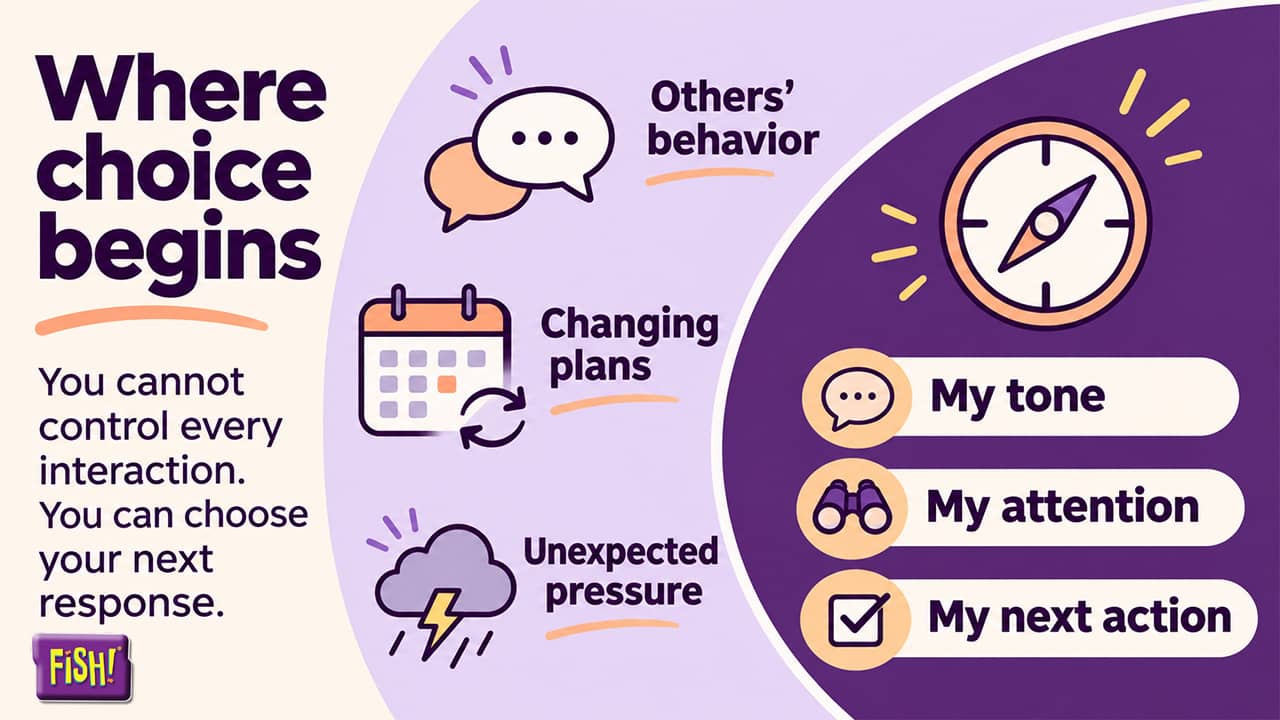
You cannot control every interaction, but you can choose your next response.
Kitsap Regional Library is one of many organizations whose experiences with the FISH! Philosophy have been documented. Its story is useful because it does not promise that a film can remove difficulty. Instead, it shows how a team can use a shared idea to talk about its response to difficulty.
Why does change at work feel so hard?
Workplace change reaches beyond a plan or an org chart because it can unsettle a person’s sense of skill, belonging, control, or security. Even a change that leaders see as necessary may feel sudden or unfair to the people who must carry it out.
A helpful response begins with honest communication. Ask what is changing, what is staying the same, and what the next decision point will be. If you do not know an answer, say so and explain when you will look for one; clear questions turn vague worry into something a team can work with.
The FISH! practice of Be There adds an important layer. Being there means complete presence: physical, mental, and emotional.
During a conversation about change, listen with an open mind, notice what the other person is saying, and leave room for a different view. You can respect a concern even when you reach a different conclusion.
How to deal with change at work when you cannot control it
Start by separating influence from control. You may not control a new policy, another person’s behavior, or the timing of a decision. You may still control how you prepare, what questions you ask, how you speak to customers, and whether you ask a coworker for support.
This is the heart of Choose Your Attitude. The practice asks a person to notice their mood, face the facts of the situation, and decide how to approach the next moment. That choice can happen before a difficult day, then return after a tense conversation or a setback.
Try asking, “Who are you being while you’re doing what you’re doing?” The question separates a feeling from the response that follows it. Worry can exist alongside clear communication; annoyance can give way to respect; disappointment can still leave room to help the team solve its next problem.
Leaders have a special responsibility here because teams watch how leaders respond. When a manager acknowledges a hard change, stays curious, and treats people with respect, employees see a model for their own behavior. Telling people to fix their attitude while ignoring real obstacles usually increases resistance, while steady example and conversation make the choice easier to practice.
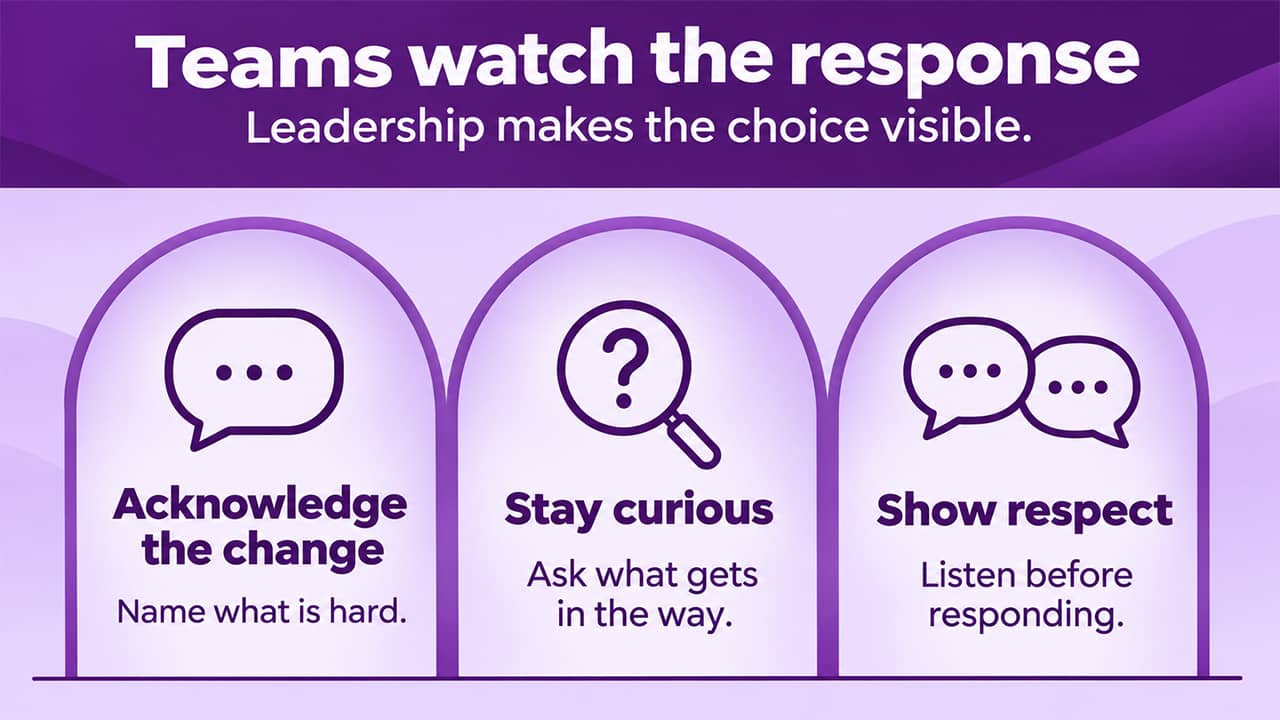
When leaders acknowledge a hard change and stay curious, their teams see a model for their own response.
How can humor help a team through hard times?
Humor can lower tension, restore a sense of connection, and give people a short break from stress. It reminds a team that work includes human feelings and imperfect moments. A shared laugh may make it easier for people to speak, ask for help, or try again after a mistake.
Some humor strengthens a team, while other humor leaves damage behind. Include people rather than putting someone on display: laugh at your own small mistake, notice the absurd side of a hectic day, or find a playful way to approach a problem. Humor that mocks, excludes, or humiliates closes the door that a shared laugh can open.
The FISH! practice of Play brings curiosity, energy, and creativity into ordinary work. A playful team can ask, “Is there another way to handle this?” From there, it can test an idea, learn from what did not work, and improve without treating every misstep as a personal failure.
Before bringing humor or play into a tense situation, check it against the other practices. Does it help people feel included and help you stay present with them? Does it reflect the attitude you want to bring?
If the activity fails those tests, choose another approach and invite people into fun rather than asking them to perform it.
What can you do when a good idea is not approved?
Change often includes a delay between seeing a useful idea and getting permission to try it. A first “no” may reflect timing, a need for more detail, or a decision-maker who does not yet see the need; the idea may still deserve another look later.
Persistence works best when it is thoughtful. Keep track of the problem the idea could address, listen for new conditions, and be ready to explain it in a way that fits the team’s current needs. You can also ask what would need to be true for the idea to be reconsidered.
A useful idea can be carried forward without damaging trust. Listen closely to concerns, respond without giving up your agency, and keep enough curiosity to adapt the proposal as you learn.
How can coworkers support one another during change?
Support often starts with noticing. A coworker who is usually quiet may be overwhelmed, while someone who seems impatient may be carrying information you do not have. You do not need to guess at the whole story; make room for a real conversation and ask what would help.
Be There asks you to give the person your attention before reaching for a solution. They may need a clear answer, help sorting the next step, or simple recognition that someone sees the effort they are making.
Make Their Day turns that awareness into a sincere action. It might be a specific thank-you, a useful handoff, an offer to help with a task, or recognition of work that is easy to overlook. These gestures show that a person’s effort and presence matter rather than treating appreciation as a reward system.
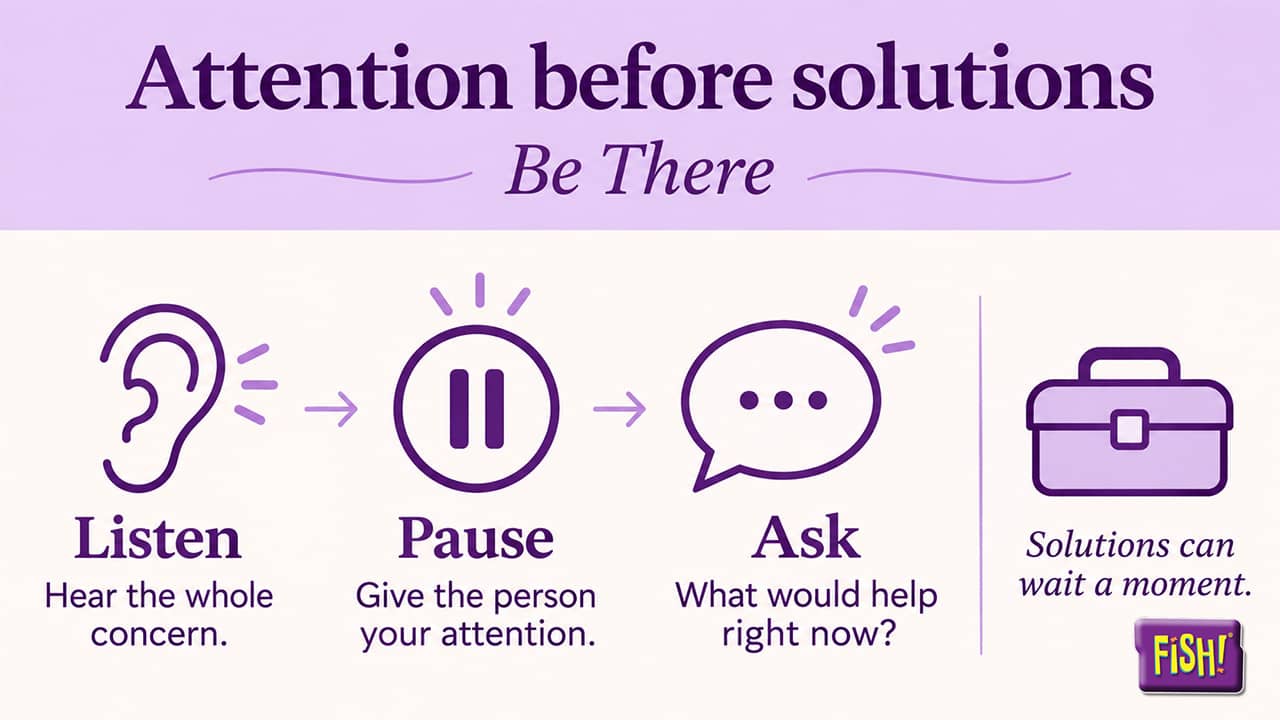
During change, a coworker may need your full attention before they need a solution.
Leaders can make this practice part of daily work by recognizing specific behavior. Name what the person did and why it helped, then make the recognition genuine and appropriate to that person.
Some people prefer public thanks, while others would rather hear it privately. During change, remember behind-the-scenes contributions as well as the work everyone can see.
How can a team build resilience during organizational change?
Resilience is easier to build before the next crisis arrives. A team can talk about the values it wants to protect, the behaviors that support those values, and the boundaries that keep people safe. Clear boundaries give people room to be creative without guessing what will harm a customer, coworker, or the work itself.
Together, the four practices give that conversation a useful shape. Choose Your Attitude helps people decide how to approach uncertainty, while Be There keeps communication human and attentive. Make Their Day strengthens connection through recognition and service, and Play leaves room for curiosity and better ways to work.
Teams also need conditions that help people stay steady. Breaks, realistic workloads, training, and time to ask questions support mental presence and better decisions when change is constant. A resilience plan that ignores exhaustion cannot support an attitude choice for long.
A practical way to start
You do not need to transform a workplace in one meeting. Begin with one real situation, listen fully to the people involved, and name what lies within the team’s control. Then find one sincere way to make someone’s day easier and one safe place to bring curiosity or lightness into the work.
Over time, those choices can change how a team experiences change at work. A healthy workplace lets people face difficulty honestly, choose their response, stay present with one another, and keep looking for a better way forward.
Try the FISH! Philosophy with your team
If your team is coping with change at work, the FISH! Philosophy upgraded trial gives you 30 days of access to the FISH! film and its digital guides. Use the materials to start a shared conversation about attitude, presence, recognition, and play, then connect those ideas to the changes your team is facing.

Frequently Asked Questions
How can employees protect their energy during a long period of change?
Set small boundaries around attention and recovery, such as taking an appropriate break, clarifying priorities, and asking for help before the workload becomes unmanageable. These habits support clearer thinking and make it easier to stay present with coworkers and customers.
How can teams learn from a change after it happens?
Hold a short debrief that asks what helped, what created friction, and what the team should repeat or adjust next time. Keep the conversation focused on learning and workable improvements rather than assigning blame.
What is a good first activity for a team learning the FISH! practices?
Ask people to describe a time when a coworker made a difficult day easier, then discuss what the person did and how it affected the work. From there, the team can choose one small behavior to practice and reflect on what it changes.
How can remote teams stay connected during change?
Use regular check-ins that leave room for questions, and make listening as important as reporting tasks. Remote teams can also recognize specific contributions in writing or in meetings so useful work does not disappear simply because people are not sharing a physical space.
What should a team do when people adjust to change at different speeds?
Make room for different questions and give people more than one way to understand the transition, such as written updates, conversations, and practice. Patience helps the team gather useful concerns without expecting every person to respond in the same way.