A safety recognition program can do more than hand out rewards. It can show people that speaking up, paying attention, helping a teammate, and taking safety seriously all matter. A Chicago-area refinery used the FISH! Philosophy to improve its safety and overall culture, and the results it reported offer useful ideas for any workplace trying to build stronger employee safety engagement.
What did the refinery want to improve?
The refinery was seeking to improve its safety and overall culture. It turned to the FISH! Philosophy to foster an engaging way to improve the safety culture.
Its objectives were clear. The refinery wanted to create a work environment that more deeply embraced safety, implement specific programs to improve safety culture, improve overall morale and teamwork, provide a simple set of safety tools to create awareness and shift behaviors, and reduce accidents and near misses experienced on the job.
Those goals connect safety performance with the daily experience of work. A strong safety culture also depends on whether people feel involved, supported, and willing to speak up when they see a risk.
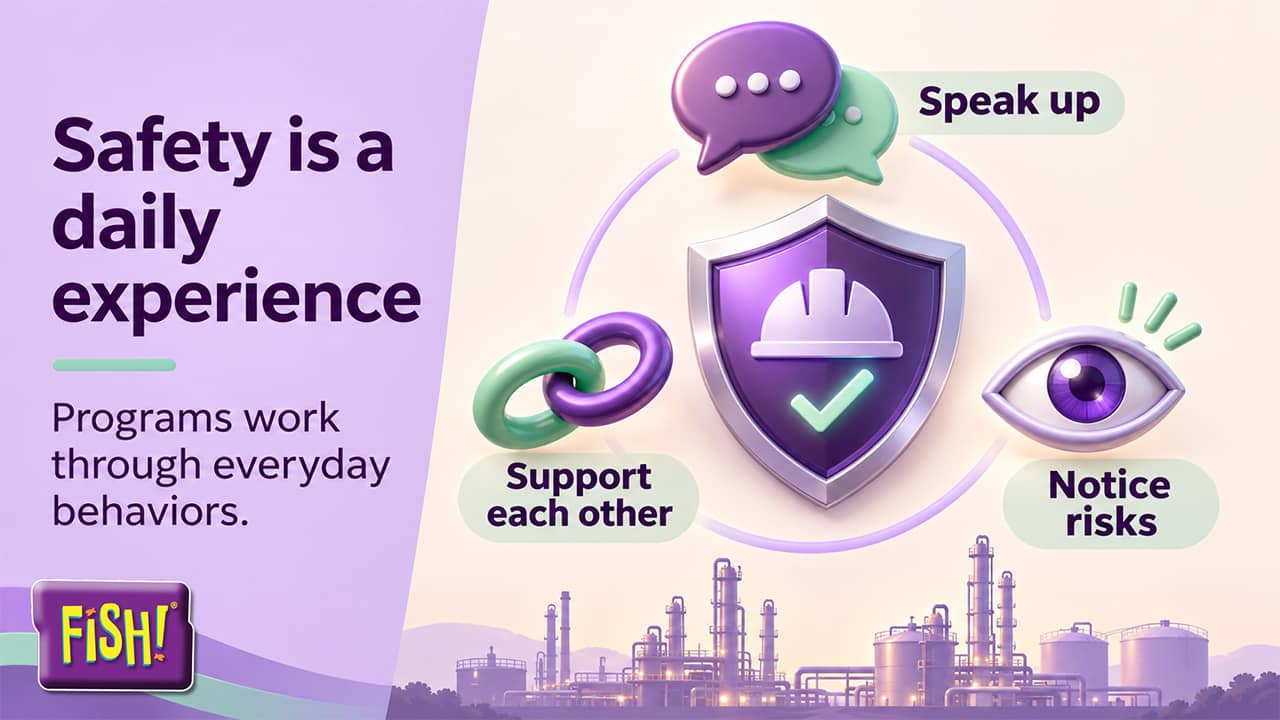
Safety programs work through the everyday behaviors people practice on every shift.
How did the refinery introduce the FISH! Philosophy?
The refinery introduced the FISH! Philosophy through a one-day training that taught the four FISH! practices as they related to safety behaviors and trust building. More than 1,000 refinery employees and contractors were trained.
It then reinforced the environment with posters, books, Pete the Perch, and FISH! screen savers. Reminders like these can keep a training idea visible and give people prompts to revisit as they put it into practice.
Choose Your Attitude
The refinery used Choose Your Attitude as a tool to help shift behaviors by trying new ways to approach safety. In the FISH! Philosophy, the practice means noticing the attitude a person is bringing to a situation and choosing how to approach it, both before a difficult moment and as circumstances change.
That idea gives employees a practical question to carry into safety work: Who are you being while you are doing what you are doing? The way people show up can affect their decisions, teamwork, and the safety of the work around them.
Be There
The refinery improved TSTI, or Total Safety Task Instruction, meetings and Morning Muster meetings by including management in the meetings. This reinforced Be There, and team members felt valued and supported by having managers attend.
Be There means complete presence. It includes physical presence, mental attention, and emotional presence. In a safety meeting, that can mean listening closely, noticing what people are saying and not saying, and treating their concerns as worth attention.
Play
The refinery implemented monthly themed safety lunches to focus on the importance of Play and creating a fun culture while reinforcing the importance of safety.
Play does not mean treating safety casually. It means bringing curiosity, energy, and creativity to the work while keeping the purpose clear.
Make Their Day
The refinery hosted “playful” recognition activities to Make Their Day. Its examples included ice cream events, handing out Zero (Incident) candy bars, and holding celebration events that recognized specific individuals.
Make Their Day turns recognition into a meaningful moment. It shows people that their effort, choices, and presence matter. The practice works best when recognition is genuine and specific, rather than a generic reward given without much thought.
The refinery also implemented a Safety Suggestion Program to share and discuss new ideas to implement. This “made their day” because people knew their ideas were welcomed and valued.
What results did the refinery report?
The refinery reported that it reduced its OSHA (Occupational Safety and Health Administration) rating from 1/200,000 to 1/1,500,000 through programs initiated with FISH! It was recognized as one of the best teams in the global organization. Project performance improved through timeliness and safety measures.
The refinery is one of many organizations whose results with the FISH! Philosophy have been documented, so readers can also look at how other organizations have adapted the practices.
What makes a safety recognition program work?
The refinery’s example points to a useful rule: a strong program recognizes the behaviors that help create safety. That can include reporting a near miss, making a safety suggestion, joining a safety huddle, helping a coworker notice a hazard, following a procedure, or asking a careful question.
These are leading indicators. They show that people are participating in the work of prevention before an incident occurs. When leaders recognize those actions, employees can see what the organization values and repeat the behavior.
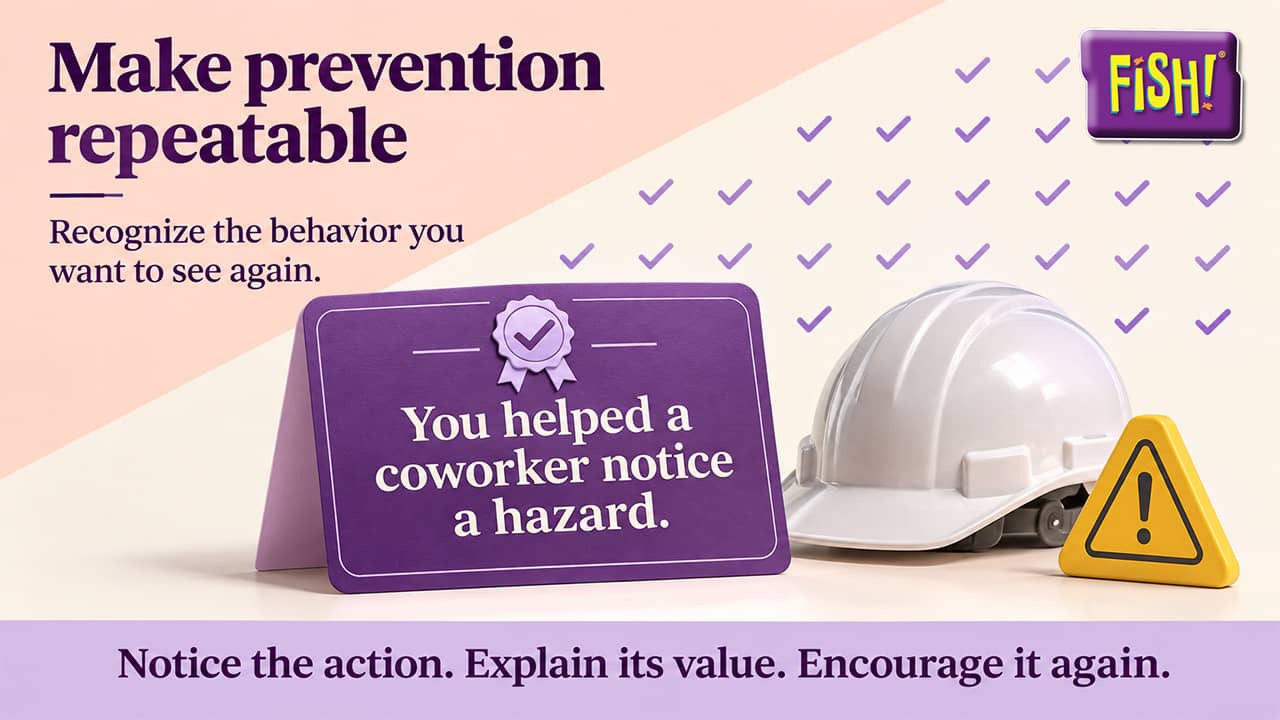
Recognizing a specific safe action tells the person and the rest of the team what to repeat.
Rewards tied only to an injury-free period can create a serious problem. If people think reporting an injury or near miss will cost the team its reward, they may stay quiet. A program that rewards silence works against safety because leaders lose information about hazards and employees learn that looking good matters more than telling the truth.
A healthier safety recognition program makes reporting part of the success. A team might thank someone for raising a near miss, then focus on what can be learned and what needs to change. It can recognize participation in audits, safety committees, toolbox talks, and morning meetings without suggesting that a perfect record is the only acceptable outcome.
How can leaders make safety meetings matter?
People are more likely to value a safety meeting when leaders show that the meeting matters to them, too. When a manager attends, safety becomes visible as part of leadership’s work instead of a topic handed off to someone else.
Management attended the refinery’s TSTI and Morning Muster meetings, and team members felt valued and supported. In your own meetings, leaders can build on that lesson by listening, responding to concerns, and following through on ideas instead of treating the meeting as a routine interruption.
The best safety meeting ideas make the conversation useful, whether or not every meeting feels entertaining. A team can rotate between a recent near miss, a safety suggestion, a question about a procedure, and recognition of a helpful action.
Safety committee ideas work in the same way. Give the committee a clear question to work on, invite input from employees and contractors, and close the loop by explaining what happened to the ideas. A suggestion program loses energy when people submit ideas and never hear whether anyone considered them.
The FISH! practices give these conversations a shared lens. Be There brings attention to the people and risks in the room, while Choose Your Attitude supports a problem-solving response to concerns.
Make Their Day adds specific acknowledgment for useful participation. Play invites a better way to discuss a recurring risk without making light of it.
Why does attention matter in workplace safety?
Distraction makes it harder to notice changing conditions, remember instructions, and respond to what another person is doing. In a workplace where people must stay aware of their surroundings, attention is part of prevention.
The refinery developed safety programs that highlighted “being there” behaviors. Those behaviors included being fully present for oneself and others while being aware of their surroundings. Presence also calls for attention to the task, the environment, and the people affected by the work, not simply standing in the right place.
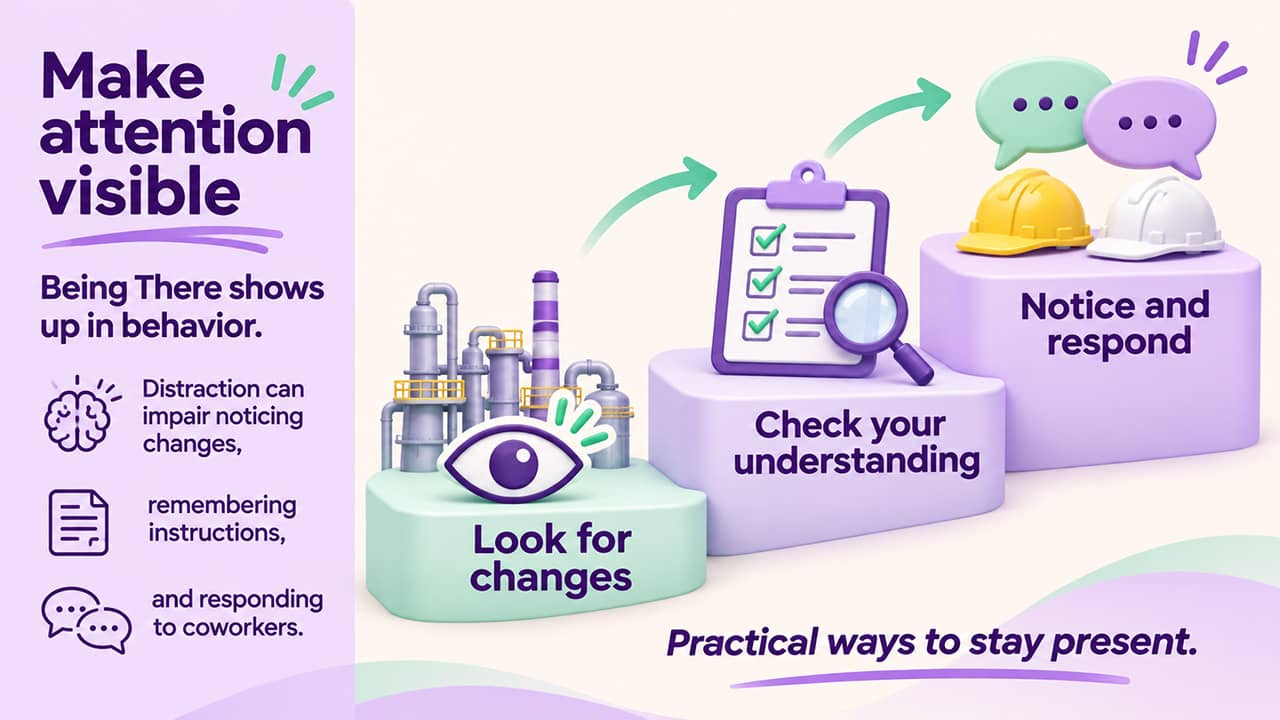
Distraction makes it harder to notice changes, remember instructions, and respond to coworkers, so attention is part of prevention.
Teams can practice this without turning it into a checklist that people rush through. At the start of a shift or safety huddle, a leader might ask what could change the risk today, what signals people should watch for, and what would make it easier to speak up. During a debrief, the team can ask where attention was strong and where it was pulled away.
Be There also applies to a person who raises a concern. Listening without dismissing it helps create the trust needed for employee safety engagement. Even when a suggestion cannot be adopted, people should see that someone considered it carefully.
How can workplaces keep recognition and safety culture from going stale?
The refinery used posters, books, Pete the Perch, and screen savers to reinforce the FISH! environment. Other workplaces can use their own reminders, as long as they connect them to current work.
A team that talks about Be There can make room for focused listening. Make Their Day can point to a real person and contribution, while Play can invite useful creativity within safe boundaries.
Recognition should also be varied. Public celebrations may encourage some people, while a private thank-you works better for others.
It can happen in a safety meeting, through a note, during a team lunch, or in the moment when someone makes a good safety choice. Specific praise tells the person and the rest of the team what to repeat.
The same principle applies to safety suggestions and near miss reporting. Thank the person for speaking up, share what the team learned, and explain the next step when possible. That response shows that participation leads somewhere.
A practical way to begin
Each workplace can choose activities that fit its own setting. Begin by asking employees what safer, more supportive teamwork would look like, then choose one meeting habit, one way to invite safety suggestions, and one way to recognize safe participation.
The most important part is consistency. The four practices work together as an ongoing conversation about how people want to work. When that conversation reaches safety meetings, contractor safety, near miss reporting, and everyday decisions, people can see the culture in daily actions.
Try the FISH! Philosophy with your team
If your team wants a simple way to start talking about safety culture, employee engagement, and recognition, try the FISH! Philosophy upgraded trial. It gives a team 30 days of access to the FISH! film and its digital guides. With those materials, you can explore the four practices and begin putting ideas such as focused attention, welcomed suggestions, meaningful recognition, and creative safety conversations into practice.

Frequently Asked Questions
Should safety recognition include contractors?
Yes. Recognition is more useful when it reflects the people who share the work and the safety environment. The refinery trained more than 1,000 employees and contractors in its one-day introduction to the four practices as they related to safety behaviors and trust building.
How can a team include night-shift workers in safety recognition?
Use the same recognition standards across shifts and make sure night-shift employees can suggest ideas and receive appreciation in ways they can see. A note, handoff message, or recognition shared at the next all-shift meeting can help prevent timing from deciding who gets noticed.
How often should a safety committee review suggestions?
The right schedule depends on the workplace, but people should not have to guess whether their ideas disappeared. Set a regular point to review suggestions, decide what needs more information, and communicate what the team will do next.
Can a playful safety activity become distracting?
It can if the activity makes the risk seem unimportant or excludes people. Play works best when it supports curiosity, connection, and useful problem-solving while the team stays clear about safe boundaries and the purpose of the conversation.
What is a good first step for improving safety culture?
Start by listening to employees and contractors about what helps or blocks safe work, then choose one small action the team can see. A focused safety suggestion question, a leader attending a safety huddle, or specific recognition for a useful behavior can create a visible starting point.