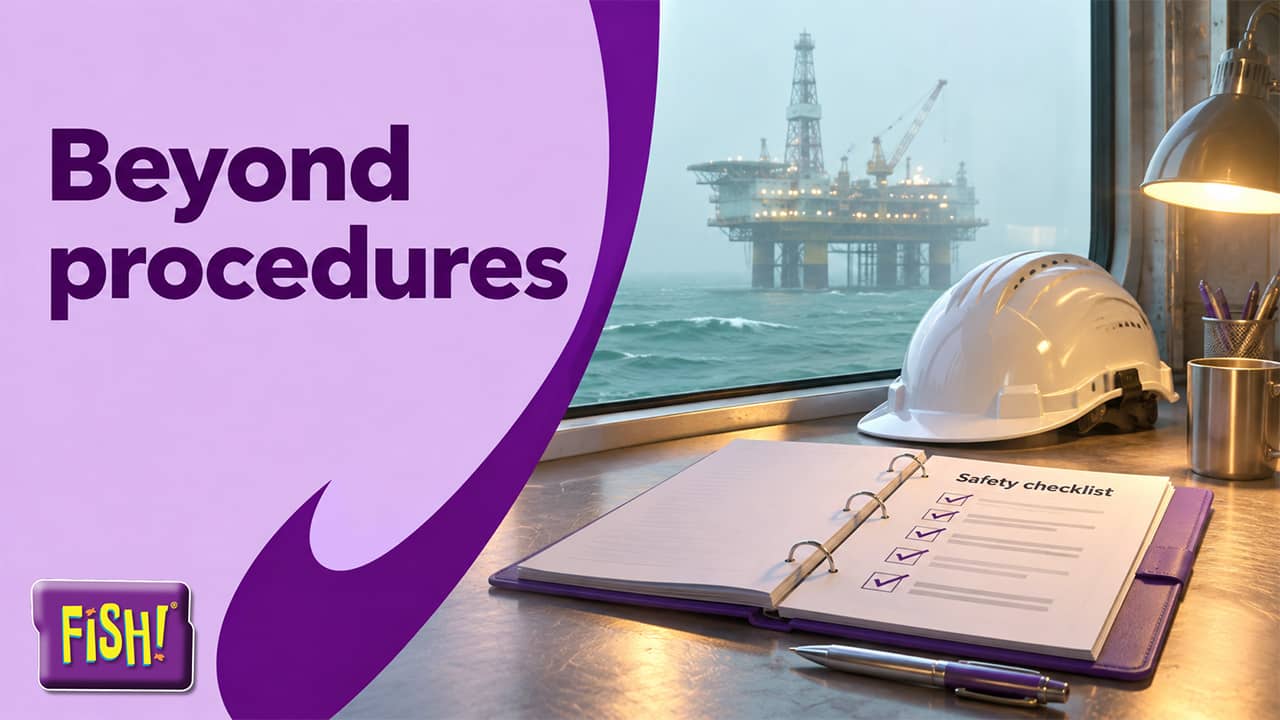
Safety culture can be hard to improve when procedures are already in place. Shell Expro’s Brent Delta platform shows why: rules can tell people what to do, but they cannot make people care about one another enough to act on those rules every time.
This North Sea case study offers a practical answer to the question, “How can a company improve its safety culture when procedures are already in place?” It also shows how to improve safety culture through deeper ownership, trust, and daily action.
What was happening at Shell Expro’s Brent Delta platform?
Shell Expro, a partnership of Shell and Esso Exploration and Production UK, operated four large drilling platforms in the Brent oil and gas field in the North Sea. These platforms were critical in meeting the UK’s energy needs. One of them, Brent Delta, employed a staff of 160 operating a factory and processing plant.
The platform had rigorous safety procedures, but its safety record was not meeting expectations. Before FISH! was introduced, it recorded 72 injury-related medical visits and a total recordable case frequency of 13.3, a measure of accidents per hours worked. Both numbers were above what was acceptable.
Brent Delta had already tried several safety improvement initiatives, with little progress. The platform concluded that staff needed more than processes. They had to want to make those processes work and become emotionally invested in the entire team’s safety from moment to moment.
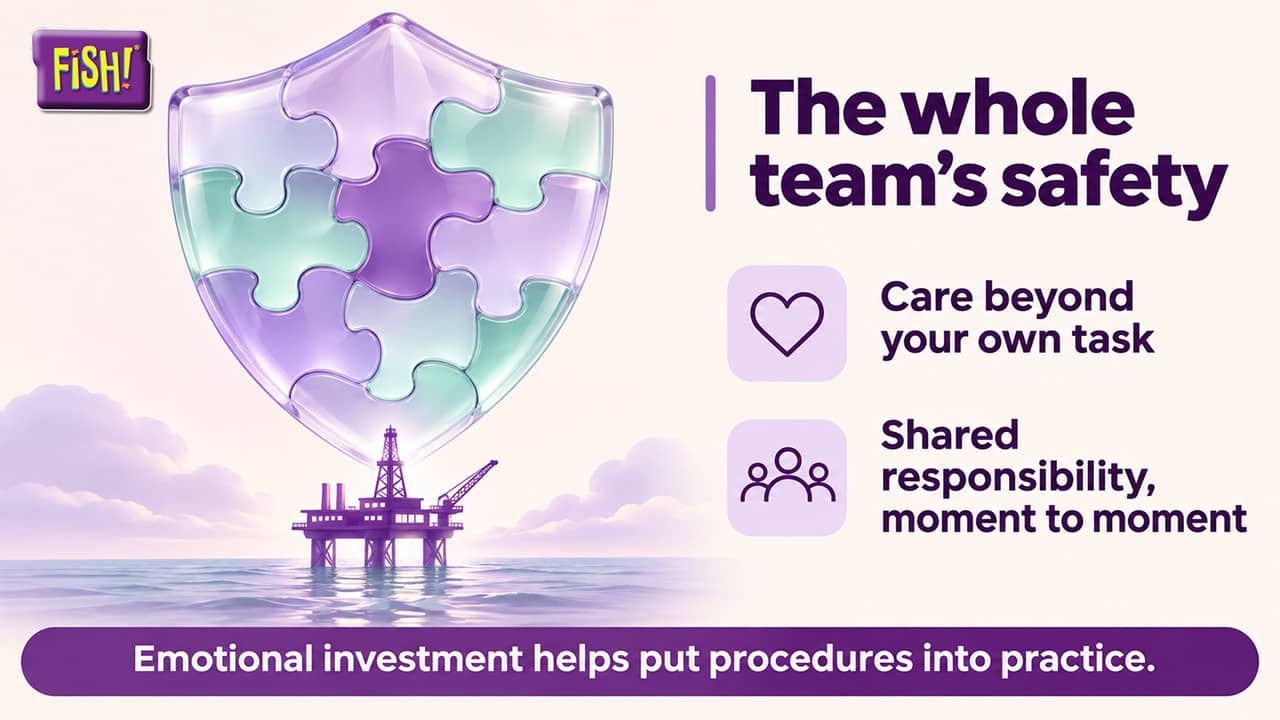
Brent Delta’s crew needed more than procedures. They had to care about the whole team’s safety from moment to moment.
How did Brent Delta create a new safety vision?
At a safety course sponsored by Shell Expro, members of the Delta leadership team saw the videos FISH!, about the deep commitment and focus of the Pike Place fishmongers, and FISH! Sticks, which showed how they kept their vision alive. From this, Brent Delta created a new vision: “a World Class Safe and Fun Platform.” It introduced The FISH! Philosophy to support that vision.
The team started with Being It, a key concept from FISH! Sticks: imagine the person you would like to work with, then “be” that person.
Staff committed to coaching each other to live their vision. They agreed to let go of egos and encourage the free flow of ideas across position and department. In time, it became unacceptable to walk past any action that was not safe.
What did Brent Delta do with the FISH! practices?
The platform applied the practices to everyday work rather than treating them as a separate activity. By understanding that they could consciously choose how they showed up, staff approached pre-work safety checks with more open, focused attitudes. This is the practical side of Choose Your Attitude: people prepare for a task, notice how they are arriving, and make a deliberate choice about how to approach it. It does not mean pretending that difficult conditions are easy. It means bringing attention and intention to the work that must be done.
Staff also focused on being more present for coworkers. They worked hard to make each other’s day during long, exhausting days, increasing teamwork and cooperation. Be There means complete presence: physical, mental, and emotional attention to the person and situation in front of you. In safety work, that kind of presence helps people notice when a coworker needs support, clarification, or a direct conversation about a risk.
The team used Play to build camaraderie and community. An entertainment committee planned film nights, quizzes, and snooker competitions. By having fun together, staff built stronger relationships, making it easier to coach each other about safety concerns.
Play does not mean treating serious work carelessly. It brings curiosity, energy, and creativity to work, helping safety conversations feel less like personal attacks.
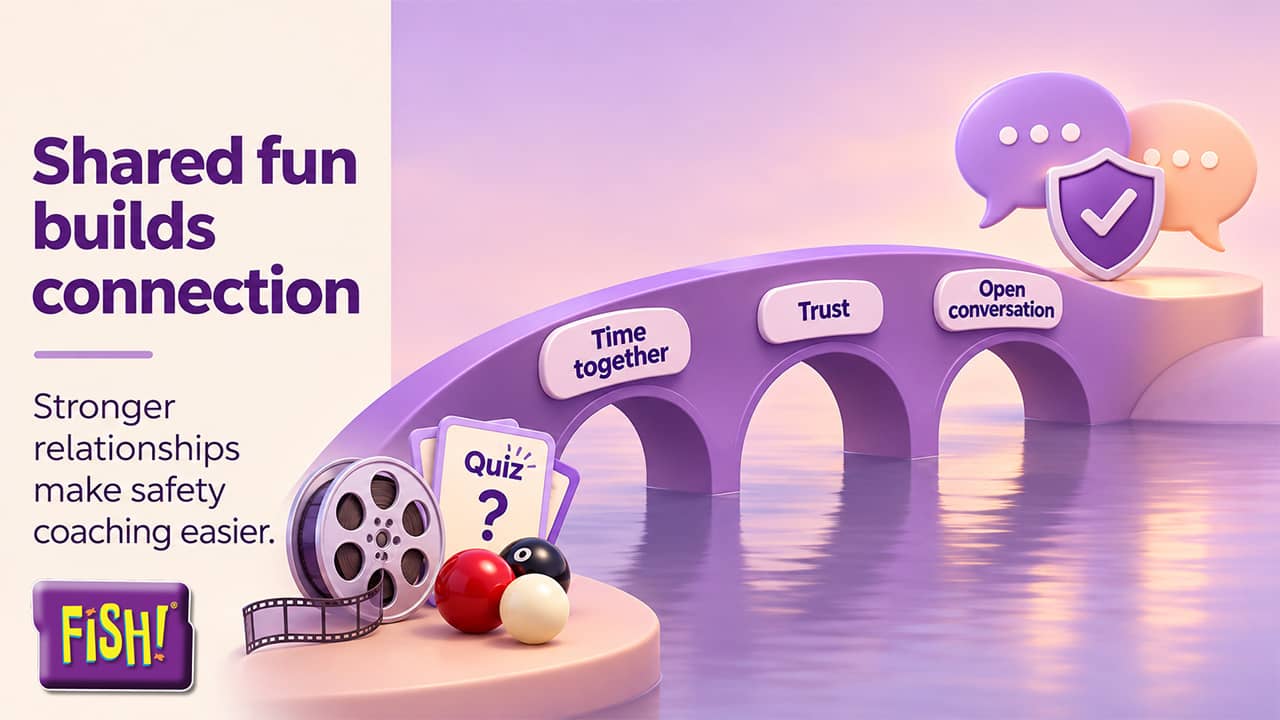
Film nights, quizzes, and snooker competitions helped the crew build the relationships that made safety coaching easier.
Make Their Day also appeared in the platform’s effort to support one another through long, exhausting days. The practice is about creating moments that show people their efforts and presence matter. A sincere word of appreciation, practical support, or recognition can strengthen the sense that people are working with one another rather than merely sharing a workplace.
What changed after the FISH! Philosophy was introduced?
In the year after it introduced The FISH! Philosophy, safety at Brent Delta improved dramatically. Medical visits fell from 72 to less than 20, a drop of more than 70 percent. Total recordable case frequency fell from 13.3 to 4.1, a decrease of 70 percent.
As safety improved, so did performance. The platform ran for 218 straight days, a mark never achieved before, and surpassed its oil targets by 16 percent. These are the results the platform reported. They show why safety engagement matters to both people and performance, while also showing that the human side of safety should not be dismissed as separate from operational results.
Why did the approach meet resistance on other platforms?
When Brent management tried to introduce the Delta “FISH! Philosophy” to the rest of the business, staff on the other platforms initially saw it as an attempt to impose someone else’s approach on them.
Shell Expro adjusted its strategy. Instead, it worked with its entire offshore staff to create a shared vision. They created a new vision that recognized staff skills and empowered people to coach, communicate, and protect each other, rather than burdening them with redundant processes.
A key vision concept was “no negative conversations,” which meant: “Only complain to someone who can do something about it.” The aim was to change conversations from “You have a problem” to “What can I do about this problem?” As staff began to “own” the vision, they enthusiastically adopted The FISH! Philosophy to help them live it.
The lesson was simple: create your vision, then use FISH! to support it. People often resist a program imposed from outside, while shared ownership helps them define what good looks like. Brent Delta is one of many organizations whose results with The FISH! Philosophy have been documented, but its experience is especially useful because it connects a safety vision with everyday behavior, peer coaching, and relationships.
How can a company improve safety culture when procedures are already in place?
Start by asking what the procedures depend on. If a process requires a worker to stop a job, report a near miss, question a decision, or coach a peer, then the workplace needs more than compliance language. It needs trust.
Trust between coworkers affects safety because people weigh the social cost of speaking up. Blame, embarrassment, or dismissal can keep workers quiet after a hazard is found, while a fair response makes it easier to share what they see. Psychological safety supports accountability by making honest information available before a small problem becomes a serious one.
Brent Delta’s commitment to coach each other and refuse to walk past an unsafe action offers a useful model for peer-to-peer safety coaching. This approach protects the shared vision instead of turning a concern into a chance to catch someone out. Teams can agree on respectful language for raising concerns, discuss what happens after a stop-work decision, and recognize people who speak up early.
Leaders also shape safety culture by what they practice in public. When leaders visibly follow procedures, listen to concerns, and welcome bad news, their actions show that safety is a real value rather than a poster on a wall. Be There applies to leadership as much as to coworker conversations: people need to feel that their concerns and their work matter.
Shared vision gives those actions a center. A team can ask, “Who do we want to be while we do this work?” and turn the answer into observable behaviors: prepare with focus, look out for one another, raise concerns, and learn from near misses.
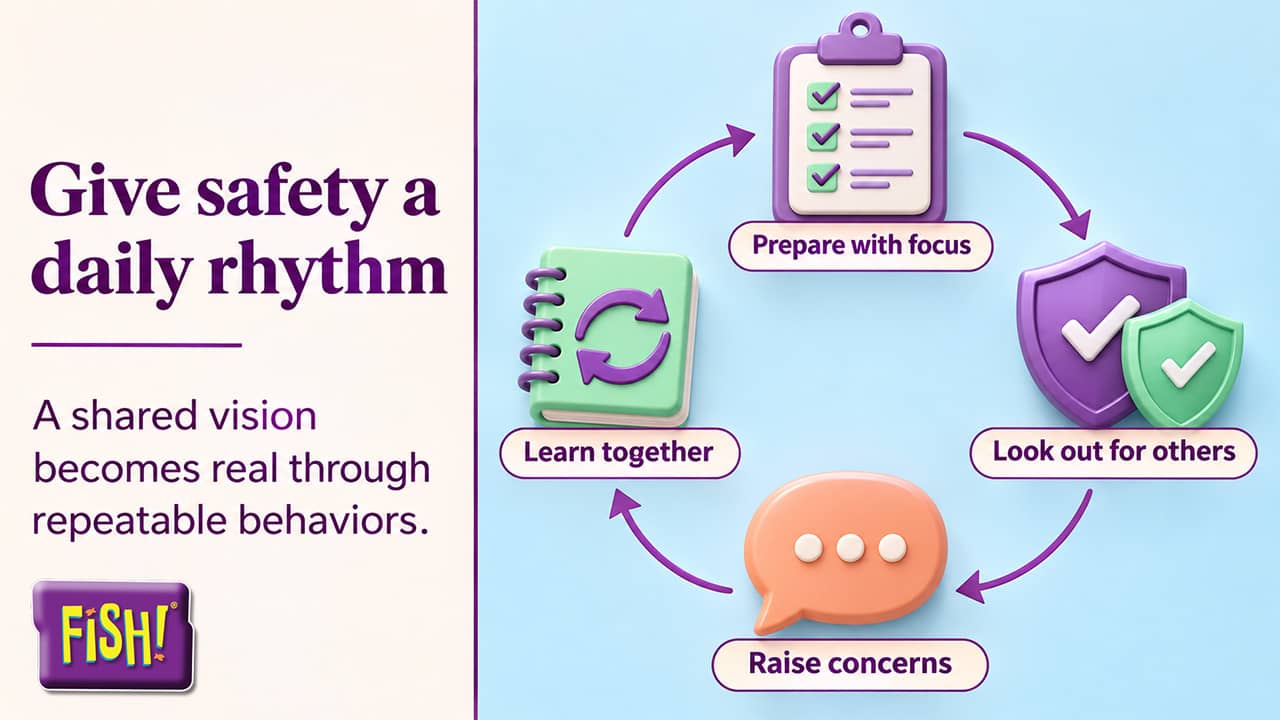
A shared safety vision becomes real through behaviors a team can repeat every shift.
Choose Your Attitude can help before a shift, a difficult inspection, or a tense conversation. The practice asks people to notice their state and choose the attention and care the situation requires, whether or not they feel cheerful. Leaders spread it through their own example rather than telling employees to “fix” their attitude.
Be There makes safety communication more reliable. Give the person speaking your physical, mental, and emotional attention, and listen without forming a rebuttal before they finish. Notice the coworker who seems overloaded or distracted, because presence may reveal a risk that a checklist will miss.
Play can make a team more open to learning. Permission to use curiosity and creativity helps people look for a better way to handle a problem, while clear boundaries keep play from embarrassing, excluding, or distracting people from safe work. Used well, it creates the relationships and trust that make difficult conversations easier.
Use “no negative conversations” as a prompt for action. When someone raises a hazard or process problem, ask who can help and what support is needed. The goal is to move from blame toward ownership.
What can other workplaces learn from Brent Delta?
The platform’s experience suggests that safety culture is built in the space between formal rules and human choices. Procedures remain essential, but people have to bring attention, courage, and care to them. A shared vision can connect those qualities to daily work, while peer coaching and trust help keep the vision alive.
Try one small conversation with your team: What would a world-class safe workplace look like in the way we treat one another today? Look for behaviors that can guide the next shift, then choose one way to be more present, make someone’s day, or speak up for safety.
Try the FISH! Philosophy with your team
If your team wants a shared language for safety engagement, trust, and everyday ownership, try the FISH! Philosophy upgraded trial. It gives a team 30 days of access to the FISH! film and its digital guides, so you can explore the practices together and start putting these ideas into practice.

Frequently Asked Questions
How do safety culture and safety compliance differ?
Safety compliance asks whether required rules and processes are being followed. Safety culture includes those requirements, but also covers the shared beliefs and everyday behaviors that shape whether people speak up, learn from near misses, and protect one another when no one is checking.
What is a good first step for building frontline ownership?
Invite frontline workers to describe the safe workplace they want to help create and the behaviors that would show it is real. Starting with their experience helps turn a leadership message into a shared vision that people can guide and coach one another toward.
How should a team respond to a near-miss report?
Thank the person for bringing useful information forward, then focus on what happened and what can prevent a repeat. A fair, learning-focused response makes future reporting more likely and helps the team improve the system instead of searching for someone to blame.
How can leaders tell whether safety conversations are becoming more open?
Look for useful signs in everyday work: more questions raised early, more near-miss information shared, and more respectful coaching between coworkers. These signals matter because they show that people are contributing information before a formal measure records a failure.