In a restaurant turnaround, leaders often start with the menu, costs, cash flow, or marketing. Those areas matter, but what if the biggest problem is the team?
The story of the Applebee’s in Austin, Minnesota, shows why restaurant culture can be part of the turnaround itself. When the way managers and employees work together changes, guest service, productivity, retention, and profit can change with it.
What was wrong at the Austin Applebee’s before its turnaround?
Before the turnaround, sales were low, guest service was down, and turnover was high at the Austin, Minnesota, Applebee’s. The location ranked 27th out of 58 locations for front of house, or serving area, productivity. Its guest service scores were 38th in the state. The location had also seen a lot of rotation with managers, and morale was low. Something had to change.
Hannah Weirather, the newly appointed general manager, wanted the location to succeed. “Things needed to change and needed to change quickly,” she said. She also described the kind of workplace she wanted: “I want to work in a place where I want to want to come to work.”
Hannah and her management team explored their options and chose the FISH! Philosophy. They first looked at themselves. “We had to first put ourselves under the magnifying glass and ask how are we showing up? What should we be doing differently?”
The managers watched the FISH! film and started sharing the FISH! Philosophy with employees. All employees were invited to join them in exploring the tools and philosophy.
How did the team change its restaurant culture?
A culture shift began to happen. The Austin team moved “from lecture to dialogue” and from being driven by management to being driven by the energy they generated together. Hannah knew the change was real when “the employees began holding the managers accountable for their attitudes!”
The reported results were strong. Overall profit increased 15%. Statewide guest service scores improved from 38th to 3rd. New hire retention increased. Front of house productivity jumped from 27th to 1st. Sales increased year over year by 8%, and new hire retention increased 23%. Austin was named National Turnaround Location of the Year.
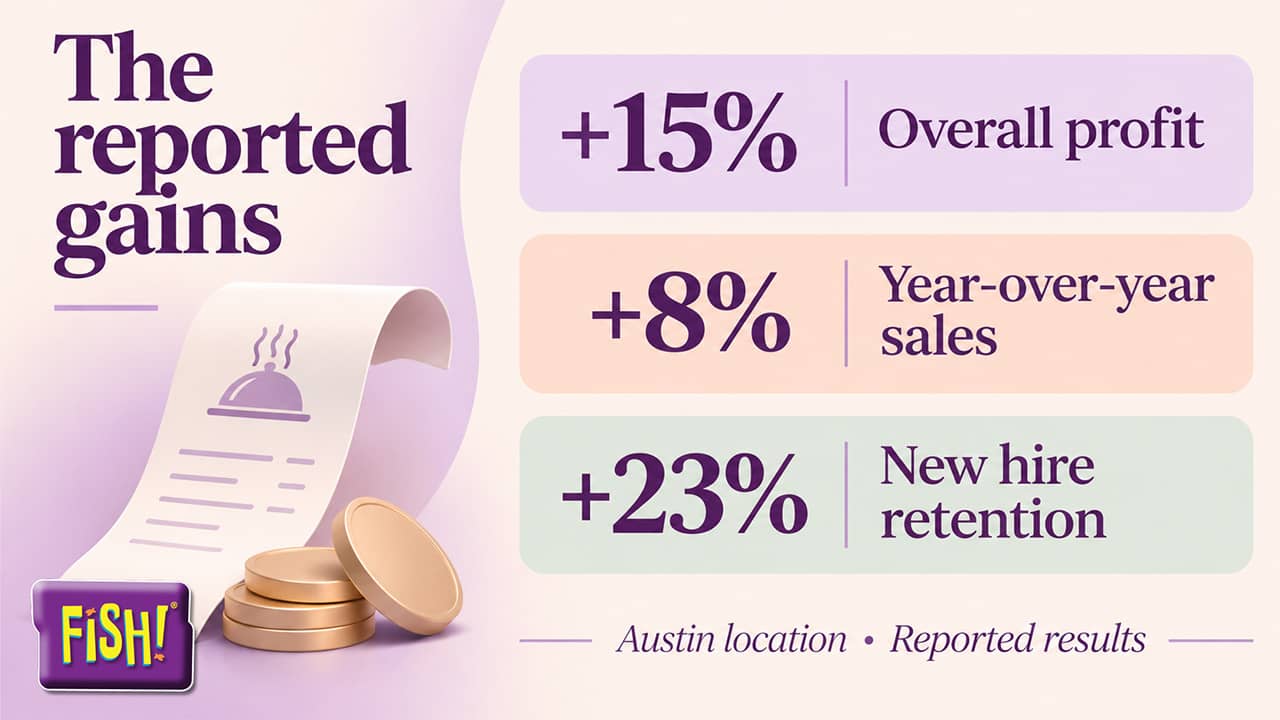
The Austin location reported gains in profit, sales, and new hire retention during its turnaround.
Hannah explained the connection between caring for employees and caring for guests: “They take care of my guests. If I’m not taking care of them there is something seriously wrong with me.”
The Austin Applebee’s is one of many organizations whose results with the FISH! Philosophy have been documented. Its story is useful because it shows a people-centered side of turnaround work: before a team can create a better guest experience, leaders may need to examine the experience they create for the team.
How do you turn around a struggling restaurant when the problem is the team?
Begin with a diagnosis. Review the menu, food and labor costs, cash flow, staffing plan, service steps, marketing, and loyalty efforts. Pair those checks with attention to teamwork.
The first people-side question is simple: how are managers showing up? A manager’s attitude is visible during every shift, and employees notice whether the leader stays calm under pressure, listens to concerns, recognizes effort, and treats service problems as chances to learn. Guests then experience those choices through the pace, warmth, and care of the front of house.
This is the FISH! practice Choose Your Attitude. The practice starts with noticing what you are bringing into a situation and deciding how you want to respond, while still dealing honestly with the problem. For a leader, that choice becomes a visible example that can shape the team and the customer experience.
Before a shift, ask, “Who are you being while you’re doing what you’re doing?” A useful response matters more than forced cheerfulness.
Why does a manager’s own attitude shape guest service?
A restaurant manager sets the emotional tone of a shift because the job controls more than schedules and tasks. During a full dining room, a struggling new hire, or an unhappy guest, the manager shows the team what matters. A steady, constructive response gives employees a model for handling pressure with guests and one another.
This is where Be There becomes practical. In the FISH! Philosophy, presence is physical, mental, and emotional, so a manager can be nearby yet miss what a server is saying if attention is elsewhere or defensiveness takes over.

A manager’s steady response shapes how the team behaves and, from there, how guests are treated.
In its summary of the service-profit chain, Harvard Business Review says successful service managers put frontline workers and customers at the center of management concern and invest in people, recruiting, training, and support for frontline work. Systems work better when the people using them feel supported.
How can restaurant managers improve team morale and retention?
Make the work experience specific, human, and connected to the guest. Clear expectations matter, and so does showing employees that their effort is seen. A manager can recognize a careful handoff, a patient explanation to a new hire, or a server who steadied a tense guest interaction, then name why it helped.
That is the FISH! practice Make Their Day. It creates a moment that leaves another person better off, whether the gesture is small, spontaneous, private, or public. Sincere recognition shows that a leader or teammate was paying attention; forced praise rarely does.
Retention is difficult in restaurants. The National Restaurant Association reported in 2025 that 77% of operators said recruiting and retaining employees was a significant challenge. The report connected retention with positive workplace experiences, clear job expectations, mentorship, recognition, and career growth opportunities.
Black Box Intelligence’s 2024 research found that lower turnover accompanied better traffic and sales growth, while management turnover remained above its 2019 level.
Retention deserves attention as an operating result. Ask new hires what helps them learn, watch where people leave, and look for patterns in training, scheduling, communication, recognition, and manager behavior.
New hire retention, guest service, front of house productivity, and profit all increased at the Austin location. Look at managers first, invite employees into the exploration, and discuss how people work together.
How can employees hold managers accountable without creating conflict?
Accountability works best with a shared language for behavior. “You have a bad attitude” is vague, while “When the shift got busy, we stopped listening to one another” gives the team something to examine.
The Austin Applebee’s reported that employees began holding managers accountable for their attitudes. This gave the team a way to recognize that leaders were part of the culture they were asking others to create, without taking over management.

A shared language for behavior lets employees and managers talk about a hard shift without turning it into conflict.
The FISH! practices give that conversation a balanced language. Choose Your Attitude brings attention to what each person is bringing to the work, while Be There calls for full listening before a defense. Make Their Day turns the response toward helping the other person do good work, and Play leaves room to test a better approach within boundaries that protect respect, safety, and the guest experience.
After a difficult shift, a short review can ask what the team noticed, how behavior affected coworkers and guests, and what to try next time. That turns a lecture into dialogue and connects morale to service measures without reducing people to numbers.
What should a restaurant turnaround measure besides sales?
Sales and profit matter, but they are late signals. Managers should also watch guest service, front of house productivity, new hire retention, staffing stability, training progress, and shift handoffs.
Marketing and loyalty programs can bring people back, but the visit still has to feel worth repeating. Menu and cost changes work best when the team can deliver the meal and welcome consistently.
The FISH! practice Play treats work as a place for curiosity, energy, and creative problem solving. In a busy restaurant, that can mean giving people room to look for a better way, try a small change, and learn from what happens. Clear boundaries keep the idea respectful, safe for guests, and suited to the team’s responsibilities.
That kind of workplace can make restaurant management more responsive. A server may see a problem first, a host may notice guest frustration, or a new hire may ask why a step exists. Curiosity can surface useful information before it becomes a larger operations problem.
What did the Austin Applebee’s change during its turnaround?
During the turnaround, the Austin location moved from low sales, low morale, high turnover, and weak rankings to higher reported profit, better guest service and front of house productivity rankings, increased new hire retention, and national recognition. The approach began with managers examining how they were showing up, then sharing the FISH! Philosophy with employees and moving from lecture to dialogue.
A film alone cannot carry a restaurant turnaround. Shared practices can give managers and employees a way to discuss attitude, presence, recognition, curiosity, and accountability while they do the operational work that keeps a restaurant healthy.
Try the FISH! Philosophy with your team
If your restaurant team is working hard but morale, retention, or guest service still needs attention, try the FISH! Philosophy upgraded trial. Your team gets 30 days of access to the FISH! film and its digital guides.
Explore the practices together and start with a simple conversation: how are we showing up, how are we treating one another, and what guest experience do we want to create?

Frequently Asked Questions
Is restaurant culture more important than food quality?
No. Food quality, value, safety, speed, and financial control still matter. Culture affects whether the team can deliver those basics consistently, especially during busy shifts and periods of change.
How can a new restaurant manager build trust quickly?
Begin by observing, listening, and examining your own behavior before asking employees to change. Be clear about what you are learning, invite useful input, and follow through on the issues you can actually address.
What is the difference between restaurant turnover and new hire retention?
Restaurant turnover describes people leaving and needing replacement. New hire retention shows whether onboarding, training, expectations, and early support are working.
How can a team use FISH! without making it feel forced?
Use the practices as invitations and shared questions. Let people connect the ideas to real shifts, listen for honest feedback, and keep the focus on better relationships and better service.
How long does a restaurant turnaround take?
There is no reliable single timeline because the causes and starting points differ. Leaders can make early changes in how they communicate and run shifts, but lasting improvement usually requires repeated attention to people, operations, guest feedback, and financial results.