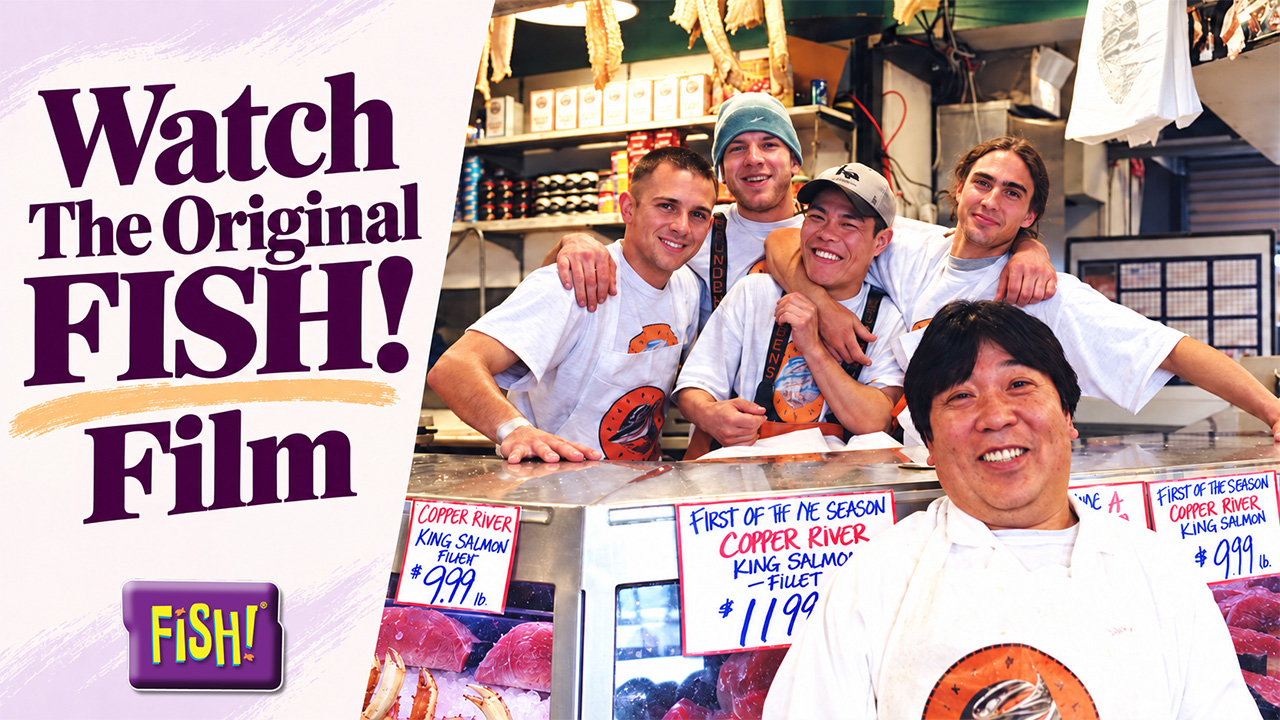
The FISH! Philosophy video began with a filmmaker, a crowded Seattle market, and a question about why one fish stand felt so alive.
John Christensen, a filmmaker with ChartHouse Learning and the creator of the FISH! Philosophy, was in Seattle working on another project when he wandered through Pike Place Market. He heard a commotion and noticed a crowd gathered three or four people deep around a fish stand. Salmon were flying over the counter, fishmongers were calling out, and visitors were laughing.
Christensen watched for a while, trying to understand what he was seeing. Then he asked a fishmonger named Shawn what was going on. Shawn asked whether John had eaten lunch and whether the waiter had connected with him or simply taken his money. Then he looked at John and said, “This is our moment. How may I serve you?” The question changed what Christensen saw. The fishmongers were not only putting on a lively show; they were giving their full attention to the people in front of them.
Christensen spoke with owner Johnny Yokoyama and learned that the crew had once made a shared decision to become “world famous.” They chose to enjoy their work, connect with customers, and create a different kind of fish market. Christensen returned with a film crew, and that visit became the FISH! film.
The idea traveled well beyond Seattle. As The Seattle Times reported, “It was at a weekly staff meeting that one of Pike Place Fish Co.’s fish throwers first suggested, ‘Let’s become world famous.’” The article also described how companies began using the film to discuss motivation, teamwork, and the experience people create at work. That same question still gives the film its pull: What could your team change about the way people experience your workplace?
What does Pike Place Fish Market have to do with FISH!?
Pike Place Fish Market is an open-air fish stand inside Seattle’s Pike Place Market. Visitors see fishmongers working with fish, ice, and customers for long hours in demanding conditions. They also see a team that brings energy, humor, creativity, and care to the job.
The market’s transformation was deliberate. The fishmongers had chosen to enjoy their work, connect with people, and make a difference to the people who came into contact with them. From those choices came a simple language teams could use in many kinds of workplaces. The four practices grew out of the way the fishmongers worked: staying present, choosing a helpful attitude, creating good moments for other people, and bringing playfulness and creativity to serious work.
The film has been translated into 20 languages and used across 32 countries. More than 80 percent of the Fortune 500 have used FISH!, showing how far the ideas have traveled from one Seattle fish market. The market is an example, though, rather than a script to copy. A hospital, school, office, or government department may have a very different way to bring the practices to life.
How does the film show the four FISH! practices?
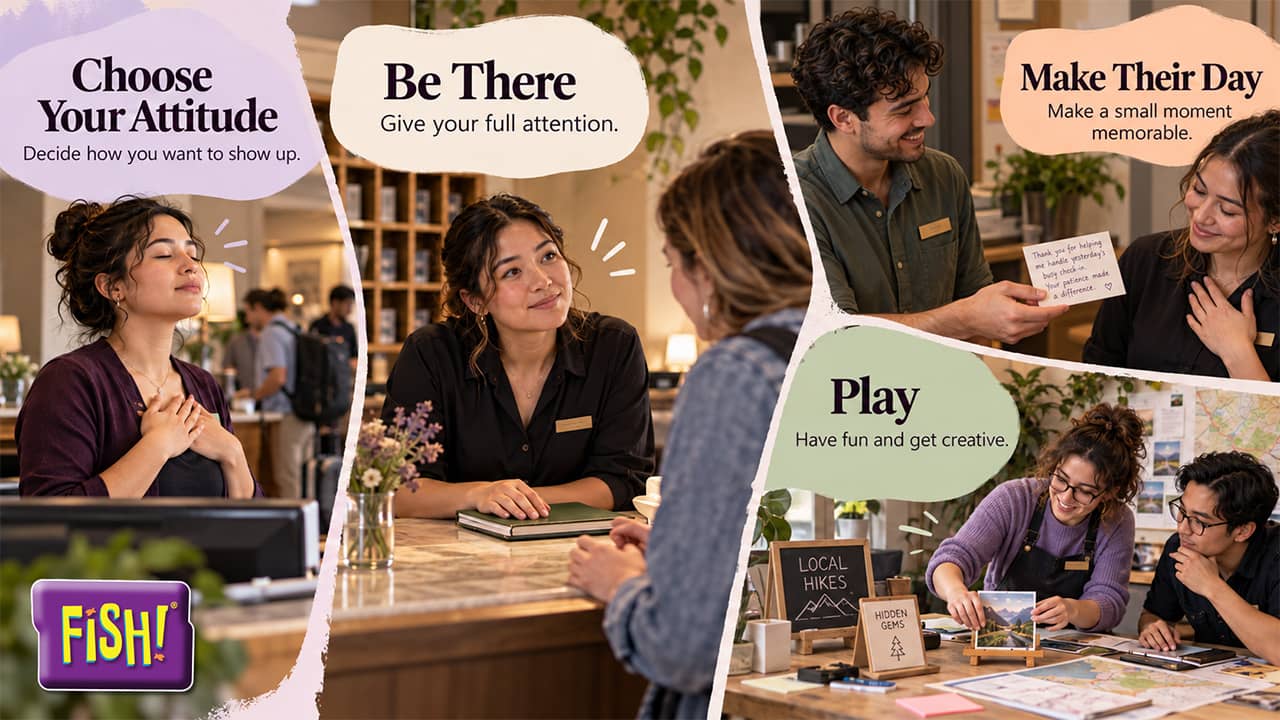
Choose Your Attitude
The film shows that people do not control every event, but they can choose how they respond. A difficult morning, a tired customer, or a stressful task may still happen. Choose Your Attitude gives people a way to pause and decide how they want to show up. It asks each person to take responsibility for the energy and behavior they bring into the moment.
Be There
Be There means giving another person your full attention. At the market, that may mean looking at a customer, listening carefully, or setting distractions aside. In another workplace, it may mean putting down the phone, closing the laptop, or slowing down long enough to hear a co-worker’s concern. When people feel seen and heard, trust and teamwork have room to grow.
Make Their Day
The fishmongers look for ways to leave people feeling better than they did before the interaction. Make Their Day can be a big gesture, but it often starts with something small: a warm welcome, a thoughtful question, useful help, or a moment of respect. Because Be There helps you notice what people need, it becomes easier to find a way to make a customer’s, patient’s, student’s, or co-worker’s day better.
Play
Play brings energy, imagination, and creativity to the work. The right kind of play helps people try new ideas and makes routine tasks more engaging. It should fit the setting and include the people around you. What works at Pike Place Fish Market may not work in your workplace, so each team has to discover its own playful, respectful approach.
How can different industries use the FISH! film?
Education
Schools can use the FISH! training video to open conversations about how teachers, office staff, leaders, and students experience the school day. Be There can shape the way adults listen to students and families. Make Their Day can inspire small acts of welcome and encouragement. Play can support creativity in the classroom and help staff bring fresh energy to routines, while Choose Your Attitude can help people think about how they respond during stressful days.
Healthcare and hospitality
Healthcare and hospitality depend on human interactions. A patient, guest, or family member may remember how a person made them feel as much as they remember the service itself. Teams can use the film to talk about being fully present, noticing needs, and creating a more caring experience.
Augusta University’s Jagwire described a medical-center FISH! training led by specialist Kimberly Hayes. Her advice was direct: “Be alert, be active. Don’t just come in and tune out.” She also encouraged staff to do something kind for a patient, student, or co-worker. Those examples show how the practices can support skilled care and service in a real workplace.
Business
Businesses can use the FISH! customer service video to start a practical discussion about teamwork, morale, customer relationships, and creativity. The film gives teams a shared language for talking about how they work together. Leaders can ask, “What would Be There look like here?” or “How could we Make Their Day in a way that fits our customers?” Those questions turn a memorable film into workplace actions.
A viewer who saw the film at work described that effect this way: “I saw the Fish video at work a few months ago, and I loved it. You have to be able to have fun during work, it makes me work harder. I’m so glad my supervisor thinks that way, makes the working day a good day :-))” The comment captures why the film often starts conversations about energy, effort, and the connection between enjoyment and performance.
Government
Government teams often serve people through complex systems, long processes, and high public expectations. The FISH! film can help employees discuss how presence, attitude, service, and creativity affect those interactions. Be There may mean listening without rushing. Make Their Day may mean explaining the next step clearly. Play may mean finding a better way to solve a problem, while Choose Your Attitude can help a team respond constructively when the work is difficult.
How do I use the FISH! film to train my team?
The film works best as the anchor for a facilitated session. Invite the group to watch it with a question in mind: What does this have to do with our work? After the viewing, ask what scenes, people, or moments stood out. This gives the team space to form its own conclusions and connect the story to its own experience.
From there, connect the conversation to the four practices. Ask where the team already sees Be There, Play, Make Their Day, and Choose Your Attitude. Then ask what each practice could look like in your setting. A customer service team might focus on a better welcome. A healthcare team might focus on presence during a difficult conversation. A school might focus on making students and families feel noticed.
The FISH! training programs include the guides and workbooks that support this process. FISH! Essentials and FISH! Complete provide the full film along with digital learning materials. The guides help a facilitator introduce FISH! as an invitation, lead discussion after the film, and move from ideas to practice. Workbooks give participants space to reflect, talk with one another, and choose an action to try.
A short session can include an introduction, the film, a group discussion, an activity, and a commitment for the week. Longer sessions can spend more time on each practice and use conversation starters, scorecards, and practice activities from the guides. The aim is to help people try the practices, talk about what they notice, and keep improving together.
What is in the free FISH! film preview?
The free preview runs 11 minutes and introduces the world-famous Pike Place Fish Market and the people who work there. You will see a busy open-air market where customers gather around the fish stand, fishmongers work together, and the atmosphere is full of movement, humor, and personal connection.
You will also hear the central idea of FISH!: the fishmongers choose how they show up at work. Selling fish can be cold, wet, tiring work, but the team has created a place where people enjoy what they do and help customers enjoy being there, too. The preview gives a feel for the full FISH! training video while leaving room for the longer film and the team discussion that follows it.
As you watch, notice the way the team pays attention to people, supports one another, and makes ordinary moments memorable. Those details point to Choose Your Attitude, Be There, Make Their Day, and Play. The preview is a useful starting point whether you are remembering the film or seeing the Pike Place Fish Market video for the first time.
Where can I watch the FULL FISH! Philosophy video?
The full FISH! film runs a little over 18 minutes and is included with every FISH! training program. Teams can access it by subscribing to the FISH! Essentials or FISH! Complete package. The upgraded FISH! trial also gives a team 30 days with the film and its digital guides.
Many people search for a free download because they saw the film years ago and want to show it to a team again. There is no free download of the full film. The options above give your group a way to watch it together and continue with the guides, workbook activities, and conversation that make the viewing useful.
How long is the FISH! film?
The complete film runs a little over 18 minutes. The preview on this page is 11 minutes, so you can get a quick sense of the story and the four practices before deciding how to introduce the film to your team.
Is the FISH! film available in other languages?
Yes. The FISH! film has been translated into 20 languages and used across 32 countries, so teams in many regions can explore the same ideas.
Can I download the FISH! Philosophy video for free?
The full film is not available as a free download. You can watch the 11-minute preview on this page, or access the complete film through FISH! Essentials, FISH! Complete, or the upgraded trial. The trial includes 30 days with the film and digital guides.
What does the FISH! film have to do with my workplace?
The fish market shows one team’s way of bringing the practices to life. Your team can choose its own ways to Be There, Make Their Day, Play, and Choose Your Attitude so they fit your customers, co-workers, responsibilities, and setting.
What should my team do after watching the film?
Talk about what stood out, connect the four practices to your daily work, and choose one small action to try. Then come back to the conversation and notice what changed. FISH! becomes useful through practice and shared reflection.
The FISH! film begins with a fish market, but its invitation is much wider: choose how you show up, pay attention to people, create better moments, and bring useful energy to the work. Start with one conversation and one small action your team can try this week. From there, keep practicing and see what becomes possible.
Try the FISH! Philosophy upgraded trial with your team. You’ll have 30 days of access to the FISH! film and digital guides so you can watch it together, discuss what it means in your workplace, and begin putting the practices to work.