
Work is shaped by more than a job description. An employee brings skill, time, care, judgment, and personal circumstances. An organization offers pay, responsibilities, relationships, opportunities, and a way of working. Those are some of the expectations that shape the employee experience—but they are not the whole story.
When employees and leaders carry different assumptions about what work should look like, quiet quitting can begin. The problem is not always that someone is refusing to work. Sometimes the role, the expectations, or the relationship has changed without anyone naming it.
The term quiet quitting can blur two different things: honoring reasonable boundaries and pulling back because the work no longer feels fair, meaningful, or sustainable. Leaders need to know the difference.
Work is more than a job description
Every job has some clearly stated elements: a title, pay, responsibilities, and schedule. It also includes less visible expectations about communication, availability, collaboration, initiative, growth, recognition, and what happens when priorities change.
These expectations are not fixed or identical for everyone. They may shift with a person’s life, the organization’s needs, the team’s stage of work, or a change in leadership. Some expectations are written down. Others are communicated through habits, examples, and what gets rewarded. Still others may never have been discussed at all.
That is where trouble often grows.
A manager may think, “I am giving her a chance to show executive potential.” while the employee may think, “I am being asked to be available every night.”
Neither person is wrong for wanting what they want. The problem is assuming that the other person must want the same thing—or that one set of expectations is automatically the definition of commitment.
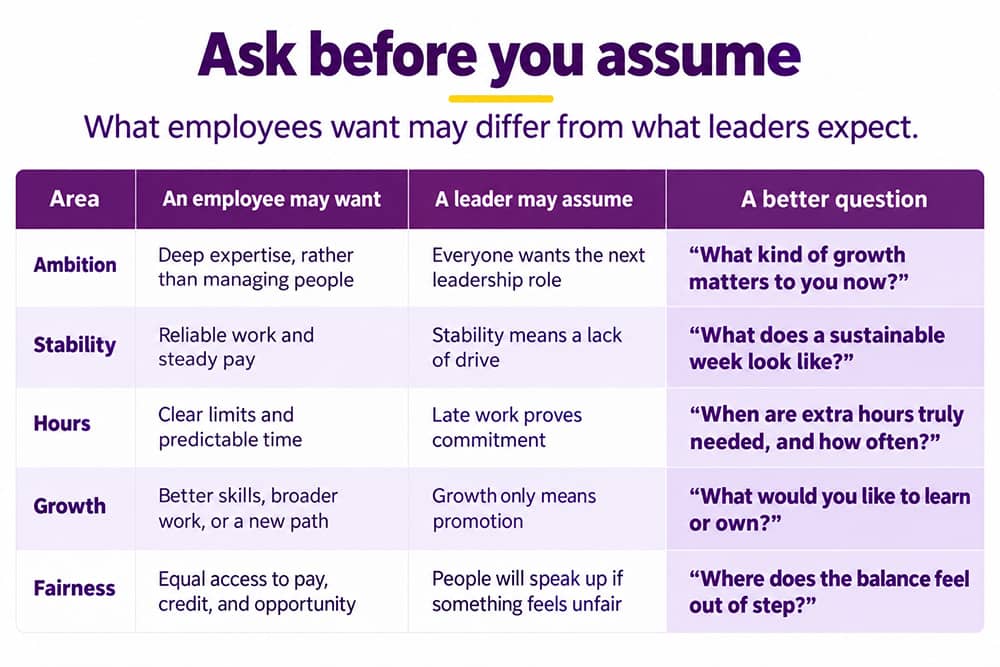
A strong workplace makes expectations visible enough for people to make informed choices—and flexible enough for people to revisit those choices when circumstances change. Clarity does not require leaders to predict every need or define every acceptable behavior. It means creating room for honest conversations about what matters, what is required, and what may be possible.
What is quiet quitting? Start with the real gap
The definition of quiet quitting is often fuzzy. It usually describes an employee who stays but stops giving energy beyond the basic role. In practice, the experience can range from healthy boundary-setting to genuine emotional withdrawal.
If an employee meets agreed goals, collaborates well, and signs off at the end of the day, that person may be working responsibly. Leaving on time is not proof of disloyalty. At the same time, an employee who was once engaged may begin to stop sharing ideas, caring about results, or imagining a future with the organization. That may be a sign of disengagement.
The useful question is not, “Is this person trying hard enough?” It is, “What has changed in the work, the expectations, or the relationship—and have we talked about it?”
Sofia was not unambitious. She had a different ambition.
Sofia was a mid-career operations specialist whose steady problem-solving kept projects moving. She also cared for an aging parent whose health needs could change with little warning.
Sofia wanted meaningful work, fair pay, and reliable hours. She was proud of the work she did. She did not want an executive job right then. She wanted to be excellent in a role she could sustain.
Her manager saw something else. He saw a future executive. He began inviting Sofia to evening planning calls, giving her high-visibility projects with unclear deadlines, and hinting that leaders “do whatever it takes.” When Sofia declined a late meeting or asked for a due date to move, he described her as unambitious.
That label hurt. Sofia had stayed late during urgent launches, trained teammates, and earned trust across the organization. Still, each request seemed to test whether she would put work ahead of everything else.
Over time, she stopped volunteering for special projects. She completed her work with care, but she no longer offered extra ideas in meetings. She stopped talking about the future. Her manager saw a drop in drive. Sofia saw self-protection.
During a one-to-one, her manager asked, “I may have been making assumptions. What do you want from work over the next year?” Sofia said she wanted a steady schedule, meaningful problem-solving work, and expert growth. She could stretch for a real emergency, but routine late calls would not work.
They reset the role for 90 days. He clarified the meetings that needed her, protected core hours, and created an expert-growth plan. He also admitted that the executive track would bring travel and less predictable time. Sofia could choose it later, but did not have to pretend it fit now.
Neither person was the villain. Their assumptions about the role had drifted apart, and some expectations had never been spoken aloud. A reset might create a better fit; it might also make a thoughtful exit the right choice. Both are better than letting resentment speak for them.
Ask about the working relationship before performance slips
A useful one-to-one is not a speech about culture or career ladders. It is a two-way check on fit, expectations, capacity, and what each person needs to do good work.
Try these questions:
- “What kind of work gives you energy, and what drains it?”
- “Do you want more responsibility, deeper expertise, more stability, or something else?”
- “What does a workable schedule look like for you?”
- “Which parts of the role feel clear, and which feel unclear?”
- “What feels unfair, difficult, or hard to sustain?”
- “What has changed in your work experience recently?”
- “Is there anything you need from me to do your best work?”
Listen for meaning, not just words. Do not correct the employee’s experience or promise what you cannot deliver. Say what you heard, explain what can change, and return with an answer.
Follow-through is what makes the next honest conversation safer. The goal is not to create a perfect list of expectations. The goal is to make it possible for people to discuss the expectations that matter most—and to recognize when those expectations no longer fit.

What does quiet quitting look like? Watch for a pattern, not a personality
The signs of quiet quitting are changes over time, not proof of failure. Look for several changes together:
- An employee who once brought ideas now speaks only when asked.
- Ownership, curiosity, or care has faded.
- The person avoids stretch work they once enjoyed.
- Communication turns into task-in, task-out exchanges.
- They stop discussing learning or future goals.
- They appear less connected to decisions or outcomes that once mattered to them.
Do not diagnose from a distance. A quiet week, a firm end-of-day boundary, or a preference for focused work is not enough to draw a conclusion. Consider changes in workload, recognition, management, personal circumstances, and role clarity before assigning a label.
Say what you noticed without judgment: “I have seen you participate less in planning. I value your view. How has work been feeling lately?” Then pause.
How to prevent quiet quitting by making expectations visible and fair
Prevention does not mean defining every part of employment or expecting constant enthusiasm. It means making the most important expectations visible, reasonable, and open to discussion.
Write down the real job
Clarify key outcomes, what can wait, and when extra effort is truly needed. If a role needs evening work at times, say so before it becomes a surprise. A rare push is different from an endless emergency.
Also explain what is flexible, what is essential, and how priorities will be reset when new work arrives. Employees should not have to guess which expectations are firm and which are simply habits.
Keep extra effort an exception
When someone finishes early, do not automatically reward speed with another pile of work. Recognize the result and ask what comes next. Extra effort can be meaningful when it is chosen, recognized, and connected to a real need. It becomes corrosive when it quietly turns into the new baseline.
Offer more than one form of growth
Skills, influence, mentoring, pay, project ownership, and specialist paths all count. Management is not the only sign of ambition. Ask what growth means to the person in front of you rather than treating a promotion as the universal answer.
Check fairness in plain view
Who gets high-profile work, late hours, flexibility, credit, coaching, and access to decision-makers? Inspect the pattern; do not wait for a risky complaint.
Respond to truth with action
Employees do not need every request approved. They do need to see a leader listen, decide, and explain. Sometimes the answer will be yes. Sometimes it will be no, because the role or the business has real constraints. A clear answer is more respectful than indefinite ambiguity.
When the honest answer is that the fit has changed
Not every mismatch can be fixed. A team may need travel, unpredictable hours, or a faster leadership path. An employee may need more stability, a different kind of growth, or a clearer boundary around work. Sometimes the work itself changes. Sometimes the person changes. Sometimes the relationship changes.
Naming this early is respectful.
Managers should not punish a person for naming limits or exploring another job. They should clarify priorities, document the work, and make a clean handoff plan when needed. An employee should also be honest about what they can and cannot sustain rather than silently withdrawing while hoping the organization notices.
A healthy working relationship is not one in which everyone wants the same things. It is one in which people can understand the important expectations, discuss differences, and make informed choices about whether the role still fits.
The goal is not to make every employee want more. The goal is to make it safe and clear for employees and leaders to talk about what “good work” means in this role, at this time.
Turn the conversation into daily practice with FISH!
The FISH! Philosophy can help leaders make this kind of working relationship feel real. It is not forced fun, fake cheer, or more work with a smile.
Be There means giving full attention when an employee talks about capacity, fairness, or changing priorities. Choose Your Attitude asks leaders to avoid cynicism and defensiveness. Play can mean testing a better handoff, schedule, or workload plan. Make Their Day means noticing useful effort before it becomes invisible.
These practices do not replace fair pay, enough staffing, clear roles, or honest conversations about limits. They make it easier to discuss those needs before silence becomes withdrawal.
Ready to move from good intentions to daily action? Sign up for the FISH! Philosophy upgraded trial at a discount—the original FISH! Film plus 8 actionable guides and training videos to jumpstart your culture transformation.

FAQ: Expectations, disengagement, and leaving well
How do you know if someone is quiet quitting?
Look for a lasting shift from that person’s normal pattern, not one quiet week or a firm end-of-day boundary. Notice reduced ideas, ownership, or connection alongside changes in workload, role, recognition, or management. Ask privately what has changed. A direct, respectful conversation will tell you more than a label ever can.
Why do employees choose quiet quitting?
People may pull back when extra effort becomes expected, growth feels closed, workload seems unfair, or feedback goes nowhere. Some are also setting reasonable boundaries after a hard period. Others may be responding to a role that no longer matches their needs or expectations. The response should be curiosity and clarity, not an accusation of laziness.
What is the best way to quit a job I hate?
The best way to quit a job you hate is to leave on purpose, not in anger. First, name what is unsustainable: schedule, workload, respect, pay, role, management, or the work itself. Write down what you need next. This turns “I hate this job” into a decision standard.
Next, decide whether a safe, direct conversation could help. Ask for clearer priorities, a workload reset, a transfer, a pay discussion, a defined schedule, or another specific change. Bring examples and make a clear request. If the answer is no, do not keep hoping for a ruled-out change.
Then make an exit plan. Review finances, update your résumé, reconnect with trusted contacts, and search privately. Keep company information private. If possible, line up savings or a next step before resigning. Follow your contract and workplace policy on notice. If the situation is unsafe, use formal support or safety channels.
When you resign, be brief and clear. You do not need to win an argument. Say: “I have decided to resign. My last day will be [date]. I will document my current work and help with a reasonable handoff.” Keep doing the agreed work through your last day. Do not use a long, hidden withdrawal as an exit plan.
For leaders, a resignation is feedback. Thank the person for being direct, learn without pressure, and plan the handoff with respect.
How do you manage quiet quitting in the workplace?
Start with the working relationship, not a label. Talk privately, listen without defending, clarify performance and hours, and look for fair fixes to workload, recognition, growth, communication, or role fit. Then follow through.
If the role and the person no longer fit, support a respectful transition rather than letting frustration spread. The goal is not to force more enthusiasm. It is to create enough clarity for both sides to decide what comes next.