Restaurant customer complaints rarely begin with one isolated problem. A slow order, poor food quality, or rude interaction may be the moment a guest speaks up, but the deeper cause can be the way employees feel at work. Furr’s Restaurants offers a useful example because its reported results connected morale with what customers said on a 1-800 line.
What problems was Furr’s Restaurants trying to solve?
Furr’s Restaurants faced low morale, high turnover, and unsatisfied customers. The company knew it had to address those problems soon, but it was not convinced that the usual motivational programs would help. Furr’s thought most motivational programs “simply didn’t work, or didn’t last.”
The company wanted a program that was not too hard to put in place. That matters for any restaurant company dealing with turnover and pressure because a complicated plan can lose energy before a team uses it. Furr’s needed something practical, and it needed it soon.
Furr’s then adopted the FISH! Philosophy, developed by ChartHouse Learning, and reported finding immediate true results. The philosophy centers on four practices: Choose Your Attitude, Be There, Make Their Day, and Play. They are not fixed steps; together, they give a team shared language for how people show up and how guests feel.
The clearest reported change appeared on the customer 1-800 line. The line went from 75% complaints to 75% compliments. Steve Barnhill, CEO, said checking the 1-800 numbers now made his day, and he wished he had known about FISH! three years earlier because he had no idea that this was possible.
That reversal does not erase the hard work behind service problems. Still, it gives restaurant leaders a strong question: What might customers be saying about the workplace employees experience every day?
Furr’s is one of many organizations whose results with the FISH! Philosophy have been documented. Its case stands out for the simple contrast: a line dominated by complaints became a source of compliments.
What causes most restaurant customer complaints?
Guests complain when the experience does not match what they expected. Common triggers include slow service, poor or inconsistent food, an incorrect order, a dirty dining area, confusing charges, or a dismissive employee. Online reviews add another layer because a guest can describe the whole experience after leaving.
A kitchen bottleneck may cause a long wait, but the complaint becomes worse when nobody explains the delay. A wrong order may be fixed quickly, yet the guest may still leave unhappy if the response feels defensive.
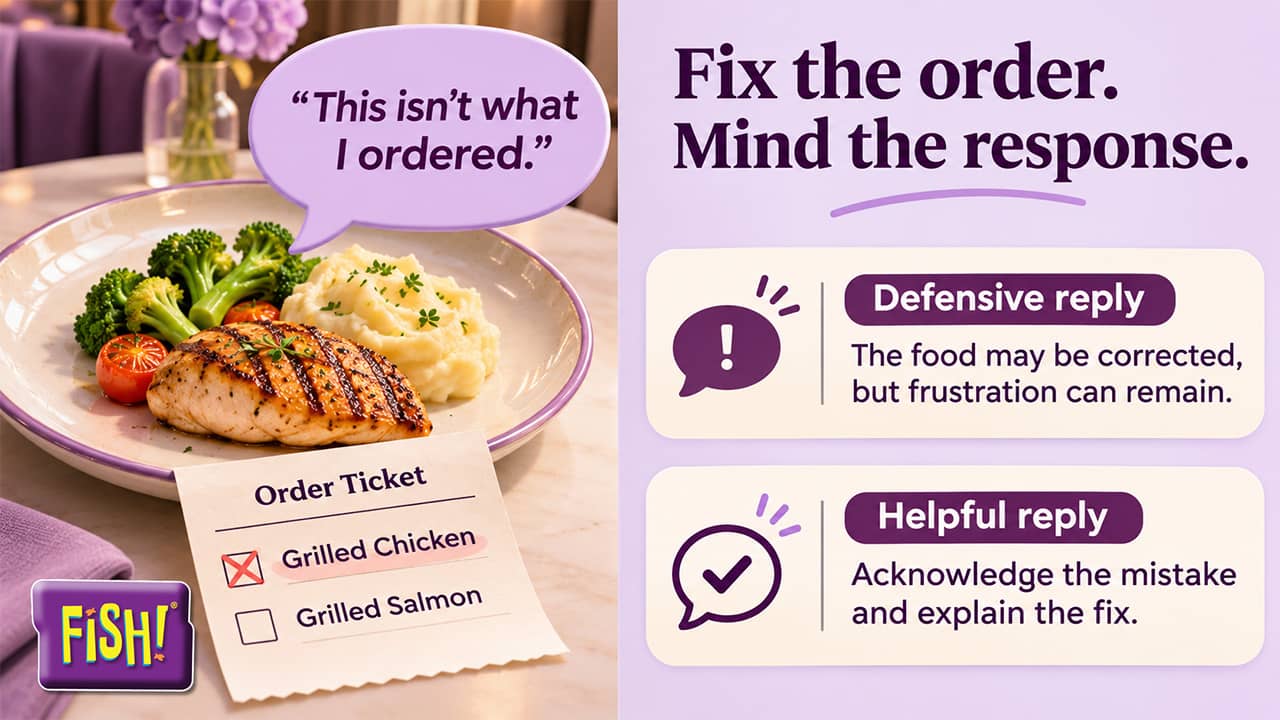
A wrong order can be fixed quickly, but the way the team responds decides how the guest feels when they leave.
Restaurant employee morale shapes those moments. Employees who feel worn down, unsupported, or disconnected from the purpose of their work may have less energy for eye contact, careful listening, and small acts of hospitality. A low-morale employee is not necessarily careless, and every complaint is not the employee’s fault; the guest experience reflects conditions behind the counter as well as the menu and dining room.
FISH! gives teams language for that connection. Choose Your Attitude asks people to notice the attitude they are bringing into a shift and to keep choosing how they will approach difficult moments. The practice recognizes hard days while inviting people to make a conscious choice, and leaders spread it by modeling that choice themselves.
How can a restaurant handle customer complaints better?
The first response should show that the restaurant has heard the guest. Be There means complete physical, mental, and emotional presence: giving attention, listening without preparing a rebuttal, and recognizing the feeling behind the words. A guest upset about a cold meal may also be upset because the group has been waiting or nobody seemed to care.
A useful service-recovery conversation has a few clear parts: listen without interrupting, acknowledge the problem, apologize when the restaurant fell short, explain what happens next, and follow through. If the employee cannot solve the issue, bringing in a teammate is better than making the guest repeat the story.
Be There also applies to the team member receiving the complaint. A manager who listens carefully can learn whether the issue came from training, staffing, equipment, communication, or a process that makes mistakes likely. When the team studies the complaint as useful information, it can spot patterns and improve the work instead of getting stuck in blame.
How can restaurants turn complaints into compliments?
A complaint can become a compliment when the guest sees that the restaurant took the concern seriously and made the next moment better. The goal is to repair trust through an attentive, fair, and sincere response.
Make Their Day helps explain the human side of service recovery. The practice means creating a moment that leaves another person better off by showing that their needs, efforts, choices, or presence matter. In a restaurant, that could be a thoughtful acknowledgment, a clear explanation, a sincere thank-you for bringing a problem to the team’s attention, or a small gesture that fits the situation and the restaurant’s standards.
The gesture should not be automatic or exaggerated. A guest who has waited too long may not want cheerful small talk; they may want an honest update and a solution. Making their day begins with Be There, because the right response depends on noticing what the person needs.
Play can support this work by giving employees room to use judgment and creativity within clear boundaries. A serious complaint still deserves care, while Play brings curiosity, energy, and problem solving to the response. The team can ask, “What would make this situation better?” and develop a thoughtful answer rather than relying on a script.
Those boundaries matter. A playful response should never embarrass, exclude, or target a guest or coworker. Be There keeps attention on the person in front of the team, Make Their Day keeps the guest’s experience in view, and Choose Your Attitude shapes the delivery.
How should restaurants use customer feedback?
A feedback line, survey, review site, or comment card becomes more useful when leaders listen for the human experience behind the score. Restaurant customer feedback can show where guests are struggling, and it can reveal where employees are creating moments people remember.
Patterns give feedback a practical starting point. Are complaints connected to wait times, food quality, cleanliness, order accuracy, or the tone of an interaction? Do compliments mention a specific employee behavior?
Discussing one or two themes helps the team respond thoughtfully rather than treating every comment as a separate emergency.
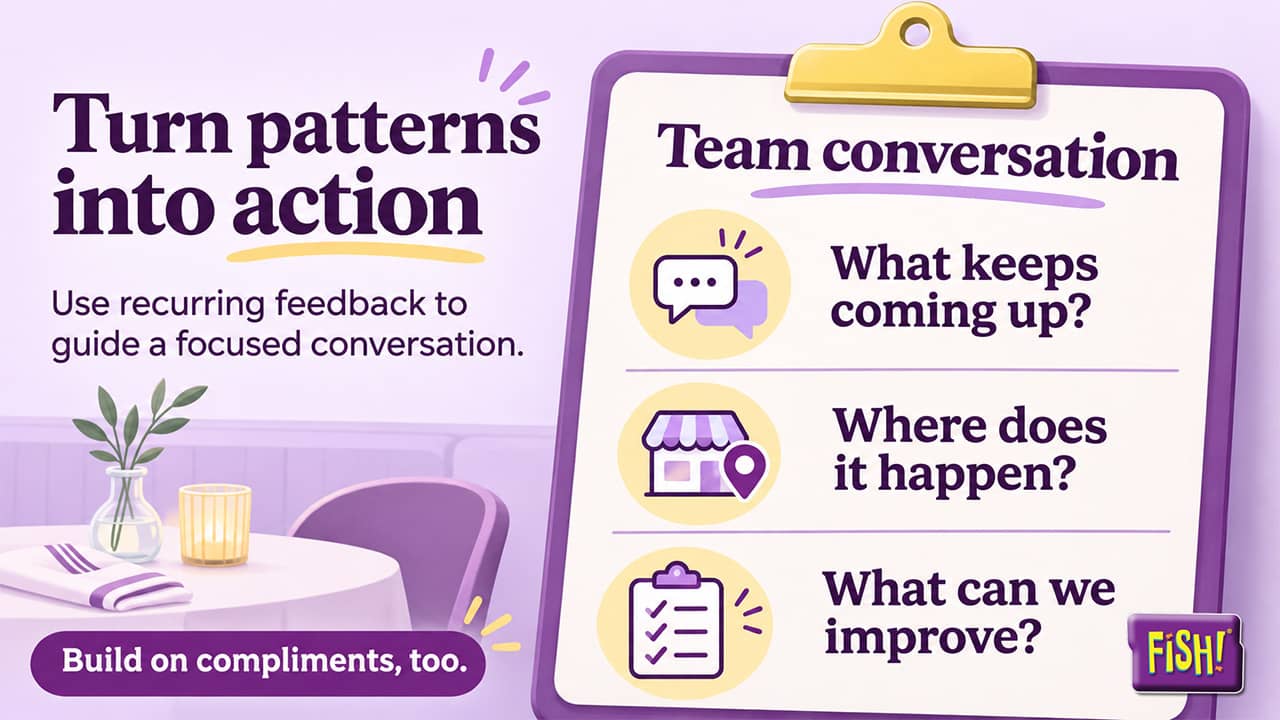
Recurring feedback gives a restaurant team a focused place to start, and compliments deserve the same attention as complaints.
Feedback should travel back to the people doing the work. Hearing only about errors turns it into another source of pressure.
Specific compliments, paired with the behavior that created them, turn customer feedback into recognition and a learning tool. That is Make Their Day inside the workplace: people know someone noticed what they did and why it mattered.
Leaders also need to be present with the feedback itself. Checking a number without reading or understanding the comments can hide the human experience behind the metric.
Furr’s experience shows the emotional power of that connection: Barnhill said checking the 1-800 numbers made his day after the line shifted from 75% complaints to 75% compliments. Other restaurants can apply the same lesson by pairing feedback review with a conversation about what guests and employees need.
Why do motivational programs fade, and how can teams keep them useful?
Many programs fade when they remain a launch event instead of becoming part of daily conversation. A meeting may create excitement, but the team still needs reminders, leaders who model the ideas, and permission to discuss what is working. Paperwork alone will not make employees see lasting value.
The FISH! practices stay useful when they connect to real restaurant moments. Before a busy period, the team might discuss the attitude it wants to bring; during a difficult interaction, a manager can model Be There. Specific thanks can recognize a teammate’s help, while Play can open a search for a better solution to a recurring service problem.
The practices do not erase staffing problems, poor equipment, or unclear policies. Good operations still matter, while the FISH! ideas help employees and leaders face those problems with more attention, ownership, and creativity. When leaders invite ideas and make it safe to learn from attempts, employees have more reason to speak up before a small problem becomes a customer complaint.
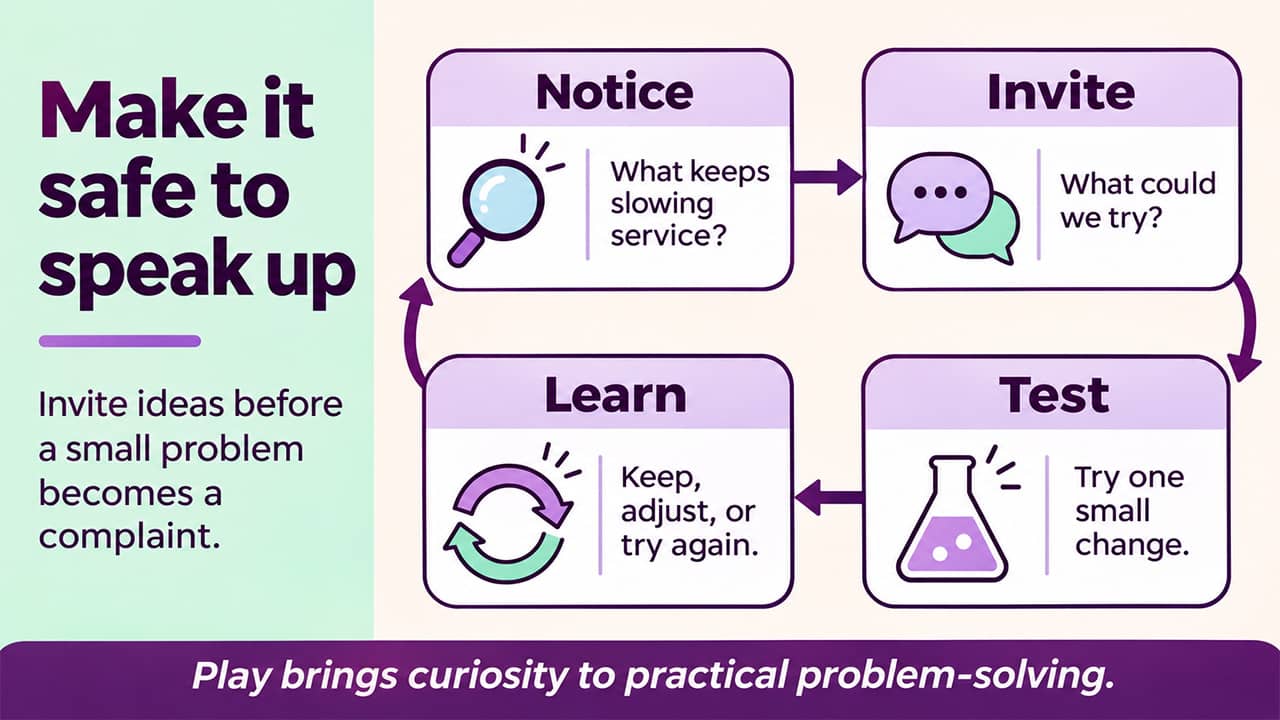
When employees feel safe to suggest a small change, problems can be solved before guests ever notice them.
The useful question is whether the workplace gives people a shared way to choose their response, listen carefully, notice what others need, and bring energy to solving problems. That is how morale can begin to show up in the guest experience.
A practical starting point for your restaurant team
Bring one recent customer complaint to the team without looking for someone to blame. Ask what the guest needed and where attention broke down. Then choose a small, safe experiment that could make the next similar moment easier or make the guest’s day better.
That conversation brings the four practices together without turning them into a checklist. It links customer complaints to the employee experience, the lesson at the center of Furr’s experience.
Try the FISH! Philosophy with your team
If your restaurant is working to reduce customer complaints and build stronger employee morale, try the FISH! Philosophy upgraded trial with your team. It gives your team 30 days of access to the FISH! film and its digital guides, so you can begin practicing Choose Your Attitude, Be There, Make Their Day, and Play in the real situations that shape the guest experience.

Frequently Asked Questions
Should every restaurant complaint be treated as valid?
Every complaint should be heard respectfully, even when the restaurant cannot agree with every detail or provide every requested outcome. Listening helps the team separate the guest’s experience from the solution it can offer, and that distinction supports better service recovery.
How can a restaurant train new employees to handle guest complaints?
Give new employees a simple response framework, then let them practice listening, acknowledging the concern, and getting help when needed. Training is stronger when managers model Be There and discuss why a response works, rather than asking new hires to memorize lines.
What should a manager do with an unfair online review?
Respond calmly, thank the reviewer for sharing the experience, and address the concern without revealing private information or arguing in public. The review can still be useful internally because it may point to a pattern or show how the restaurant’s response looked from the guest’s side.
How can a restaurant improve morale without a large budget?
Start with consistent attention and specific recognition. Leaders can notice useful work, listen to obstacles, share credit across shifts, and invite practical ideas, while also fixing the operational problems they can control.
How can a restaurant prevent repeat complaints?
Track recurring complaints by cause, not only by date or location, and assign a clear owner to the fix. After the change, check whether the guest experience improved and tell employees what changed so they can help keep the problem from returning.