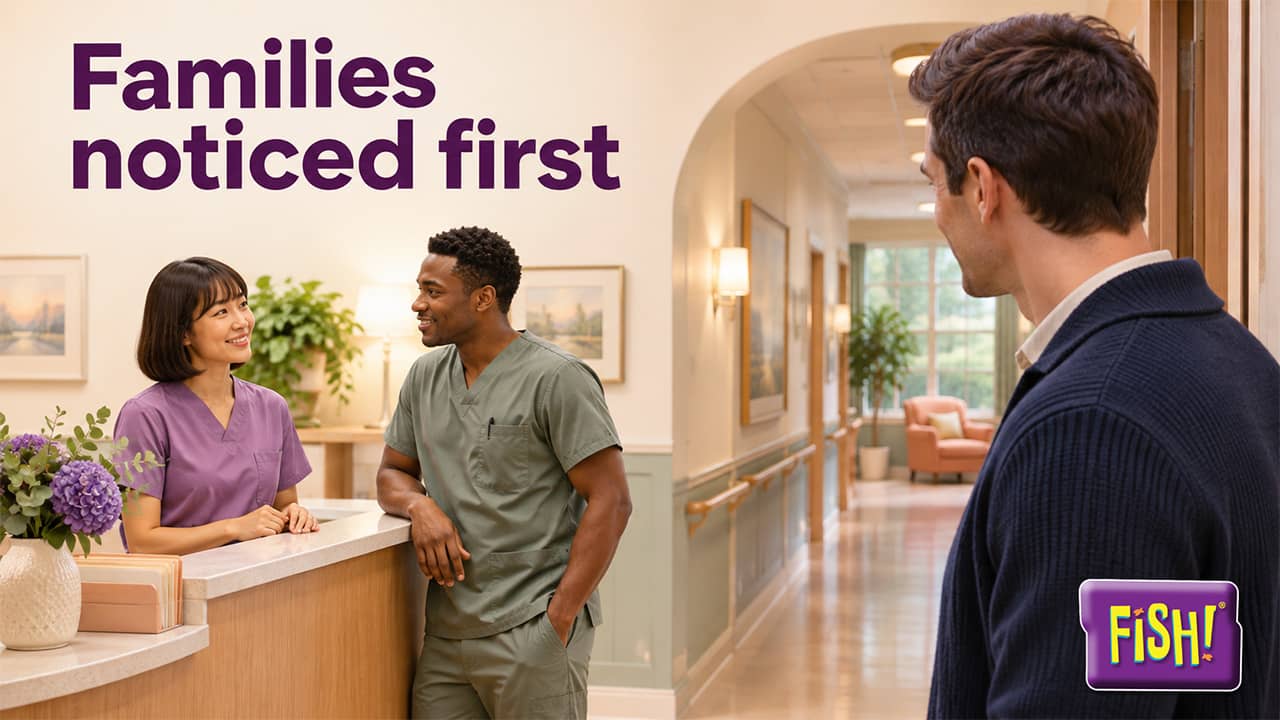
Nursing home staff retention is often discussed as a hiring problem. The Pines, a Genesis ElderCare nursing center, offers a different lesson: people may stay when the daily culture helps them feel connected to their work, their coworkers, and the people they serve. In a letter, Stacey Radcliffe, the center’s Senior Administrator, described how the FISH! Philosophy made what she called “an incredible impact” on the nursing home.
The story matters because staff stability affects more than a facility’s staffing report. Residents and families experience turnover through changing faces, disrupted routines, and relationships that have to be rebuilt. Research has linked nursing-home turnover with more inspection citations and lower quality scores, while the Centers for Medicare & Medicaid Services says longer-tenured nurses are more likely to know residents well enough to notice small health changes.
What changed at The Pines?
Radcliffe wrote that The Pines began its FISH! journey “nearly three years ago.” Before FISH!, the center “ranked in the mid to low range of 43 nursing homes in our region.” When prospective customers toured, they always commented on how friendly the staff was and how the building “resonates with positive energy.” The center reported that its annual customer service scores had “dramatically improved” and that it was “number two in the region.”
The letter also reported changes connected with surveys and retention. The Pines had its “first deficiency free annual survey (2002)” and received “only one E level deficiency this year.” Radcliffe wrote that state surveyors were interested in FISH! and that the center enjoyed explaining the philosophy to them.
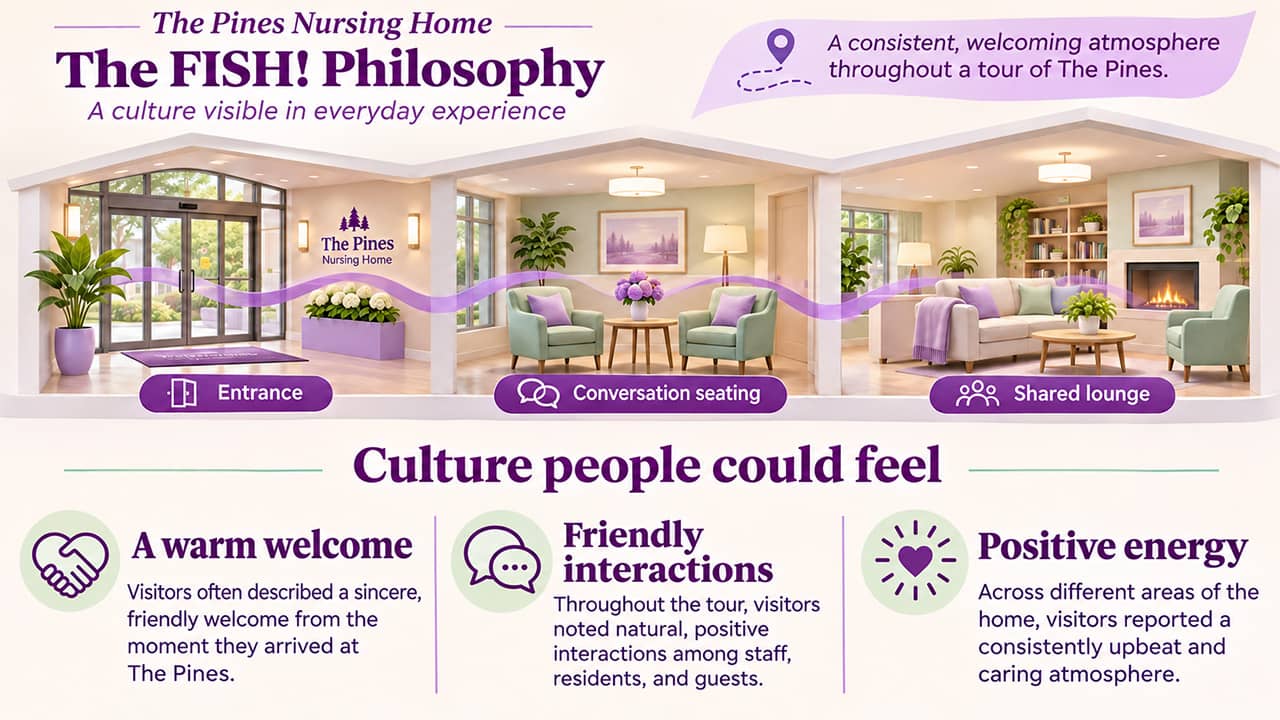
Prospective customers touring The Pines often commented on the friendly staff and the positive energy in the building.
Employee turnover had previously been at an average level for the industry. Since beginning the FISH! journey, Radcliffe said, turnover had decreased so much that The Pines had “some of the highest retention in the region.” She added that “some really great employees” had applied to come back because of what they were hearing about the center.
Radcliffe had been a nursing home administrator for fifteen years and had seen “many management theories come and go.” Her conclusion was direct: “nothing has ever worked for us like FISH!” She called the philosophy “simple, easy, and truly meaningful” and said it had renewed the commitment of her staff and herself to their customers, company, and industry.
The Pines is one of many organizations whose results with the FISH! Philosophy have been documented. Its account shows how workplace culture can show up in customer service, surveys, and employee retention.
Why does staff turnover affect residents and families?
A nursing home is built on repeated contact. Caregivers help residents with daily needs, notice changes, answer questions, and learn what comfort looks like for each person. Frequent departures mean new workers must learn the residents, routines, and unwritten details of the workplace, which can make consistent, person-centered care harder to deliver.
A 2021 study in Health Affairs found that nursing staff turnover was higher in lower-rated nursing homes and noted earlier research connecting high turnover with more rehospitalizations and more frequent use of physical restraints. A 2023 study in JAMA Internal Medicine reached a related conclusion: within a facility, higher nursing staff turnover was associated with more health inspection citations and lower assessment-based and claims-based quality scores. The findings give operations leaders and families a strong reason to pay attention to nursing home turnover while recognizing that many factors shape care outcomes.
The effect is also relational. Residents may have to repeat their preferences to new caregivers, while families may feel less confident when they do not know who is caring for a loved one. A stable team has more chances to build trust and recognize when a resident is not quite acting like themselves.
How can a nursing home improve staff retention?
Retention starts with the practical conditions of the job. Competitive pay, useful benefits, safe staffing, reliable breaks, and schedules that respect life outside work matter because care workers cannot build a lasting career around constant exhaustion or uncertainty. Flexible scheduling can support work-life balance when the organization, rather than individual workers alone, carries responsibility for filling gaps.
Autonomy matters too because caregivers are close to residents and often see problems before senior leaders do. Giving them a real way to raise concerns, shape improvements, and use their skills signals that their judgment has value. Training and career paths offer another reason to stay because employees can become more capable without leaving the organization to grow.
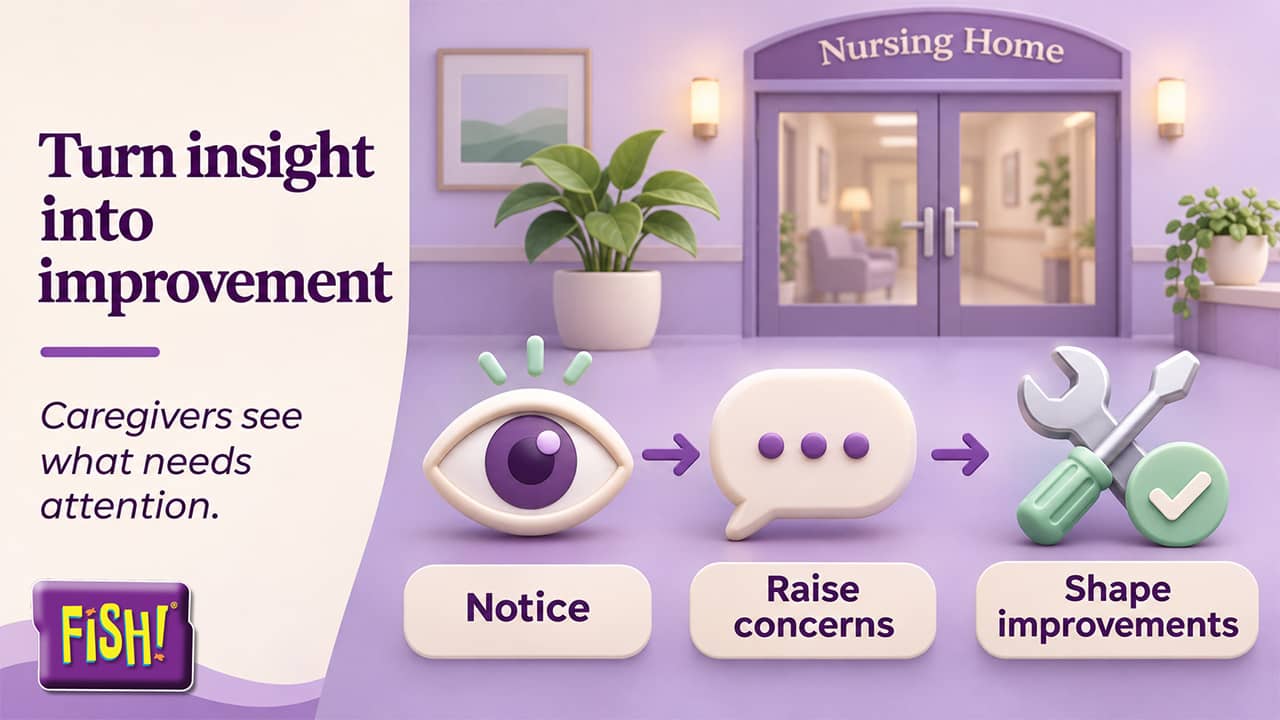
Caregivers often see problems first, so giving them a real way to raise concerns helps them stay and helps care improve.
A 2023 systematic review in Healthcare found that retention was supported by positive relationships with supervisors, peers, residents, and families; a cooperative culture; on-the-job training and career development; appropriate wages; injury prevention; and job stability. It linked turnover with understaffing, heavy workloads, stress, and low job satisfaction.
Employee retention grows from several connected conditions. Pay and benefits help bring people in, while scheduling, safe conditions, respect, training, and voice help people stay.
How can the FISH! practices support caregiver retention?
The four FISH! practices give a team a shared language for the human side of retention. Fair pay, adequate staffing, and safe policies remain essential, while the practices help leaders and employees make culture visible in the choices they repeat every day.
Choose Your Attitude begins with noticing the attitude a person is bringing into a shift and deciding how to approach the situation. A hard day can remain hard without turning the practice into an order to “fix” an employee’s attitude. Leaders set the example by acknowledging difficulties while choosing how they will show up, and a team can discuss how it wants to handle setbacks, criticism, uncertainty, and differences between coworkers.
That practice is useful in senior care because the work can be physically and emotionally demanding. A leader who stays steady under pressure, listens before reacting, and treats problems as real while still looking for a constructive next step creates a different signal from a leader who blames the nearest employee. The practice invites shared responsibility for the workplace people are creating, with room for honest difficulty rather than forced cheerfulness.
Be There means complete presence: physical, mental, and emotional. In a nursing center, that can mean putting attention on the resident, family member, or coworker in front of you; listening without preparing a defense; and noticing when another person needs support. For managers, it means making room for concerns and following through, even while protecting time for other responsibilities.
Presence also helps explain why culture becomes visible during a family tour. Families notice whether employees acknowledge one another, whether conversations feel respectful, and whether people seem engaged with residents. At The Pines, prospective customers commented on friendly staff and positive energy, giving other centers a useful question to consider: what would families notice when they walk through your doors?
Make Their Day turns ordinary interactions into meaningful moments by showing that another person’s effort, choice, and presence matter. In practice, that can include sincere recognition, a thoughtful thank-you, or support tailored to what a resident, family member, or coworker actually values. Specific, genuine recognition helps people feel that someone has noticed the contribution behind their work.
For retention, this practice addresses a common question employees carry: Does anyone see what I do? A caregiver who feels invisible may still care deeply about residents, but repeated lack of recognition can drain that commitment. Leaders can build the habit by noticing good judgment, patience, teamwork, and learning.
Play brings energy, curiosity, and room for people to be fully human at work. The practice keeps its place beside professional care by leaving residents’ needs and serious situations fully respected. In heavy work, Play may be as simple as allowing appropriate warmth, creativity, and shared enjoyment within clear professional boundaries.
This matters because teams need both energy and clear boundaries. The other practices help keep Play respectful and turn shared values into repeated behavior.
How can nursing homes tell whether culture is lasting?
A management idea becomes more than a passing fad when it changes decisions, conversations, and daily expectations over time. Leaders can ask whether supervisors model it and whether it shapes onboarding, recognition, coaching, scheduling, and responses to mistakes.
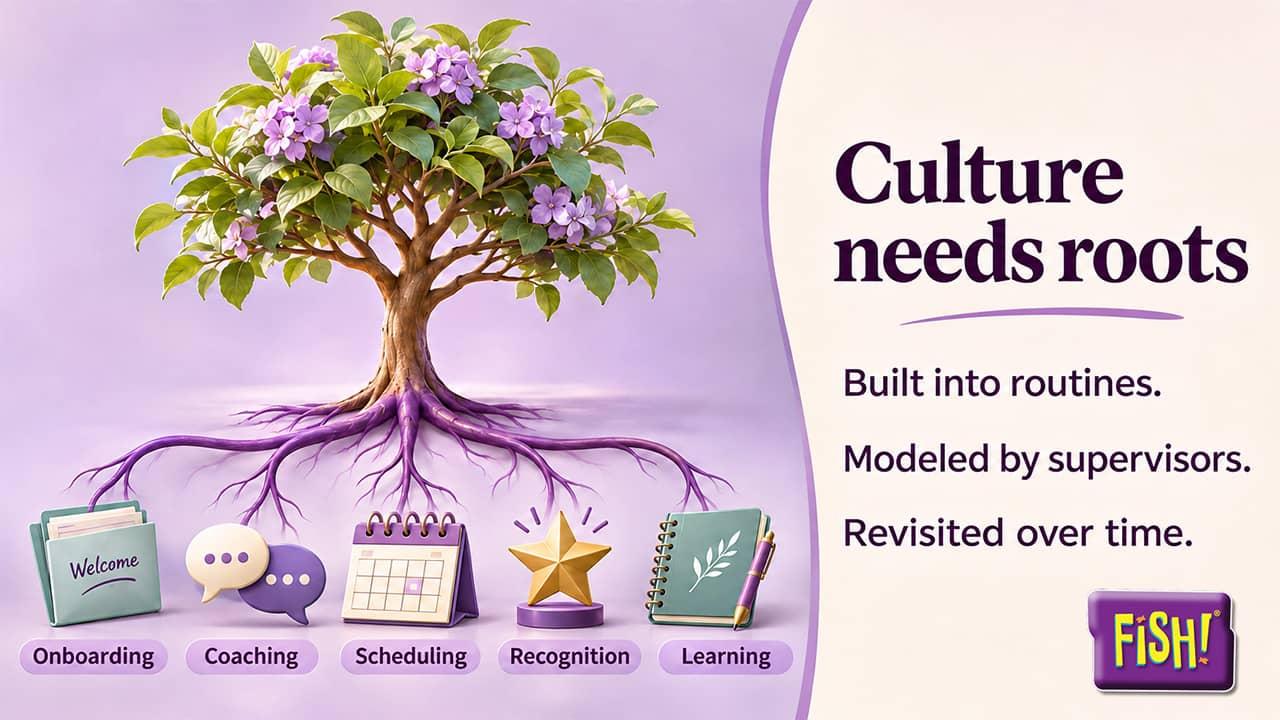
A culture lasts when it is built into routines, modeled by supervisors, and revisited over time.
At The Pines, FISH! was connected with customer service, a deficiency-free annual survey, and higher retention. A nursing home should track turnover, vacancies, absenteeism, overtime, survey findings, resident and family feedback, and employee experience.
The most useful approach is to combine measurement with listening. If turnover rises, leaders should look at pay, workload, schedules, staffing, training, supervision, safety, and culture together. Values become durable when daily operations give them regular support.
What can leaders learn from The Pines?
The Pines’ reported results suggest that nursing home quality and employee retention are connected to the experience people have while doing the work. Friendly service, positive energy, survey performance, and employees wanting to return all point toward a workplace that people experienced differently after the FISH! journey began.
For another long-term care team, the first step could be a simple conversation: What do we want residents, families, and coworkers to feel when they interact with us? From there, leaders can pair the answer with practical action—fairer schedules, stronger training, better listening, specific recognition, and a shared commitment to showing up with care.
Try the FISH! Philosophy with your team
If your nursing home is working on staff retention, resident satisfaction, or workplace culture in senior care, try the FISH! Philosophy upgraded trial with your team. It gives a team 30 days of access to the FISH! film and its digital guides, so you can begin a shared conversation and put these ideas into practice while connecting them to the working conditions your caregivers need.

Frequently Asked Questions
What is the difference between caregiver retention and nursing home staff retention?
Caregiver retention usually focuses on the people providing direct care, such as nursing assistants and other frontline workers. Nursing home staff retention can include those caregivers along with nurses, administrators, activities staff, and other employees whose stability affects the resident experience.
How can a nursing home support new caregivers during their first weeks?
New caregivers need clear training, practical support, and a way to ask questions as they learn residents’ needs and workplace routines. Early guidance can build confidence and relationships before the pressure of the job makes a new employee feel alone.
How can families evaluate staff stability in a nursing home?
Families can ask how the center tracks turnover, how it introduces new caregivers to residents, and how it handles continuity when staff members leave. They can also observe whether employees seem engaged, respectful, and familiar with residents’ preferences during a tour.
Does a deficiency-free survey prove that a nursing home has strong staff retention?
No. A survey is one important signal of nursing home quality, but it does not answer every question about employee experience or long-term stability. Leaders should consider survey results alongside turnover data, staffing patterns, resident outcomes, and feedback from employees and families.
What is one practical way to start improving retention?
Ask caregivers what makes them want to stay and what makes the work harder than it needs to be, then act on a small number of specific themes. A listening process works best when leaders report back what they heard, explain what will change, and keep the conversation going.