Direct support professional retention is a challenge for many human services organizations. The work can be meaningful, but it can also be tiring, emotional, and demanding. Rolling Hills Center offers one organization’s reported experience with a culture built around the FISH! Philosophy.
What did Rolling Hills Center report after adopting FISH!?
Rolling Hills Center is a 30-year-old program serving people with developmental disabilities. Chuck Prestwood, the center’s administrator, reported that the center had implemented FISH! about three years earlier. He wrote: “Turnover rates have dropped to less than 3% and staff morale is at an all time high in the 30-year-old program.”
He also described the center’s daily motto: “Work Made Fun Gets Done.” In his account, the motto was part of a “daily, ongoing environment.” Prestwood wrote, “My staff are excited, motivated and love to come to work. I’ve been able to stop seeking ‘motivational’ sources to excite my staff. Fish! Alone has done it!”
In other words, Rolling Hills Center reported turnover rates of less than 3% and staff morale at an all-time high after adopting FISH! Rolling Hills Center is one of many organizations whose results with the FISH! Philosophy have been documented. Its experience raises a larger question for any provider of developmental disability services: what can a workplace do to help support staff stay, feel valued, and bring energy to difficult work?
Why is it hard to keep direct support professionals?
Direct support professionals do work that asks for patience, judgment, flexibility, and care throughout the day. They may help with routines, communication, health needs, community life, or moments of distress. The work can be deeply rewarding, yet the emotional demands do not disappear just because the mission matters.
Retention becomes harder when employees feel worn down, underpaid, unseen, or unsure about their future. Unpredictable schedules can make personal life difficult, while training may cover tasks without preparing people for the emotional side of the job. A worker may care about the people they support and still leave when staffing, coaching, recognition, or room to grow fall short.
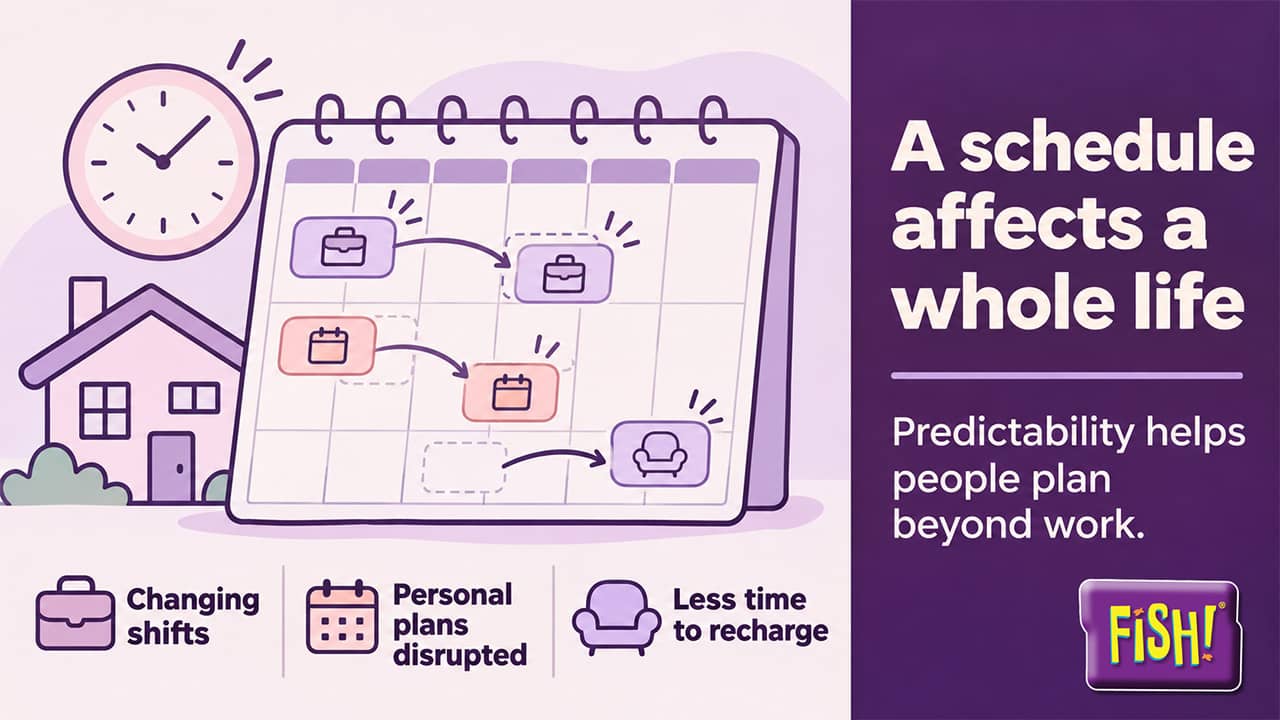
Predictable schedules help staff plan their lives beyond work, which makes the job easier to keep.
Strong DSP retention calls for more than a morale event or a motivational message. Pay and benefits matter, along with safe staffing, useful training, flexible scheduling, career paths, and supervisors who listen. Culture matters because the daily experience of work often decides whether a person can keep doing it for the long term.
The FISH! practices offer a shared language for that daily experience. Fair pay, adequate staffing, and sound policies remain essential; the practices help leaders and teams pay attention to how people treat one another while they solve those larger problems.
How can a workplace improve staff retention and morale?
Start with the parts of the job leaders can influence every day. A supervisor who notices effort, explains decisions, follows through, and makes time for conversation helps create a workplace where concerns can surface early. When staff trust that a concern will receive attention, they have more reason to speak up.
This is where Be There can guide supervision. The practice means complete presence: physical, mental, and emotional. For a supervisor, that can mean putting attention on a staff member’s concern, listening without preparing a rebuttal, and recognizing that the person in front of them matters.
A manager may have many responsibilities, so presence sometimes means protecting a specific time and place for an important conversation. The key is to give that conversation full attention when it happens.
For DSPs, being there also supports teamwork. A staff member may notice a coworker struggling after a difficult situation or shift, and a present team can respond with care, clear information, and practical support. That connection can reduce the isolation that feeds burnout.
How does recognition help DSPs stay?
Recognition works best when it is specific, sincere, and connected to the person’s real contribution. “Good job” may be pleasant, but “You stayed calm and helped the person feel safe when the plan changed” tells an employee that someone saw what happened and understood why it mattered.
Make Their Day gives leaders a practical way to build that habit. The practice is about creating moments that leave another person better off by showing that their effort, choices, and presence matter. A supervisor might offer a private thank-you, pass along a positive comment, or acknowledge a contribution that is easy to miss because it happens on another shift.
Recognition can be public when that suits the person, but private appreciation may be better for someone who dislikes attention. It should also sit alongside efforts to fix difficult working conditions; praise cannot solve a staffing problem by itself. Genuine recognition paired with action helps people see that their work has meaning and that they belong to a team.
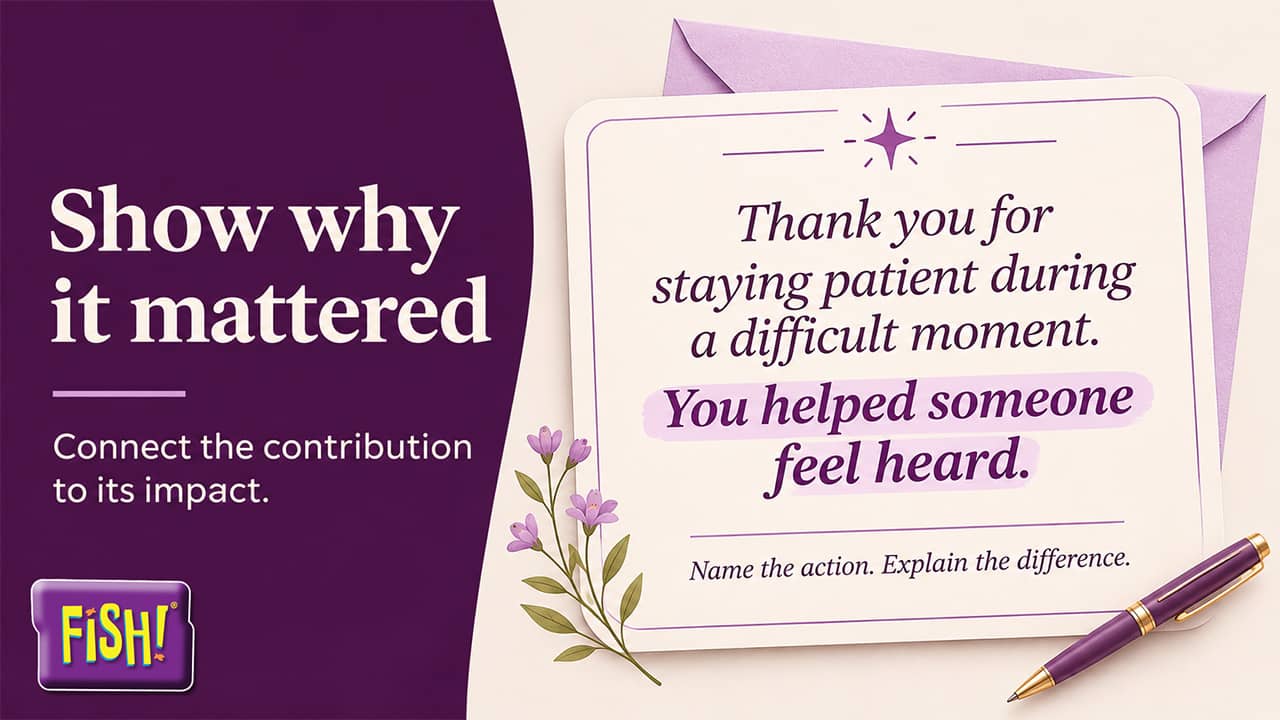
Recognition means more when it names the action and explains the difference it made.
Leaders can make recognition more reliable by looking for the behaviors they want to see. Notice patience, clear handoffs, respectful communication, creative problem solving, and care during an unexpected moment, then name the behavior and its impact. That practice gives workplace values a visible form in daily work.
Can fun at work really improve retention?
Support work can be serious and still include curiosity, energy, creativity, and warmth. Fun does not ask every employee to be outgoing or cheerful all the time; it gives people room to bring themselves to the work.
That is the role of Play. FISH! treats Play as a way of approaching work, so it can appear in a new solution, a warm interaction, or an experiment that makes a routine task more humane. A serious or quiet employee may show Play through creative problem solving or a better approach rather than through joking.
Leaders make Play possible by setting clear boundaries and allowing discretion within them. Staff need to know what is non-negotiable, especially around safety and quality, while still having room to suggest improvements, test small changes, and learn from an idea that falls short. When failed attempts bring blame, employees learn to stay silent.
A team can discuss its values and turn them into a practical “playing field.” The group can name behaviors that fit its values, identify what crosses a line, and clarify where staff may use judgment. As trust grows, the team can ask how its boundaries might expand.
These conversations help Play stay respectful and useful. Be There keeps attention on the people involved, while Make Their Day helps the team consider how its choices affect others. Together, the practices turn Play into a way to improve service and make the work more sustainable.
How can supervisors reduce burnout without asking staff to just be positive?
Exhausted employees need honest acknowledgment of hard conditions, dependable support, and a chance to influence what can be changed. They also need practical recovery: workable schedules, enough time to learn, breaks when possible, and supervisors who take concerns seriously.
Choose Your Attitude adds a personal and team-level practice without denying those realities. It asks people to notice the attitude they are bringing into a situation and decide how they want to approach it, both before a difficult task and again when plans change. A person might prepare for a demanding shift, recognize frustration after a hard interaction, and choose a response that protects the people involved.
The practice belongs to leaders too. Employees watch how supervisors respond to pressure, criticism, mistakes, and uncertainty, so a leader’s steadiness and honesty can shape the team’s response. Telling an employee to “fix” their attitude misses the point; Choose Your Attitude works as an invitation and a shared conversation about how people want to show up while facing real problems.
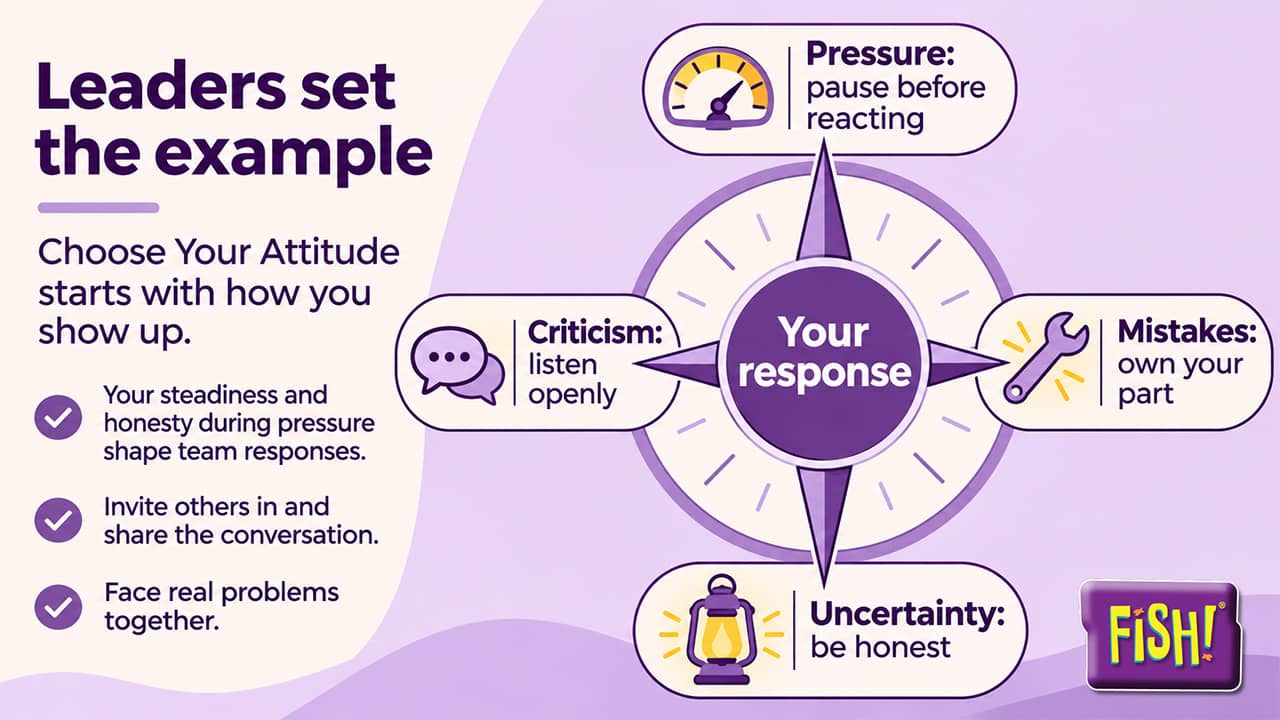
Employees watch how supervisors respond to pressure, criticism, mistakes, and uncertainty.
The other practices reinforce that choice in different ways. Be There creates the attention and support people need, Make Their Day shows that their effort is seen, and Play opens room for better ideas and humane responses. Together, they can help a team build emotional and psychological safety while leaders work on the concrete causes of burnout.
What else supports direct support professional retention?
Culture works best when backed by structure. Organizations seeking better DSP retention should look at the full employee experience, from the first week to the next career step. New employees need realistic training, a safe way to ask questions, schedules shared early enough to plan, pay and benefits that reflect the work, and a path toward roles such as lead, trainer, or coordinator.
Supervisors need support as well. Gallup’s State of the Global Workplace: 2026 Report found that manager engagement worldwide fell from 27% to 22% between 2024 and 2025. Supervisor training, manageable workloads, and regular feedback can give leaders more capacity to coach, recognize, and be present for staff.
Teams can also use simple listening practices. Ask what makes a shift harder, what helps people feel respected, and which training would build confidence. Then explain what will change, what cannot change yet, and why; honest follow-through builds trust.
Stable staff matter beyond the employees themselves. People receiving support benefit when familiar caregivers understand their communication, preferences, routines, and goals. Continuity can strengthen relationships and reduce the disruption that comes with constant turnover, so better retention supports both the workforce and the people at the center of the work.
A practical way to begin
Rolling Hills Center’s reported experience points to a simple idea: the way people experience work can shape whether they want to stay. A daily motto such as “Work Made Fun Gets Done” can focus attention on the culture a team wants to create, but that culture has to show up in everyday choices.
A team might begin by asking one question: Who do we want to be while we are doing this work? From there, staff can identify one way to be more present, one contribution to recognize, one small improvement to test, and one attitude that will help during a difficult part of the day.
Keep the conversation open, connect it to fair workplace practices, and return to it often. A workplace where people are supported, respected, noticed, and trusted gives direct support professionals more reasons to stay.
Try the FISH! Philosophy with your team
If your organization is working on direct support professional retention, the FISH! Philosophy upgraded trial gives your team 30 days of access to the FISH! film and its digital guides. Use that time to start a shared conversation about Choose Your Attitude, Be There, Make Their Day, and Play, then connect those ideas to the practical work of supporting staff and the people they serve.

Frequently Asked Questions
How can organizations make DSP training more useful?
Pair basic instruction with realistic situations, coaching, and time for questions after a new employee begins working. Ongoing training can also help experienced staff build confidence as the needs of the people they support change.
Why do career paths matter for direct support professionals?
A clear path shows employees how they can build skills and take on greater responsibility without leaving the field. Lead, trainer, coordinator, and other growth opportunities can make meaningful work feel more sustainable over time.
How can scheduling affect DSP retention?
Schedules influence whether employees can manage family responsibilities, rest, transportation, and other parts of life. Sharing schedules early, offering reasonable flexibility, and paying attention to repeated coverage problems can make the job easier to sustain.
How does staff stability help people receiving developmental disability services?
Familiar caregivers can better understand a person’s communication, preferences, routines, and goals. That continuity can support stronger relationships and reduce the disruption caused by frequent staff changes.