
Good bank customer service is more than a quick transaction or a friendly greeting. Customers want to feel heard, respected, and confident that the people serving them understand what they need. Firstar Bank’s Kansas City West Region offers a useful example because its leaders connected everyday service with a simple question: How should people show up for one another at work?
What did Firstar Bank’s Kansas City West Region change?
At one point, Firstar’s Kansas City West Region, composed of 19 bank branches in the Kansas City area, was one of the huge bank system’s five lowest producing regions. Just three months later, the region was one of Firstar’s five highest producers.
At first, some bankers questioned whether the FISH! Philosophy belonged in a bank. The approach is often associated with energy, fun, and the famous fish market in Seattle, while banking can seem serious and formal.
“Sure, there were questions about how FISH! applies to bankers,” says Pete Selenke, District Manager of the KC Region. “We talked about how they thought they could use the FISH! Philosophy and still be the ‘professional’ banker types we tell them they need to be.”
The region found that the energy of FISH! was not the whole point. Behind the fun were fundamentals that matched its vision of what customers should experience at a bank. Those fundamentals are expressed through the FISH! practices: Choose Your Attitude, Be There, Make Their Day, and Play.
Since introducing the FISH! Philosophy, the region’s customer service scores have risen dramatically. By focusing more closely on customer needs, employees also began uncovering new opportunities.
When the 119th Street office experienced staffing shortages, assistant manager Cindy Bridges stepped in to help as the drive-thru teller. She saw a high number of customers on a regular basis and began asking about investment referrals. Bridges’ commitment to “be there” for her customers—and to help her team when they needed her—led to an investment appointment and a $15,000 sale for one associate.
Firstar’s Kansas City West Region is one of many organizations whose results with the FISH! Philosophy have been documented. Its story is especially useful for branch teams because it shows how attention to customers can support both service and new opportunities.
What makes good bank customer service?
Good bank customer service starts with presence. A customer may be opening an account, asking about a loan, making a deposit, or using the drive-thru. The interaction becomes more useful when the employee keeps attention on the person and the need in front of them.
That is the heart of Be There. The practice calls for physical, mental, and emotional presence.
Physical presence includes eye contact and other signs that a person is ready to listen, while mental presence keeps attention on the conversation. Emotional presence means staying open when a customer is worried, confused, or sees a problem differently.
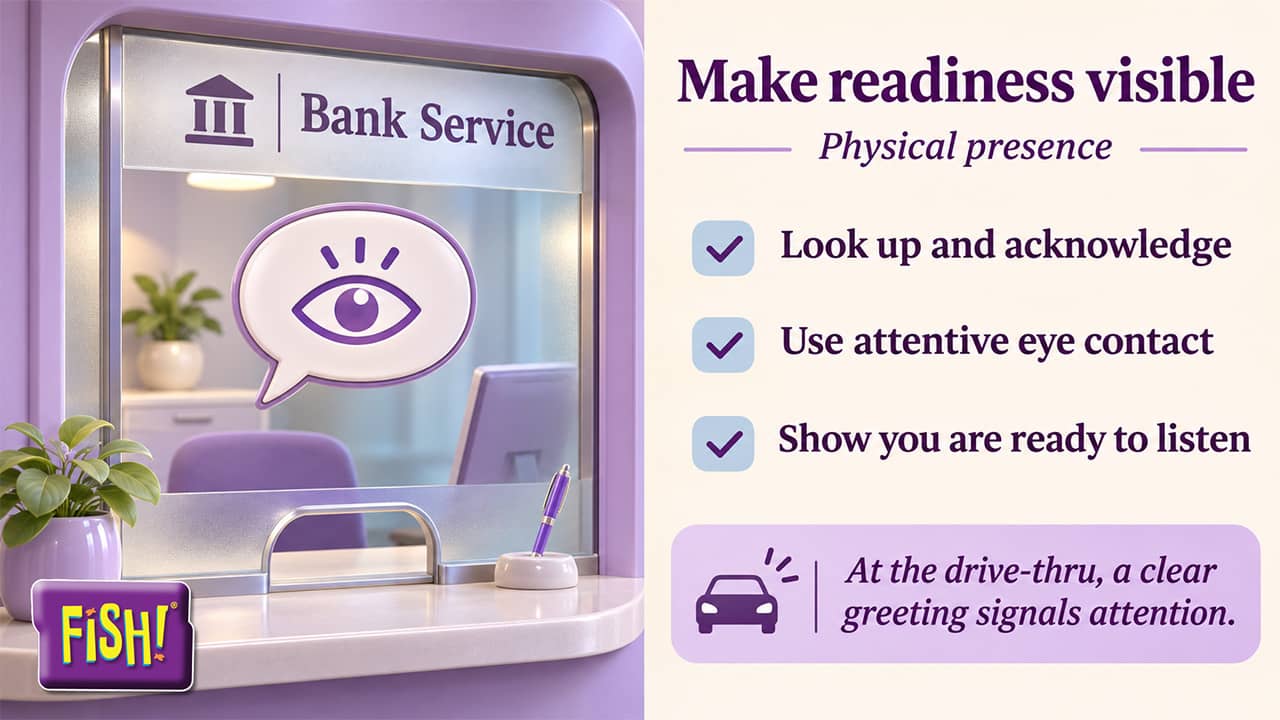
Physical presence is often the first thing a customer notices at the teller window or the drive-thru.
This matters in retail banking because money is personal. Customers want accurate information, along with confidence that their concerns are being taken seriously. A rushed answer may make a simple question feel like a burden, while careful attention can build customer trust even when the employee cannot give the customer everything they hoped for.
Branch managers can make presence part of the team’s daily language. After a difficult interaction, they can ask what the customer needed, what the employee noticed, and where attention slipped. Those questions help bank tellers and other branch staff notice the human part of each transaction without turning service into a script.
How can branch staff improve service without being pushy?
More helpful conversations begin with the customer’s needs rather than the bank’s products. Needs-based conversations sound different from a sales pitch because they start with questions and listening. The employee learns what the customer is trying to do, then explains an option only when it fits that need.
Cindy Bridges’ example shows how that can work. At the 119th Street office, she stepped in as the drive-thru teller during staffing shortages, saw a high number of customers on a regular basis, and began asking about investment referrals. Her commitment to be there for customers and her team led to an investment appointment and a $15,000 sale for one associate.
A branch team can apply the same idea without turning every interaction into a sales opportunity. Employees can ask a simple, relevant question when the moment is right, listen to the answer, and respect a customer who does not want to go further. They can also make a clear referral when another colleague is better prepared to help, keeping the customer’s needs at the center.
Choose Your Attitude supports this kind of service. It asks people to notice the attitude they are bringing into an interaction and choose how they want to approach it, even when the day has been difficult. A banker who resets after a tense conversation is more likely to listen well to the next customer.
Why does being there for customers improve the branch customer experience?
Customers often remember whether an interaction felt easy, respectful, and personal. They may not remember every detail of a product explanation, but they are likely to remember whether someone paid attention to their question and helped them take the next step.
Be There helps staff catch details that a transaction-only mindset can miss. A customer may be unsure about a form, worried about a deadline, or asking a question that points to a larger financial need. Careful listening gives the employee time to understand what the customer is actually asking before responding.
Make Their Day adds another way to strengthen the experience. The practice means creating a moment that leaves another person better off by showing that their effort, choice, or presence matters. In a bank, that might be a sincere thank-you, a clear explanation, or recognition that a customer has taken an important step; the gesture works because it is genuine.
The practice also applies inside the branch. A manager might recognize a teller for explaining a complicated issue clearly, while a teammate helps a colleague who is handling a difficult line of customers. These actions shape the service environment customers feel, even when they never see the work behind it.
How can branch managers improve service scores?
Service scores can point to patterns, but numbers alone do not tell a team what a customer experienced.
Managers can use the scores as a reason to have better conversations: Where are customers getting stuck? Which questions come up again and again? When do employees feel least able to give full attention? What would make the next interaction clearer?
The FISH! practices give those conversations a shared frame.
Be There turns attention and listening into topics the team can examine together. Choose Your Attitude helps employees decide how they will respond to pressure, criticism, or a difficult customer. Make Their Day brings focus to meaningful moments, and Play invites curiosity and creativity within clear boundaries so employees can look for better ways to handle unusual situations.
Play means bringing curiosity, energy, and creativity to the work while respecting the rules that protect customers. A team can ask how to make a confusing process easier to understand, improve a handoff, or help customers feel less anxious while they wait. Leaders should make the boundaries clear, then give employees room to suggest and test better ways to serve.
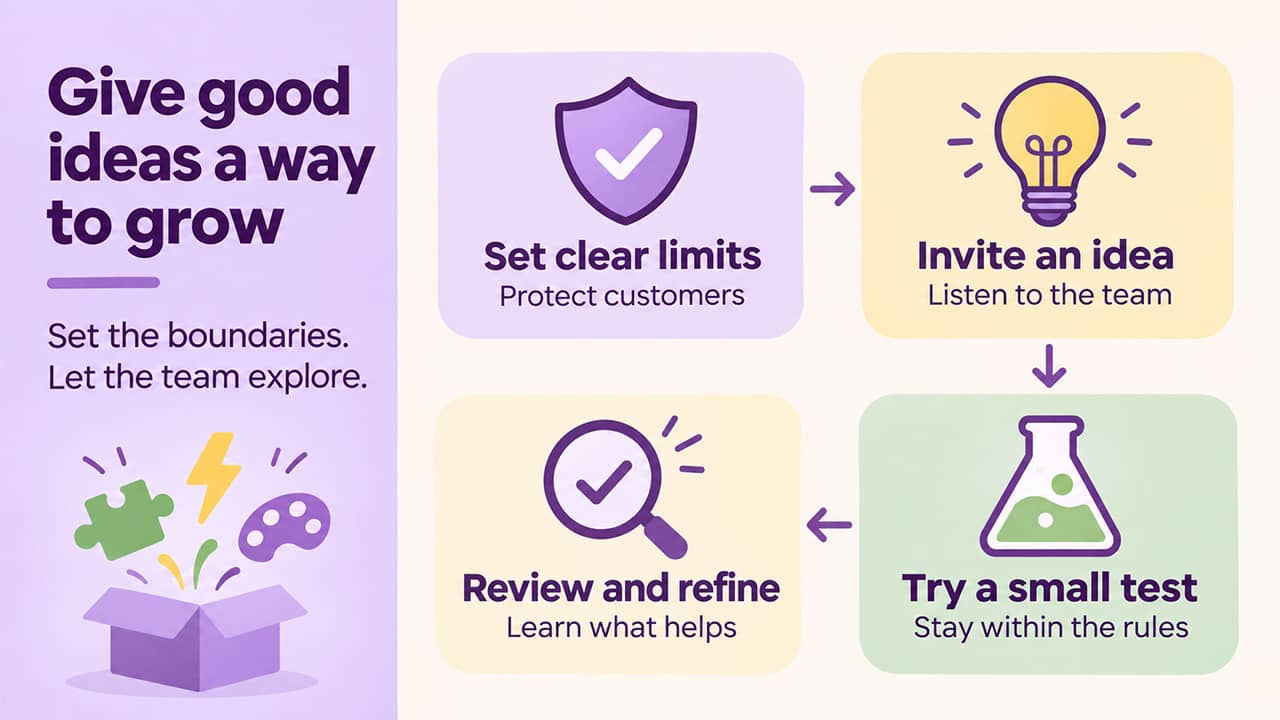
Clear boundaries give a branch team room to suggest and test better ways to serve customers.
Leaders bring the practices to life through their own behavior. A manager who listens carefully, recognizes effort, stays steady under pressure, and welcomes useful ideas shows the team what the culture looks like. Employees then have a clearer example to follow when serving customers.
What can banks learn from Firstar’s experience?
Professional service and human connection can reinforce each other. Firstar’s Kansas City West Region questioned whether FISH! fit a bank, then found fundamentals that matched its vision for customer experience. The region reported dramatically higher customer service scores and a move from one of Firstar’s five lowest producing regions to one of its five highest producers in three months.
For another branch team, the starting point can be small. Pick one customer interaction and practice complete presence. Ask one needs-based question with genuine curiosity, thank a coworker for a specific action that helped a customer, and invite the team to look for a better way to solve a recurring problem while staying within the rules that protect customers.
Those actions connect service to culture. They also make the idea practical for bank tellers, assistant managers, branch managers, and the wider financial services team. When employees pay attention to customers and to one another, the branch has a better chance to earn trust, find real needs, and create service that customers want to return to.
A simple way to start
Bank customer service improves when a team treats each interaction as a chance to be present, helpful, and sincere. Firstar’s story shows how professional standards can work alongside a more human way of serving customers. Try one small change this week: listen more closely, ask a useful question, or make someone’s workday better, then talk with the team about what you noticed.
Try the FISH! Philosophy with your team
If your branch wants a shared way to practice these ideas, try the FISH! Philosophy upgraded trial. It gives a team 30 days of access to the FISH! film and its digital guides, so employees can explore the practices together and start putting them into practice in customer service, team communication, and everyday work.

Frequently Asked Questions
How can a bank build customer trust over time?
A bank builds trust by being accurate, clear, consistent, and attentive across many interactions. Teams can strengthen that trust by listening to concerns, explaining next steps in plain language, and following through on what they say they will do.
What should a branch do when a customer is upset?
Start by staying present and letting the customer explain the concern without rushing to defend the bank. Acknowledge the issue, clarify what help is possible, and involve the right teammate when the question needs more expertise.
How can a bank balance digital service with in-branch service?
Digital tools can make routine tasks easier, while branch staff can help with decisions, questions, and situations that need personal guidance. A connected experience lets customers move between channels without having to repeat information at every step.
How can branch teams make financial information easier to understand?
Use plain language, explain one step at a time, and invite the customer to ask questions. Visual examples or a written summary of next steps can also help customers feel more confident after the conversation.
How can a branch encourage employees to suggest better ways to serve customers?
Leaders can make room for ideas, clarify which boundaries protect customers, and treat thoughtful attempts as opportunities to learn. Employees are more likely to speak up when they know a useful suggestion will be heard even if it needs adjustment before it works.