Jobsite safety depends on more than rules, equipment, and training. It also depends on whether people are paying attention to the work, to the people around them, and to the choices they make in the moment. Tile Tech Roofing Company’s experience shows what can happen when a construction company makes that human side part of its daily culture.
What was Tile Tech Roofing like before FISH!?
Before the company experienced FISH!, Tile Tech was a positive place to work, but people were not always connected. “Before we experienced FISH, Tile Tech was a positive place to work, but it was kind of like gears that just weren’t in sync,” said Vieselmeyer. Co-owner Bob Deaton described the old pattern this way: “You came to work with your game face on. You’d walk right into your office and start working. You wouldn’t even pay attention to the other people.”
The company introduced the FISH! Philosophy and FISH! Sticks. FISH! gives teams a shared language built around Choose Your Attitude, Be There, Make Their Day, and Play. Together, the practices invite people to think about who they want to be while doing their work and how their choices affect others.
How did FISH! change the workplace?
The change showed up in ordinary interactions. Director of Human Resources Heidi McCaig said, “Now when I come in ‒ I get here at six-thirty ‒ but it’s exciting and everyone’s saying ‘Good morning!’ and, you know, everybody gets each other energized.”
That kind of welcome can change how a crew begins the day. Choose Your Attitude asks people to notice what they are bringing into a situation and decide how they want to show up. Be There asks for physical, mental, and emotional attention to the work in front of you. Make Their Day turns attention into a helpful moment, while Play brings curiosity and creativity without treating work carelessly.
For Tile Tech, the practices reached beyond morale. The company used the learning program to increase safety, making job-site accidents “almost non-existent,” the company reported. McCaig connected that result to Be There: “I think ‘Being There’ was the biggest thing that affected the safety end, because daily they remind themselves ‘I have to be there and focus on what I’m doing’ and knowing that being unsafe is not going to make us World Famous.” In the FISH! story, “World Famous” points to the fishmongers’ vision of doing work in a way that people notice and value.

Tile Tech made the practices part of how people joined the company and how they grew there.
Tile Tech also made FISH! part of how people entered and developed at the company. “We use FISH! from the interview process to the performance review process,” said Vieselmeyer. Crew leader Dwight Lambert described his own change: “I used to be known as the grouchy old guy and maybe I had reasons to be,” he says, “but we all learn. They say you can’t teach an old dog new tricks, but maybe I’m the example that you can.”
Customers noticed a difference, too. After every job, Tile Tech surveyed the customer both to learn how well it had done and to find areas where it could improve. The recent scores were “astronomical.” After giving the company straight fours out of four, customers Ron and Marlene Frost said, “You have renewed our faith in the construction industry.” Tile Tech is one of many organizations whose results with the FISH! Philosophy have been shared, but its story offers a useful lesson for any construction crew: attention is a safety behavior, a people behavior, and a customer-service behavior together.
Why does attention matter so much to safety on a jobsite?
Construction work can change quickly, with moving materials, shifting conditions, tight timelines, and several people carrying out different tasks. A distracted worker may miss a change in the work area, overlook a coworker’s signal, or respond from habit rather than from what is happening now. Fatigue, stress, and rushing add to the risk.
Jobsite safety works best when formal systems and a strong safety culture support each other. Safety training, personal protective equipment, fall protection, hazard identification, safety meetings, toolbox talks, written safety plans, and compliance with applicable rules all matter. Attention helps people use those safeguards and speak up when the situation does not match the plan.
Be There gives a crew a simple way to talk about this human factor. Start with the body: notice where your eyes and attention are directed. Then keep the mind on the person, task, or condition in front of you, while staying open enough to hear a concern, correction, or warning without becoming defensive.
A crew can bring that idea into a safety meeting by asking: Where could our attention go today, and how will we bring it back? Everyone gets distracted, so the useful habit is noticing it early and making it acceptable for coworkers to help one another return to the work.
How can a construction crew build a stronger safety culture?
A safety culture takes shape through repeated actions. Crew leaders set the tone by showing that safe work, honest questions, and care for coworkers matter, while workers strengthen it by looking out for one another and treating concerns as useful information.
Choose Your Attitude can help, as long as leaders do not use it to tell someone to “fix” a bad attitude or ignore a real problem. It means noticing the mood and situation a person brings to work, then choosing how to respond. A leader can model calm attention during a setback, while a crew agrees on how to handle uncertainty, criticism, and changes in the plan.
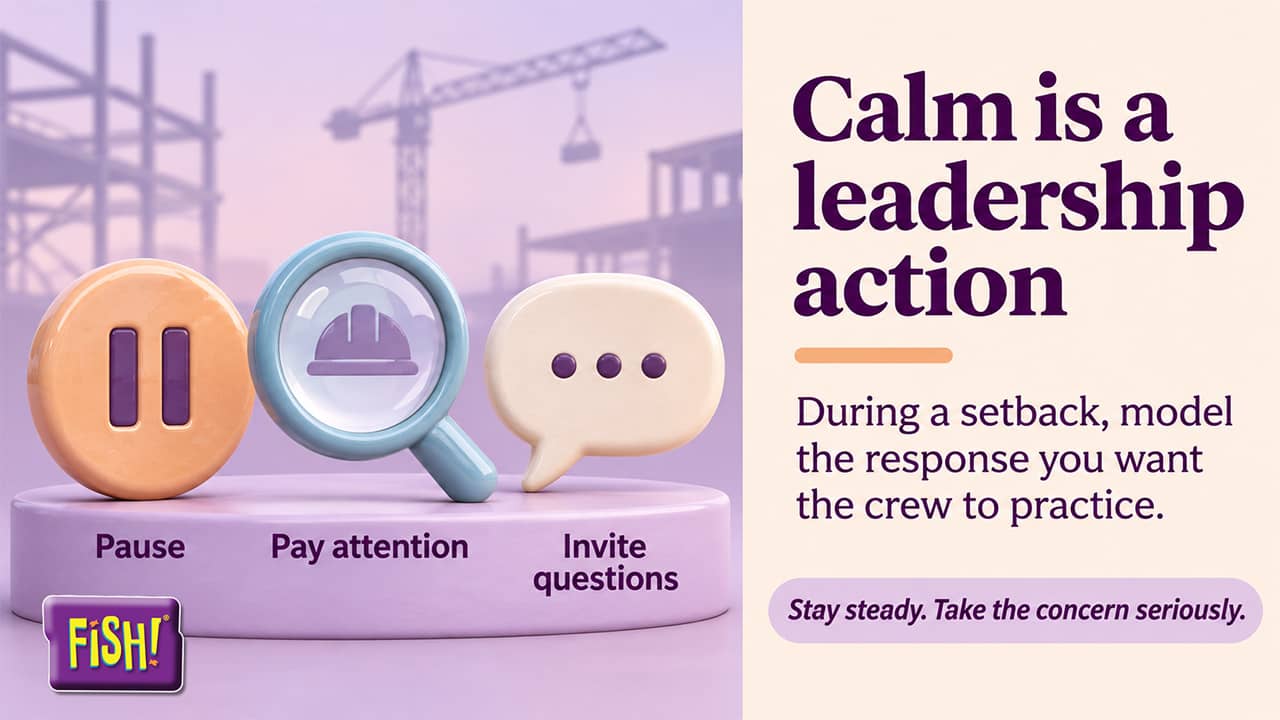
During a setback, crew leaders model the response they want the crew to practice.
Be There turns that agreement into behavior during a toolbox talk or safety meeting. Listen closely for what a coworker is noticing, then watch for signs that someone is mentally checked out, overloaded, or struggling to stay with the task. A question, a pause, or support from another team member may help; professional judgment and required procedures still guide the work.
Make Their Day adds the people side of safety culture through small, specific recognition. A thank-you for raising a concern, helping a new worker understand a task, or keeping a handoff clear tells the crew that these actions matter. The gesture works best when it is genuine and suited to the person, rather than turned into a quota or performance show.
Play also has a place when it stays within the boundaries of respect, safe work, and the team’s responsibilities. In FISH!, Play means curiosity, energy, and creativity, so it can encourage a crew to improve communication or solve a recurring problem. The other practices define the playing field: joking that distracts people or makes the job less safe is not useful Play.
What can contractors learn from Tile Tech’s customer surveys?
Customer feedback shows a contractor what the finished work feels like from the outside. A job may be complete, yet the customer may remember unclear communication or a moment when nobody seemed to listen. Regular surveys give the company a steady way to learn.
Tile Tech used the surveys to learn how well it did and where it could improve. The useful question is what the team can learn from feedback, not merely how it can defend a score.
Be There helps a contractor hear the customer’s experience without preparing a rebuttal, and Make Their Day keeps the customer’s trust in view. When feedback is difficult, Choose Your Attitude supports a constructive response; Play can then help the team look for a creative solution. Together, these practices connect customer service with construction safety.
The Frosts’ statement, “You have renewed our faith in the construction industry,” shows why this matters. Their words describe a customer relationship, while Tile Tech’s reported results belong to Tile Tech; other companies will need to learn from their own feedback.
The larger lesson is to ask customers what they experienced and use that information to improve.
How can a crew start improving jobsite safety through attention?
Start with one shared question: “Who are you being while you’re doing what you’re doing?” This FISH! question can guide a crew before work, during a safety conversation, or after a difficult interaction. It connects an attitude with a behavior that helps the team.
Next, choose one small practice to repeat, such as opening a safety meeting by asking what deserves full attention today. The crew can also recognize someone who looks out for another person. As Tile Tech did, a supervisor could add a culture question to an interview or performance review while still evaluating the skills required for the job.
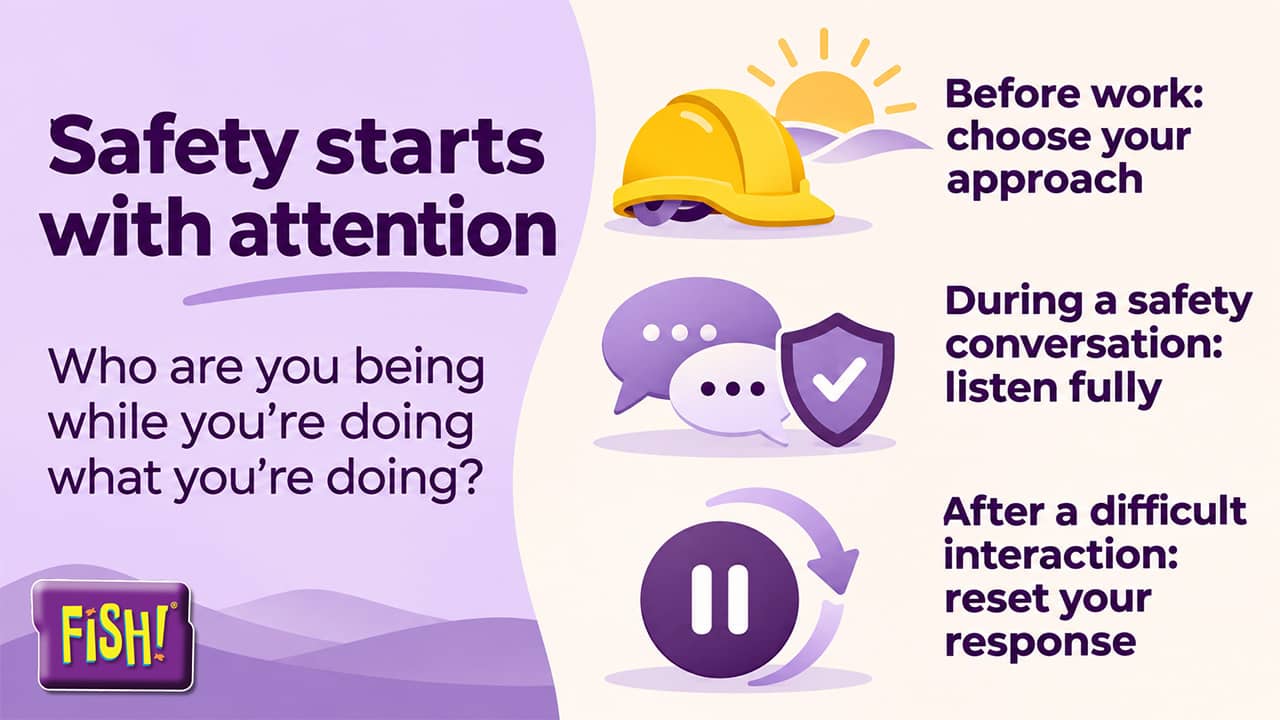
One question can guide a crew through the day: Who are you being while you’re doing what you’re doing?
Keep the conversation honest. Attention will not solve fatigue, poor planning, unsafe conditions, missing training, or equipment needs, but it can help a team notice those issues sooner and discuss them clearly. The strongest construction safety culture combines technical safeguards with people who stay present, speak up, listen, and improve.
A safer culture is built in moments
Tile Tech’s story begins with people who were positive but “weren’t in sync.” It continues with daily reminders to be there and focus, FISH! in interviews and performance reviews, customer surveys after every job, and a crew leader who saw that people can learn new ways of showing up. The company reported that job-site accidents became almost non-existent, and its customers reported a renewed faith in the construction industry.
For another crew, the first step may be ordinary: listen more closely in the next safety meeting, notice when attention has drifted, thank someone for helping a coworker, or ask what customer feedback can teach the team. Small actions become culture when people repeat them.
Try the FISH! Philosophy with your team
If your team wants to connect jobsite safety with attention, trust, and better customer relationships, try the FISH! Philosophy upgraded trial. It gives a team 30 days of access to the FISH! film and its digital guides so you can begin exploring the practices and putting these ideas into practice together.

Frequently Asked Questions
How can a company tell whether its safety culture is improving?
Look for patterns in what people do and discuss: whether concerns surface earlier, whether coworkers support one another, and whether leaders follow through. Formal safety measures still matter, but regular conversations and employee feedback can reveal changes in trust and attention.
What should a roofing company discuss in a safety meeting?
The discussion should cover the work’s required safety topics, conditions, hazards, and procedures, using qualified guidance for the specific job. A team can also ask where distraction, fatigue, unclear communication, or changing conditions could affect attention.
How can crew leaders encourage workers to speak up?
Crew leaders can listen without treating questions as disrespect, thank people for raising concerns, and show through their own actions that safety matters more than pretending everything is fine. Be There is useful as a shared language because it encourages leaders to hear the person and the issue instead of reacting only to the interruption.
What makes customer feedback useful to a construction team?
Useful feedback is specific enough to show what a customer experienced and what the team can improve. Contractors can look for repeated themes, discuss them without defensiveness, and turn the lessons into changes customers can notice.