




When repetitive work wears people down, leaders often ask how to improve workplace culture without pretending the work is something it is not. Sprint Global Communication Services offers a useful story about that challenge. Its call-center agents handled hundreds of short calls each day, yet the group changed the way work felt by giving people more room to learn, connect, and contribute.
A slogan cannot fix a hard job, but small changes in trust, coaching, attention, and meaning can change how people show up. Sprint’s story gives practical ideas for how to improve company culture when work feels repetitive.
What was happening at Sprint’s call centers?
Sprint Global Communication Services helped Sprint’s long-distance customers get connected around the world through more than 1,000 employees in seven call centers across the country.
The work was fast and repetitive. Call-center phone agents handled 500 to 800 calls per day, averaging about 30 seconds each. People learned the job quickly, so boredom could set in.
The culture sent its own signals. Casual dress was reserved for Friday, laughter in the office was generally a no-no, and retention was described as “an impossibility.” Sprint’s case study summed up the problem simply: it had a lackluster work environment, and customers knew it when they called.
The group set out to re-energize the culture, help phone agents “Be There” and stay focused on customers and colleagues, release pressure in a highly stressed work environment, avoid the “Flavor-of-the-month” syndrome, and increase retention.
What did Sprint change in its call centers?
Sprint used several practical changes rather than relying on one campaign. It drafted a new culture statement focused on the spirit of empowerment by “learning and growing from our experiences.” It announced a new dress code: “Don’t wear anything that could be a safety hazard.” It incorporated FISH! principles into regular coaching sessions and streamlined and humanized its monthly quality surveys with agents.
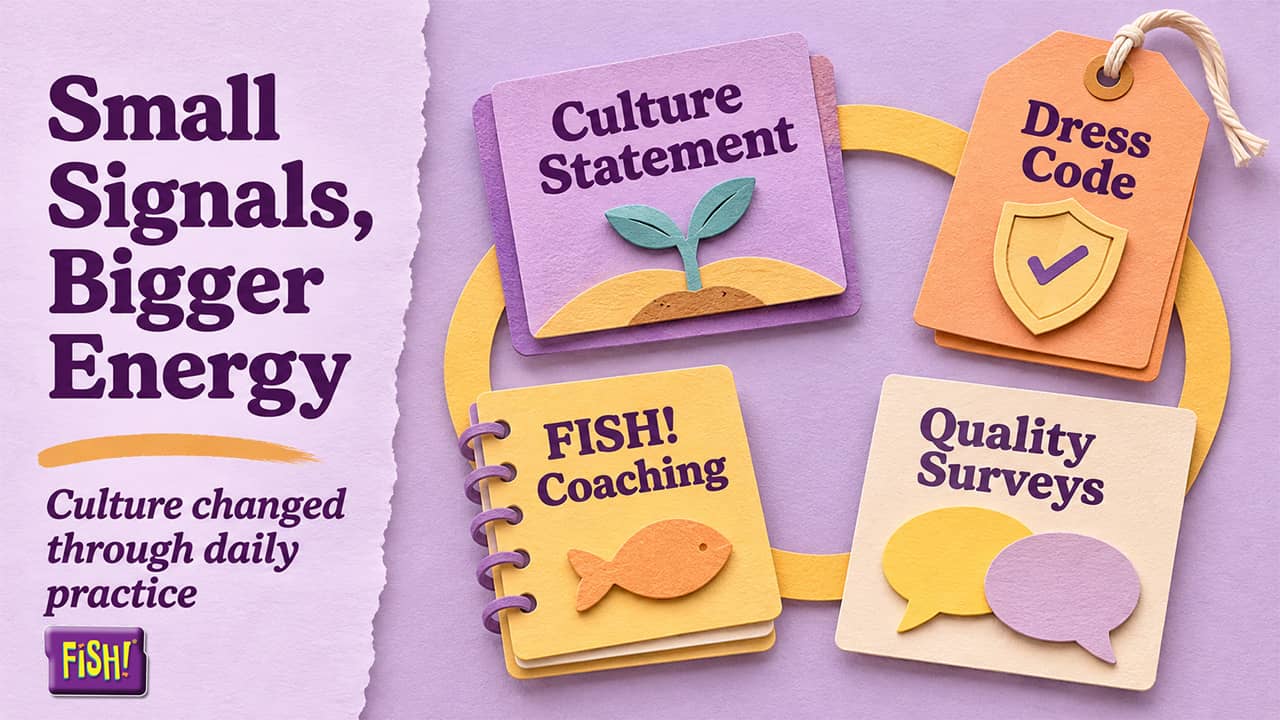
Sprint drafted a new culture statement, simplified its dress code, brought FISH! into coaching sessions and humanized its monthly quality surveys.
These changes altered the daily experience. A culture statement pointed toward growth, the dress code kept a safety boundary while removing a visible sign of control, and human quality surveys made monitoring feel more like a conversation.
The personal meaning of the work also became clearer. Rhonda, a call agent, described one emergency:
“An elderly woman had fallen and couldn’t move. Somehow she got connected to us but she couldn’t dial 911 or tell us where she was. Another agent and I spent 30 minutes trying to get her help. One of us talked to her to keep her calm. The other made long-distance calls to the police and fire departments in her area. Finally we figured out where she was. The police had to break her door down. I know we helped save a life. When I went home that night, I knew I was doing worthwhile work.”
Sprint reported that renewed agent commitment transformed the call centers into places where you could “hear the smiles in the agents’ voices.” Agent teams regularly took initiative to propose ways to improve call-handling efficiencies and customer satisfaction. The first-year retention rate jumped 25%, and the four-year productivity rate increased 20%.
Sprint also reported that its VP of Service Operations adopted a new vision statement for all call centers: “We have fun working while delivering the ideal customer experience in consumer communications.” Mary Hogan, a manager with 37 years in the call-center business, said, “I’ve been in the call center business for 37 years and I’m living proof that you can change. The past few years have been the most energizing of my career.” Lori Lockhart, Director of Global Services, Sprint, said, “After introducing The FISH! Philosophy, our work environment is more positive and we’re exceeding our retention goals.”
Sprint is one of many organizations whose results with the FISH! Philosophy have been documented, but its story is especially useful for anyone trying to improve a call center culture without losing sight of the work customers need.
How to improve workplace culture when the work is repetitive
Separate the parts of the job that cannot change from the parts that can. A call may still last 30 seconds, but leaders can change how people learn, how they are heard, how much judgment they have, and whether their effort feels noticed.
Repetition becomes heavier when people feel watched but not trusted. A culture statement should be more than handbook words: leaders need to model it, explain it during change, and use it in decisions. If it is about learning, a leader’s response to a mistake should make room for learning.
Choose Your Attitude starts with noticing the mood a person is bringing, choosing how to approach the next situation, and making that choice again after a difficult interaction.
Leaders have to practice that choice in front of the team because they cannot demand an attitude they do not show themselves.
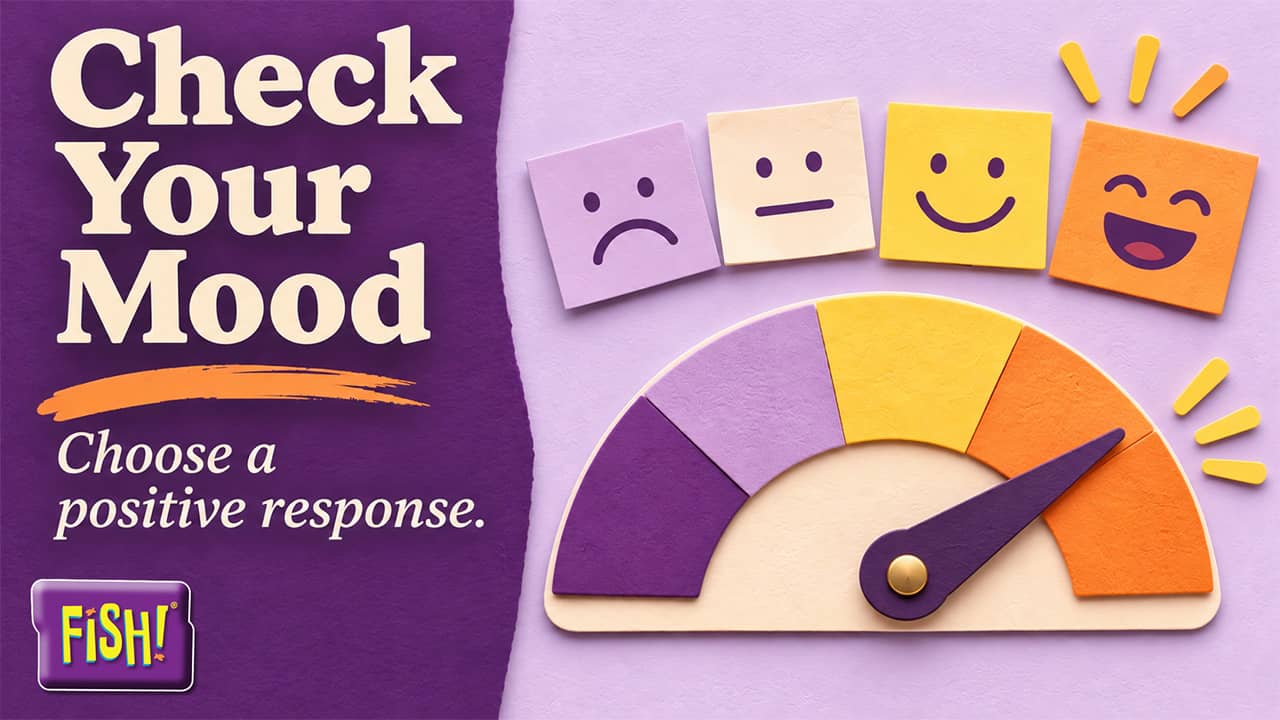
Choose Your Attitude starts with noticing the mood you bring and choosing how to approach the next call.
Why do small signals of trust change how people feel at work?
People read rules as messages about what an organization believes they can handle. A strict dress code may seem unrelated to customer service, but it can tell employees that appearance matters more than judgment. A simple safety rule can protect what needs protecting while leaving room for self-expression.
The FISH! practice Play helps explain this balance. Play brings curiosity, energy, and creativity to the way people work rather than asking them to treat work as constant entertainment.
It needs clear boundaries and permission to test, adjust, and suggest a better way. When trust grows, the playing field can expand.
Keep the rules that protect customers, coworkers, and the business, then question the ones that mainly show control. Teams can define values, describe behaviors that fit them, and decide where employees have room to use judgment.
How can coaching improve a call center culture?
Monitoring tells a person what happened. Coaching helps a person understand what to try next. Both can use the same customer interaction, but they create different experiences.
A quality survey that feels like a hidden test can make employees protect themselves. A survey that is human, specific, and connected to growth can help an agent learn.
Sprint’s case study says it streamlined and humanized monthly quality surveys and brought FISH! principles into regular coaching. For another workplace, that could mean asking what the employee noticed, what the customer may have needed, and what support would make the next call better. It could also mean reviewing patterns rather than treating one imperfect interaction as a verdict.
Be There is central here. It asks a coach to be physically, mentally, and emotionally present instead of forming a reply before the employee has finished speaking.
Leaders can also use surveys, forums, and stay interviews to listen for patterns. Listening only helps when the organization closes the loop by explaining what it heard, what it will change, and what it cannot change yet.
How do you make repetitive work feel meaningful in a call center culture?
Meaning does not always come from a dramatic mission statement. It can appear in an ordinary interaction when someone sees the effect of their work.
Rhonda’s story shows that a call-center agent may be doing much more than moving a transaction along. The work can matter because a person on the other end needs patience, judgment, and help.
The FISH! practice Make Their Day turns ordinary interactions into meaningful moments by showing people that their effort matters. Recognize a calm response, thank someone who helped a teammate, or invite a colleague to explain an improvement. Recognition works best when it is specific, sincere, and suited to the person; peer-to-peer recognition helps too.
Purpose grows when employees can see where their work leads. Career paths, mentoring, and new skills help people imagine a future at the organization. Inclusion matters too: people invest more when their voice and identity are treated as part of the workplace.
How can employee empowerment lead to better improvements?
The people closest to a process often see small problems before a dashboard does. A safe way to propose changes can improve the work and build ownership; removing all discretion may produce compliance without commitment.
Sprint reported that agent teams regularly proposed ways to improve call-handling efficiencies and customer satisfaction. For another team, the starting point could be a short monthly question: What makes this task harder than it needs to be? Leaders should respond with curiosity, test useful ideas, and explain why an idea cannot be used when that is the answer.
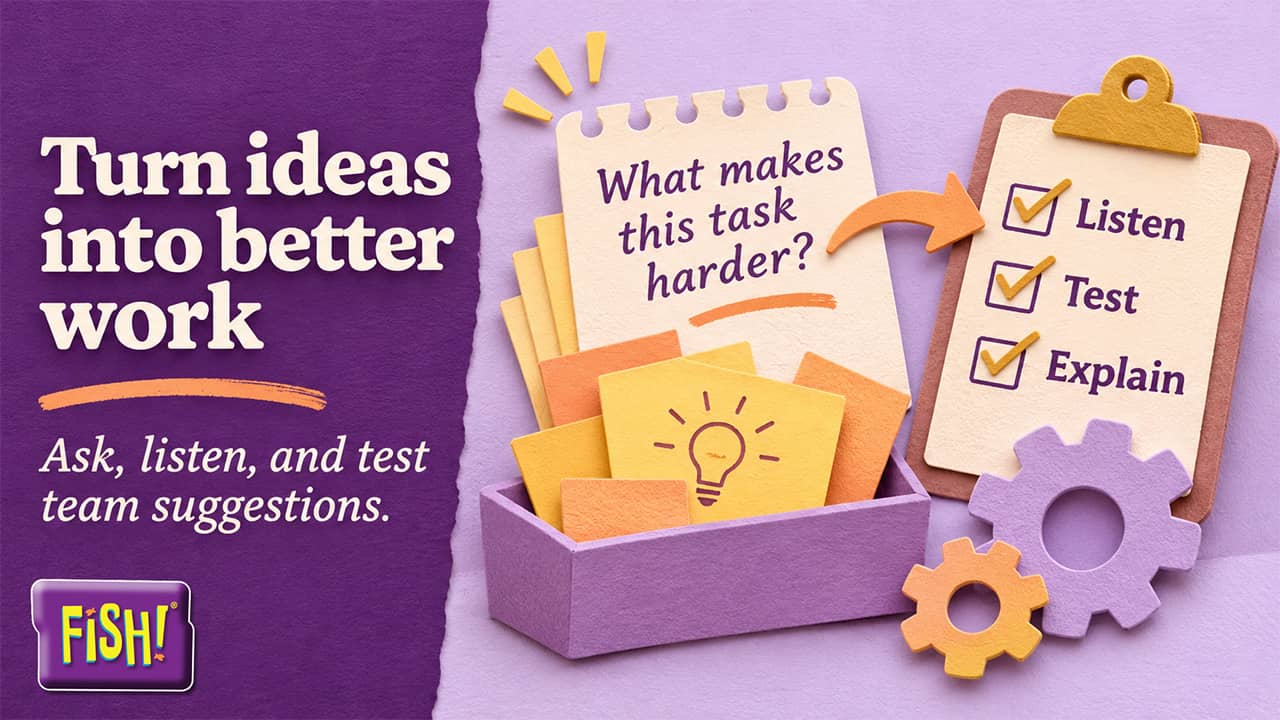
Ask the team what makes a task harder than it needs to be, then listen, test useful ideas and explain what you decide.
This is Play in a practical form, supported by Be There and Choose Your Attitude. People need freedom to suggest and adjust, respect for customers and coworkers, and leaders who treat a failed experiment as information. That is how employee empowerment becomes a habit instead of a “flavor of the month.”
What should leaders try first?
Choose one recurring moment and make it more human. Review one quality conversation as coaching instead of inspection, ask what rule helps or gets in the way, and recognize a specific behavior. Then return to the team with what you heard and what you will do next.
The four FISH! practices give those actions a shared language: Choose Your Attitude helps people decide how to show up; Be There keeps attention on the person in front of you; Make Their Day turns notice into meaningful moments; and Play creates room for better ideas. They work together, not as a fixed checklist.
A simple way to improve workplace culture
Sprint’s experience suggests that culture changes through repeated signals: a statement that invites learning, a rule that shows trust, coaching that treats people as people, and room for teams to improve the work. Try one of those signals with your team, listen to what changes, and keep the conversation going. A healthier culture is built in the daily moments employees and customers can feel.
Try the FISH! Philosophy with your team
If your team is facing repetitive work, call center stress, or a culture that has lost its energy, try the FISH! Philosophy upgraded trial. It gives your team 30 days of access to the FISH! film and its digital guides, so you can start a shared conversation about attitude, presence, meaningful recognition, and creative ways to work better together.

Frequently Asked Questions
How do you know whether workplace culture is improving?
Use more than one signal. Combine employee listening with retention, customer feedback, quality patterns, improvement ideas, and leaders’ observations. Look for a steady shift in how people experience the work rather than one perfect score.
How can a manager recognize employees without making recognition feel fake?
Be specific about what the person did and why it mattered, and choose a form of recognition that fits the person. A private thank-you may mean more to someone than public praise, while peer recognition can show that good work is noticed across the team.
What if employees do not trust a culture initiative?
Do not ask them to trust a slogan. Start by listening, make one visible change based on what you heard, and explain the decisions you cannot change. Trust grows when leaders keep their promises and respond to hard feedback without punishing the person who gave it.
Can workplace culture improve without changing pay or workload?
Pay and workload matter, and culture should not hide serious problems in either area. Leaders can still improve daily experiences through coaching, recognition, autonomy, inclusion, mentoring, and purpose.
How can a remote or hybrid team use the FISH! practices?
Make presence visible through focused conversations, thoughtful responses, and fewer distractions, then create simple ways to recognize contributions across distance. Teams can also agree on their boundaries for communication, flexibility, and experimentation so trust does not depend on everyone working in the same room.





