A hospital can reduce staff turnover by building a workplace where people feel seen, connected to a clear mission, and trusted to solve problems together. Ranken Jordan Pediatric Bridge Hospital in St. Louis offers one case study. Its annual staff turnover was reported as less than 3 percent, alongside customer service scores of 98 percent and higher. The hospital’s experience does not replace fair pay, safe staffing, manageable workloads, or good benefits. It shows how culture can support those essentials by shaping what work feels like every day.
What can a hospital learn from Ranken Jordan?
Ranken Jordan cares for seriously ill and injured children. The hospital has earned a national reputation for its innovative “Care Beyond the Bedside.” Its work is guided by a simple mission expressed by founder Mary Ranken Jordan: “Consider the children first in all you do.”
After Ranken Jordan moved into a new facility in 2004, it combined advanced medical technology with a colorful, playful environment designed to make children and families feel at home as they healed. To support its mission-led staff, the hospital adopted the FISH! Philosophy.
The hospital set six objectives: deliver excellent customer service in a warm, caring environment; build strong multidisciplinary teamwork; complement medical care with smiles and laughter; show staff they are appreciated and increase retention; create a culture in which staff believe and live the hospital’s mission and vision; and stay flexible when finding solutions for unique patient situations.
How did Ranken Jordan use the FISH! Philosophy?
Ranken Jordan’s approach was to make the four FISH! practices part of daily work rather than a one-time event. After FISH! was introduced, staff focused on living each practice for at least a month. “FISH! isn’t something you schedule, like ‘Today we’re going to be there for each other at 10 o’clock’,” CEO Lauri Tanner explained. “It’s a way of life.”
The hospital also made its values visible. Four huge banners, each carrying the name of a FISH! practice, hung in the entrance and told families, visitors, and staff, “This is who we are and what we believe.”
A volunteer FISH! Committee included people from every department. The committee created celebration ideas and coordinated fun events that kept employees connected to their beliefs. Staff recognized coworkers who made a positive difference with a small plastic fish or a T-shirt describing how the person had lived one of the practices. A newsletter honored employees nominated by coworkers for living the team’s values. As operations administrator Angie Lantz said, “We’re intentional about what we celebrate because those are things that move us forward.”
The hospital also created a multidisciplinary problem-solving approach called The Calypso Collaborative for unique challenges. Tanner said, “People have more fun solving problems if it’s a little lighter and we are more effective because everybody’s not all tight.”
The hospital reported regular customer service scores of 98 percent and higher, annual staff turnover less than 3 percent, and annual revenues that increased ten-fold in less than 10 years. Ranken Jordan is one of many organizations whose results with the FISH! Philosophy have been documented, so its story can be read alongside other workplace examples.
Medical director Dr. Nick Holekamp described the fit this way:
“The FISH! Philosophy is a natural fit for how we think and what our value systems are. The more we incorporate the FISH! philosophy into what we do, the better job we do and the better our patients do.”
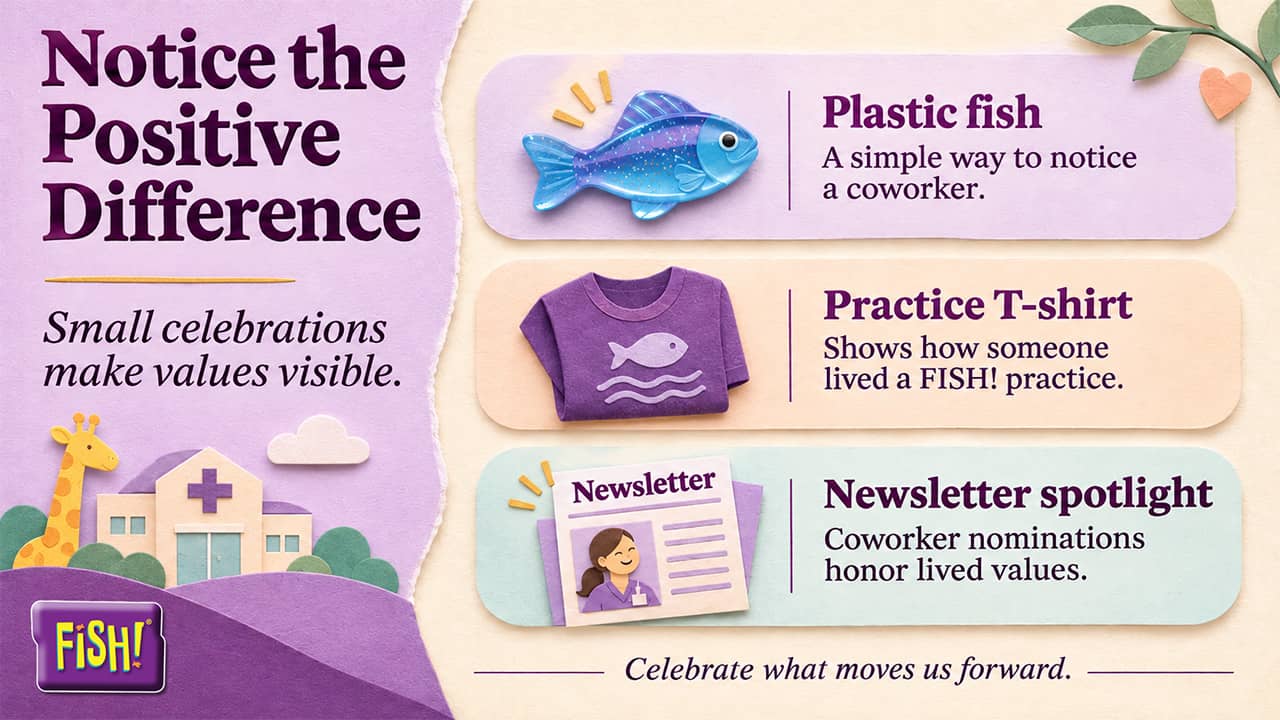
Ranken Jordan recognized coworkers with plastic fish, practice T-shirts, and a newsletter that honored employees nominated by their peers.
How can a hospital reduce staff turnover?
A strong retention plan combines culture with fair pay and benefits, enough staff to provide safe care, reasonable workloads, good scheduling, and time to recover. Employees also need managers who know how to lead, clear paths for growth, useful onboarding, and a way to speak honestly about problems. If those conditions are poor, celebrations and slogans will not fix the experience.
Culture matters because it shapes the small moments between larger policies. Does a new nurse understand the mission? Can a therapist ask another department for help?
Does a manager notice good work, or only call when something goes wrong? Those questions affect whether employees can imagine staying.
Gallup’s State of the Global Workplace: 2026 Report found that 31 percent of employees in the United States and Canada were engaged at work, while 52 percent were not engaged and 17 percent were actively disengaged. Gallup defines engagement as the psychological attachment workers have to their work, team, and employer. A hospital cannot create that attachment with a single event, but it can build daily conditions that make connection more likely.
Why does recognition help employees stay?
Recognition helps because it answers a basic question employees carry through a busy shift: Does anyone notice what I contribute? Specific, sincere appreciation shows that a person’s effort matters to a coworker, a patient, a family, or the team. It also tells people which behaviors the workplace wants to see again.
That is the idea behind Make Their Day, one of the FISH! practices. It means creating a moment that leaves another person better off. Recognition is part of it, but the practice also includes small acts of service, attention, and care.
A leader might thank someone privately, write a note, or recognize a team publicly. The right form depends on the person, because public praise can encourage one employee and embarrass another.
Ranken Jordan used several recognition channels: plastic fish, practice-based T-shirts, coworker nominations, and a newsletter. Other hospitals can begin more simply by asking employees what good work often goes unseen.
Make recognition specific: name what the person did, explain who it helped, and connect it to a shared value. Rotate attention across shifts, roles, and departments so recognition does not become a reward for only the most visible work.
Recognition should never cover up unsafe conditions or become a substitute for pay. It works best when it is part of a workplace where people can trust what leaders say and where concerns lead to action.
How do the FISH! practices build a stronger hospital culture?
Choose Your Attitude asks people to notice what they are bringing into a situation and make a conscious choice about how to approach it. A hard shift, a conflict, or grief still deserves an honest response.
Leaders should model the practice rather than telling an upset employee to “fix” their attitude. Teams can also agree on how they will handle setbacks, criticism, and uncertainty without harming one another.
Be There means complete presence: physical, mental, and emotional. In a hospital, that can look like listening without preparing a reply, giving a coworker full attention, or recognizing when a family member needs more than a quick scripted answer.
Managers can protect that presence by saying, “I want to give you my full attention for this. Can we talk at two?” and then being fully present at two.
Make Their Day turns attention into action. It may be a sincere thank-you, help with a difficult handoff, or a small gesture for someone who is having a hard day.
Genuine, tailored gestures carry more weight than quotas. Ranken Jordan’s coworker nominations show how peer recognition can reinforce a mission across departments.
Play brings curiosity, energy, and creativity to work. Clinical moments still call for judgment and respect.
In FISH! materials, Play is a mindset that supports better problem solving and allows people to look for a better way within clear boundaries. Ranken Jordan’s Calypso Collaborative brought a lighter spirit to difficult, multidisciplinary work. Other hospitals can ask teams to define their “playing field”: what values guide decisions, what behaviors are out of bounds, and where staff have room to try a better approach.
Together, the practices create a shared language for culture. That language helps a team discuss how it wants to work as well as what it wants to achieve.
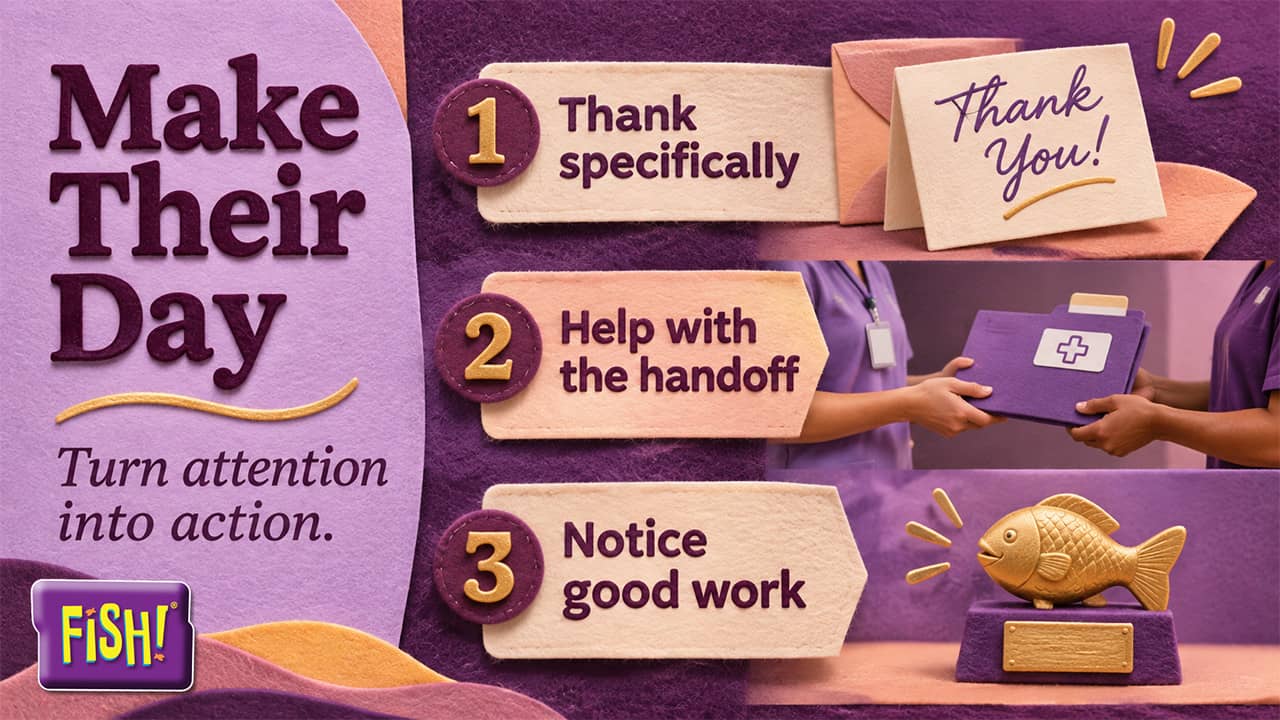
Make Their Day can be as simple as a specific thank-you, help with a hard handoff, or noticing work that usually goes unseen.
What retention strategies should hospitals add to culture work?
Start with the basics: review pay, benefits, staffing levels, workload, and schedules. A retention plan should also include useful onboarding, career development, continuing education, and visible paths for advancement. Employees are more likely to stay when they can see a future in the organization.
Managers need support as well. Gallup’s 2026 report found that manager engagement fell worldwide from 27 percent to 22 percent between 2024 and 2025. A tired or unsupported manager may struggle to provide the presence, feedback, and recognition employees need.
Train managers to listen, address conflict, give clear feedback, and recognize work fairly. Then give them the time and authority to do those things.
Finally, ask employees what would make the job better before they leave. Stay interviews, surveys, listening sessions, and exit interviews can reveal problems leaders do not see. Close the loop by explaining what the organization heard, what it will change, and what it cannot change yet.
Ranken Jordan’s example suggests that retention grows through repeated choices. Make the mission visible and give people ways to notice one another.
Bring departments together to solve hard problems and celebrate behaviors that move the team forward. Keep the conversation going so culture is lived every day rather than scheduled once in a while.
A hospital culture people can choose to stay in
Ranken Jordan’s most useful lesson comes from the connection between mission, daily behavior, teamwork, and appreciation rather than from a single event or recognition item. Culture cannot carry a hospital without adequate resources, but it can help people experience those resources, relationships, and responsibilities as part of a place where their work matters.
A team could begin this week by asking one question: What do we want families, patients, and coworkers to feel when they work with us? Then choose one practice to explore for a month, notice what happens, and keep the conversation open.
Try the FISH! Philosophy with your team
If your team is working on staff retention, recognition, teamwork, or a stronger mission-driven culture, try the FISH! Philosophy upgraded trial. It gives a team 30 days of access to the FISH! film and its digital guides, so you can begin putting these ideas into practice together.

Frequently Asked Questions
Can recognition replace higher pay or better staffing?
No. Fair pay, benefits, safe staffing, and manageable workloads are core parts of retention. Recognition strengthens the daily employee experience, but it cannot make an unsafe or unsustainable job acceptable.
How can a small hospital start a peer-recognition program?
Start with one simple channel, such as a weekly note, a shared nomination form, or a brief team thank-you at the end of a shift. Ask employees what kind of recognition feels meaningful, and make each acknowledgment specific rather than handing out generic praise.
How can managers recognize employees without seeming fake?
Name the behavior and its impact, and choose a form that suits the employee. A private thank-you may be better than public praise for someone who dislikes attention, while a team celebration may fit someone who enjoys being recognized with coworkers.
What should a hospital measure besides turnover?
Look at retention by unit and manager, vacancies, absence, workload, employee feedback, internal mobility, and patient or customer experience. These measures can show where the employee experience is improving and where leaders need to investigate further.
How can multidisciplinary teams solve problems more effectively?
Bring the people who see different parts of the problem into the same conversation, then agree on the values and boundaries that will guide the work. A lighter, more curious tone can help people share ideas, but psychological safety also requires leaders to respond seriously when someone raises a concern.