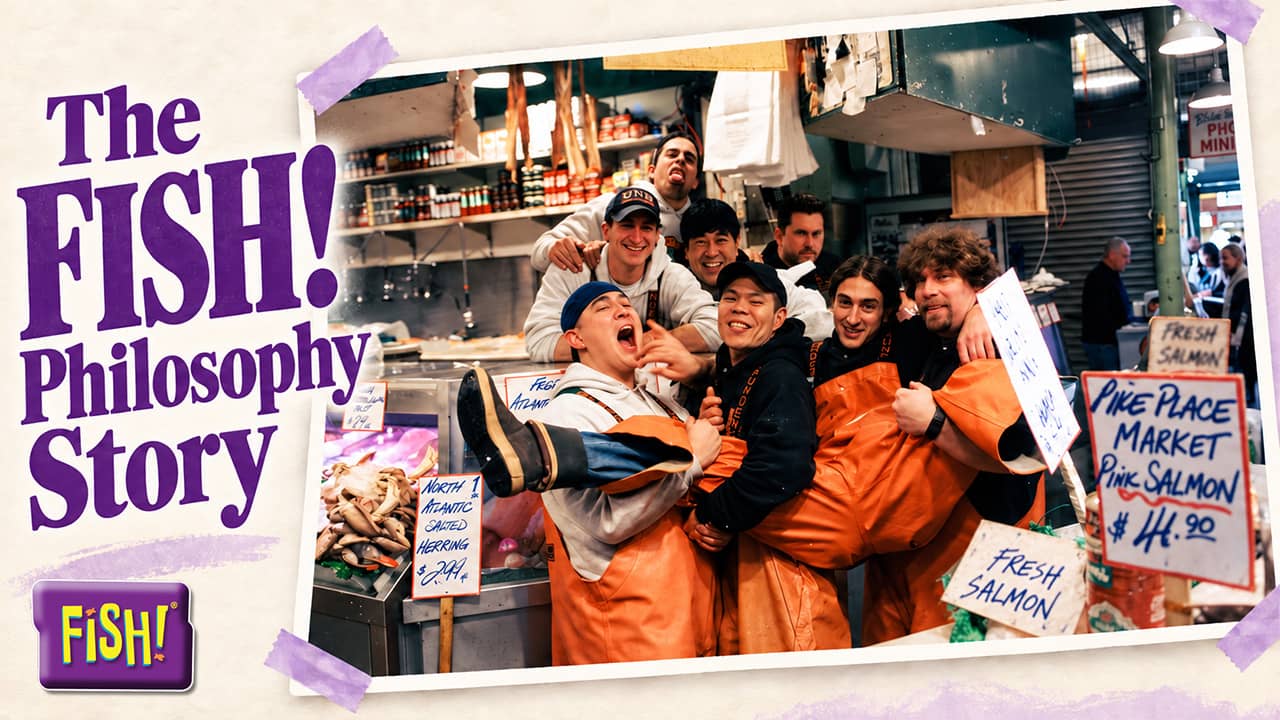
Walk through Pike Place Market in Seattle and you may notice something unexpected: fish flying through the air, customers laughing, and fishmongers treating a busy counter like a stage. That scene is at the heart of the FISH! Philosophy story, a story about a Seattle fish market that changed the way people think about work.
The fishmongers did not become famous because they found an easier job. Selling fish meant long hours, cold conditions, heavy work, and constant contact with customers. What changed was the way they chose to show up for that work and for one another.
Their story later became the FISH! film, the FISH! Philosophy book, and a set of workplace practices used by organizations around the world. But the idea began before the film, before the book, and before people started using the word “FISH!” to describe a culture.
It began with a struggling market, a decision to become world famous, and a filmmaker who recognized that something important was happening behind the counter.
What was Pike Place Fish Market like before it became famous?
In the late 1980s, Pike Place Fish Market was a difficult place to work. Its wholesale business had collapsed, the hours were long, and the work was exhausting. Owner Johnny Yokoyama has described a workplace where he often lost his temper and employees were afraid of him.
The market needed more than a new sign or a better sales plan. The people working there needed a new way to relate to one another and to the customers who came through the market.
Johnny decided he wanted to become a happier person, and he wanted the market to become a happier place. Instead of trying to make that change by himself, he invited the crew to build it with him.
That invitation mattered because the future of the market would not come from a rulebook handed down from above. It would come from a shared conversation about what kind of place the fishmongers wanted to create.
During one staff meeting, a fishmonger suggested that they become “world famous.”
At first, the idea sounded almost too large for a fish market. Yet the crew kept thinking about it, and they decided to commit to being world famous in the way they treated people and carried out their work.
The commitment gave them a new way to look at everyday choices. If they wanted to be world famous, what would that look like when a customer was impatient? What would it look like when the work felt tiring? How would a world-famous fishmonger greet someone who was only browsing?
The answer was not always written down. The team learned by trying, noticing, talking, and trying again.
Their work stayed demanding, with long hours and ice-packed fish, but they began bringing a different spirit to each task and interaction. They listened more closely and gave customers their full attention. They looked for ways to create memorable experiences, such as inviting people to catch a fish. They brought more humor and energy to the counter, and they chose the kind of day they wanted to have before the day chose for them.
As more people noticed the market’s energy, more people came to experience it. The market became known around the world without changing the basic work of selling fish.
The Seattle Times later described the culture this way: “It seems as if the Pike Place Fish culture was spontaneously generated by a team of mischievous workers. In reality, it was deliberately created.” The observation captures a key part of the Pike Place Fish Market story. The fun was real, but it grew from a shared decision and the daily effort to live that decision.
How did Pike Place Fish Market become world famous?
The market became world famous by changing the experience around the work.
The fishmongers could not control every part of their job. They could not make the fish warmer, shorten every shift, or remove every difficult customer interaction. They could control the way they responded to those conditions and the kind of experience they created together.
That is the central idea behind the FISH! Philosophy: You cannot always choose the work you have to do, but you can choose who you are being while you do it.
The phrase “world famous” became a lens. When the fishmongers looked through that lens, certain choices became easier to see. A world-famous experience called for patience, attention, humor, and care, so those qualities helped guide the team when a customer was difficult or the work felt tiring.
The commitment also gave the fishmongers permission to bring more of their personalities to work. Their humor, creativity, and playfulness became part of the customer experience. They were not pretending that selling fish was effortless; they were choosing to make the work more alive.
That choice looked different from person to person. One fishmonger might connect through humor, another might focus on careful service, and someone else might notice a customer who needed help and make that interaction more personal. Together, those choices gave the market its energy.
The team kept asking what it meant to be world famous in the next moment, with the next customer, during the next task. The vision became something they practiced rather than something they merely displayed.
That is why the market’s story has reached far beyond Seattle. Many people recognize the challenge of doing work that is demanding, repetitive, or stressful. The fishmongers show that a team can still choose how it wants to experience that work and how it wants others to experience the team.
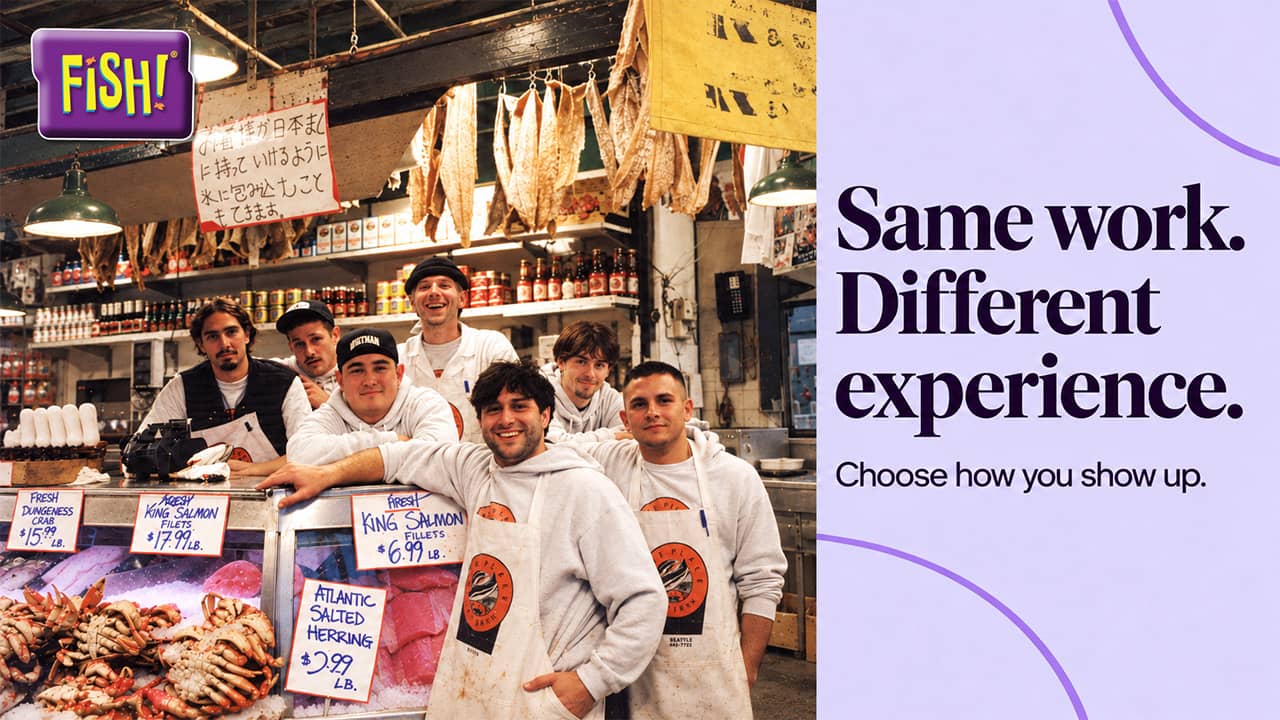
The work stayed the same. The fishmongers chose how they showed up for it.
Why do the fishmongers at Pike Place throw fish?
The fish throwing began as a practical solution.
When a fishmonger made a sale, someone had to walk around the counter to retrieve the fish and then walk back to complete the transaction. Instead of making that trip every time, one fishmonger tossed a fish over the counter to a fellow employee.
The shortcut worked. Customers also loved watching it happen, so the throw became part of the market’s playful spirit.
Over time, flying fish became the most recognizable symbol of Pike Place Fish Market. Visitors see the catches, the laughter, and the movement, but the deeper lesson is that every workplace can find its own way to bring energy and connection to the work.
The FISH! Philosophy invites each team to discover its own way to bring energy, creativity, and connection to the work rather than trying to copy the fishmongers’ particular way of playing.
The fishmongers’ version of Play includes tossing fish because that fits their environment. A teacher, nurse, engineer, or customer service team will find a different expression. Play might mean a creative way to solve a problem, a friendly challenge between colleagues, or a way to make a serious task feel more engaging.
Play also requires trust. People are more willing to experiment when they know they can try something new without being punished for every mistake. The goal is not to turn work into a circus or to ignore the responsibilities of the job. Instead, teams make room for curiosity and enjoyment while doing serious work.
The fishmongers care deeply about the work, and their playfulness helps them stay connected to one another and to the people they serve. Their example shows that taking responsibility and enjoying the moment can exist together.
How did John Christensen discover the FISH! Philosophy?
The person most closely connected with creating the FISH! Philosophy is John Christensen of ChartHouse Learning.
In 1997, John and Steve Lundin were near Seattle filming poet David Whyte. Whyte spoke about the way people sometimes leave the most courageous part of themselves in the car when they go into work. Instead of bringing their whole selves into the workplace, they hold back the part that is most creative, engaged, and alive.
After Steve flew home, John stayed in Seattle for an extra day. He went to Pike Place Market because someone had recommended it as a place to visit.
John was drawn to the flying fish and the energy around the counter. Yet the longer he watched, the more surprising the scene became. Selling fish is cold, tiring work, but the fishmongers were creating excitement for themselves and for the people around them.
As John watched, one of the fishmongers clipped a crawfish onto a little boy’s jacket. The boy screamed and grabbed his mother’s leg. The fishmonger quickly put the crawfish back in the barrel, then crawled across the floor on his hands and knees.
He looked the boy in the eye and said, “I am so sorry. Can I have a hug?”
The boy was not even a customer.
The moment struck John because he had recently taken his young daughter to urgent care during a bad asthma attack. She was struggling to breathe, yet the staff barely looked up from their screens as they directed her to wait. The contrast between that experience and the fishmonger crawling across the market floor to connect with a frightened child stayed with him.
John eventually found the courage to ask one of the fishmongers, Shawn, what was going on.
Shawn asked whether John had eaten lunch that day. John said that he had. Shawn then asked how the service had been and whether the waiter had connected with him or simply taken his money.
John was not sure where the questions were leading. Then Shawn looked him in the eye and said, “This is our moment. How may I serve you?”
That sentence helped John see what made the market different. Shawn was not treating him as another transaction. He was present with him, offering his attention and asking how he could make the interaction matter.
John connected that moment with David Whyte’s idea about bringing your whole self to work. The fishmongers were not leaving their humor, imagination, and desire to connect outside the market. They were bringing those parts of themselves into the work.
John returned to his hotel and stayed up drawing storyboards. He knew he had found the example of an engaged and alive workplace he had been looking for.
The Seattle Times quoted Christensen describing the market’s culture in a way that shows how unusual the idea seemed at the time: “Here are 20 guys that sit around every other Thursday and talk about their dreams and possibilities. We’re talking about a fish market.”
The significance of the market came from the way ordinary human needs were being met in an unexpected setting. The fishmongers wanted to work with purpose, connect with people, and create a place where their energy could make a difference.
John saw a story that could help other people ask similar questions about their own workplaces.
When was the FISH! film made?
ChartHouse released the FISH! film in 1998.
The film showed the fishmongers at work and gave names to four practices that described what viewers could see in the market: Choose Your Attitude, Be There, Make Their Day, and Play.
Those practices became the language of the FISH! Philosophy. Choose Your Attitude connects with the fishmongers’ decision to be world famous, because they consciously decided how they wanted to approach the work. Be There appears in Shawn’s question for John, which turned a brief exchange into a real human connection. Make Their Day can be seen in the fishmongers’ effort to create memorable experiences for customers and visitors. Play comes through in the fish throwing, the humor, and the energy that made the market such a memorable place.
The film was different from the usual workplace training video because it took viewers into the market and let the fishmongers demonstrate the ideas through their relationships with customers, tourists, and one another. Companies began using it to talk about motivation, teamwork, service, and the kind of culture people create through everyday choices.
The film’s message was easy to remember because it was tied to a vivid place. People might forget a list of management terms, but they remember fish flying across a counter and a fishmonger asking, “How may I serve you?”
Is there a FISH! Philosophy book?
Yes. The FISH! Philosophy book followed the film and brought the story to readers who wanted to explore the ideas in more depth.
More than 6 million copies of the book have been sold. The film has been translated into 20 languages and used across 32 countries. More than 80 percent of the Fortune 500 have used FISH!, and FISH! has more than 50,000 customers. Since the film’s release in 1998, more than 30,000 organizations have brought FISH! into their culture work.
The book helped turn the fish market’s story into a workplace parable. Readers could see the connection between the fishmongers’ daily choices and the challenges they faced in their own teams.
The story was easy to discuss because the practices could be adapted to many settings. A team could talk about what Be There meant in its own workplace or ask what Play might look like without copying the fish market.
FISH! does not ask every team to act like a fishmonger. Instead, the practices give people a way to explore how they want to show up for their work, their customers, and one another.
Over the years, additional books and programs expanded the conversation. FISH! Tales shares stories from organizations that have used the practices to create positive change. FISH! Sticks focuses on bringing a vision to life and sustaining it. FISH! For Leaders helps leaders build trust and strengthen relationships through their own example.
These resources all point back to the same idea: a culture is built through repeated choices and conversations, rather than through a single event.
What happened after the film and book?
People who watched the film began sending in their own stories of living the practices at work and at home. Over the years, those stories were collected and shared through FISH! Tales.
The stories show that the practices can take many forms. A team may use them to talk about morale, customer service, communication, trust, or engagement. A person may use them to think about how to respond to a difficult day or how to be more present with family members.
FISH! programs also developed around the original film. Some help teams continue the conversation after their first viewing. Others focus on leadership, schools, personal life, or maintaining a shared culture.
The approach remains simple, but it is not a one-time activity. FISH! is described as a journey because people keep learning what the practices mean in new situations.
A team may begin with a discussion about customer service and later discover that the same language helps with trust or communication. A leader may start by choosing a more supportive attitude and then notice that being there for employees requires better listening. A group may decide that its version of Play is not a game but a safer way to test new ideas.
The practices become useful when people make them their own.
Why does the FISH! Philosophy story still matter?
Nearly 30 years after John Christensen first saw the fishmongers at work, the central idea remains familiar and useful.
Many people spend a large part of their lives working. They may not be able to choose every task, schedule, customer, manager, or business condition. They can still ask who they want to be while they are doing the work.
That question can open a new kind of conversation. Instead of asking only, “What do I have to do today?” a person might ask, “How do I want people to experience me today?”
A team might also ask, “How can we make this work more meaningful, connected, or enjoyable?” Along with improving tasks and results, those questions create space to consider relationships and the experience people have together.
The fishmongers did not wait for perfect conditions. They worked with the conditions they had and chose a different way to experience them together.
That is why the FISH! Philosophy has traveled beyond the Seattle fish market. The practices are simple enough to remember and flexible enough to fit many kinds of work. They create a shared language for conversations that teams often need to have but may not know how to begin.
Who created the FISH! Philosophy?
The Pike Place Fish Market crew lived this way of working first, and John Christensen discovered it after visiting the market in 1997 and recognizing the connection between the fishmongers’ way of working and the ideas he had heard from poet David Whyte. John and his team at ChartHouse Learning filmed the fishmongers and named the practices Choose Your Attitude, Be There, Make Their Day, and Play.
Is the FISH! Philosophy still used today?
Yes. FISH! has more than 50,000 customers, and more than 30,000 organizations have brought FISH! into their culture work since the film’s release in 1998. The practices continue to support conversations about teamwork, leadership, service, morale, and engagement.
Is the FISH! Philosophy only for fish markets?
No. The fishmongers’ actions are specific to their workplace, but the practices can be adapted to many environments. A school, hospital, office, call center, or service team may express Choose Your Attitude, Be There, Make Their Day, and Play in its own way.
Each team can discover how the practices fit its responsibilities, relationships, and goals instead of trying to reproduce the market’s exact style.
How can a team begin using the FISH! Philosophy?
Start with a conversation rather than a mandate. Watch the film, choose one practice, and ask where it already appears in your team and where it could appear more often.
You might ask, “What would Be There look like in our next meeting?” or “What small action could Make Their Day for a customer or co-worker?”
Then try one action and talk about what happened. FISH! becomes part of a culture when people keep noticing, discussing, and practicing it together.
A simple way to start
The FISH! Philosophy story began with a fish market that decided to become world famous in the way it treated people. The fishmongers did not change the basic work; they changed the way they showed up for it.
You can try the same kind of reflection with your team. Before your next meeting or shift, invite everyone to choose one of the four practices as a focus: Choose Your Attitude, Be There, Make Their Day, or Play.
At the end, ask what each person noticed. Which choice changed an interaction? Where did the team feel more connected? What could you try again?
A meaningful next step can be small when the team chooses it on purpose.
If you would like to see the fishmongers for yourself, try the FISH! Philosophy upgraded trial. Your team receives 30 days of access to the FISH! film and its digital guides, so you can watch the story together and begin putting the practices to work in your own environment.