
At 7:05 on a Thursday morning, the front desk at Riverside Family Dental was already ringing.
The first patient had arrived early for a crown appointment. Two hygienists were reviewing their schedules. A dental assistant was setting up an operatory when the office manager announced that a dentist was running late because of a family emergency.
The schedule had no room to move. A new patient was waiting for an intake. Three hygiene appointments were stacked before lunch. The phones kept ringing, and the insurance queue from the day before still needed attention.
By 10:30, the team had skipped their first breaks. By noon, lunch had become a tray of sandwiches eaten beside the sterilization area, one bite at a time between patient questions.
At 3:00, a hygienist made a small charting mistake. At 4:15, an assistant snapped at a coworker over a missing instrument. No one was trying to be difficult. Everyone had been working since early morning without a real pause.
The office manager noticed the tension but said, “We just need to get through today.”
The team heard that sentence several times that week. Then the next week. Then the week after that.
On Friday, one of the dental assistants called in sick. She was not dealing with a contagious illness. She was exhausted and needed one day when no patient, phone, insurance claim, or coworker needed something from her.
The manager was surprised. The assistant had seemed dependable. She had stayed late, covered open shifts, and rarely complained.
That was the warning sign. She had not been fine. She had been using every available hour to keep the practice running because the workweek had no room for recovery.
This is an employee wellness problem that can hide behind reliable performance. In a dental office, the pressure may show up as a packed schedule, delayed charting, nonstop patient flow, or a team that eats lunch beside the autoclave. In another workplace, it may look like back-to-back meetings and late-night messages. The pattern is the same: people are expected to keep going without enough time to reset.
Managers can support employee wellness by building recovery into the week. Recovery is not time stolen from important work or productivity. It is what helps people return with attention, patience, compassion, and enough energy to make good decisions.
What does it mean to build recovery into the week?
Recovery is the process of restoring physical, mental, and emotional energy after effort. It can include sleep, meals, movement, quiet, focused work, time with other people, time alone, and the simple experience of not being needed for a while.
At work, recovery does not mean making every day easy. It means creating enough space for people to reset before pressure becomes unmanageable.
At work, recovery may look like:
- Taking a real lunch away from the screen
- Leaving transition time between demanding tasks
- Allowing employees to finish focused work without constant interruption
- Creating coverage so people can take scheduled breaks
- Pausing after a difficult customer, client, or project situation
- Making room for ordinary conversation and support among the team
- Respecting sick days and vacation days
- Ending the day without expecting employees to finish every leftover task unpaid or unnoticed
A manager cannot control everything an employee does outside work. But managers shape the conditions inside the workday. They decide whether breaks are treated as responsible, whether every open appointment becomes an emergency, and whether a demanding week is followed by recovery or immediately replaced by another demand.
Why recovery matters to employee wellbeing
Many jobs require focus and emotional control. Employees may spend the day managing difficult customers, complex projects, anxious clients, unexpected changes, or emotionally demanding situations. Administrative staff and frontline teams may absorb frustration from several directions while still being expected to stay calm and move quickly.
Stress is part of that work. The problem is not that employees ever feel pressure. The problem is pressure without enough time to recover.
Without recovery, employees may begin to:
- Make more documentation, scheduling, or communication errors
- Lose patience with customers, clients, or coworkers
- Struggle to focus during procedures or handoffs
- Avoid asking for help because everyone seems busy
- Work while sick
- Withdraw from coworkers
- Feel anxious when they are not available
- Use sick days as emergency rest days
- Consider leaving a workplace they once valued
These signs can be misread as attitude problems or low commitment. In many cases, they are signals that the person has been operating without enough margin.
This helps answer the question, why is employee wellbeing important? People need enough energy to think clearly, relate to customers and coworkers, and recover from the demands of work. When recovery is treated as part of the job rather than a reward for finishing everything, employees are more likely to sustain good performance.
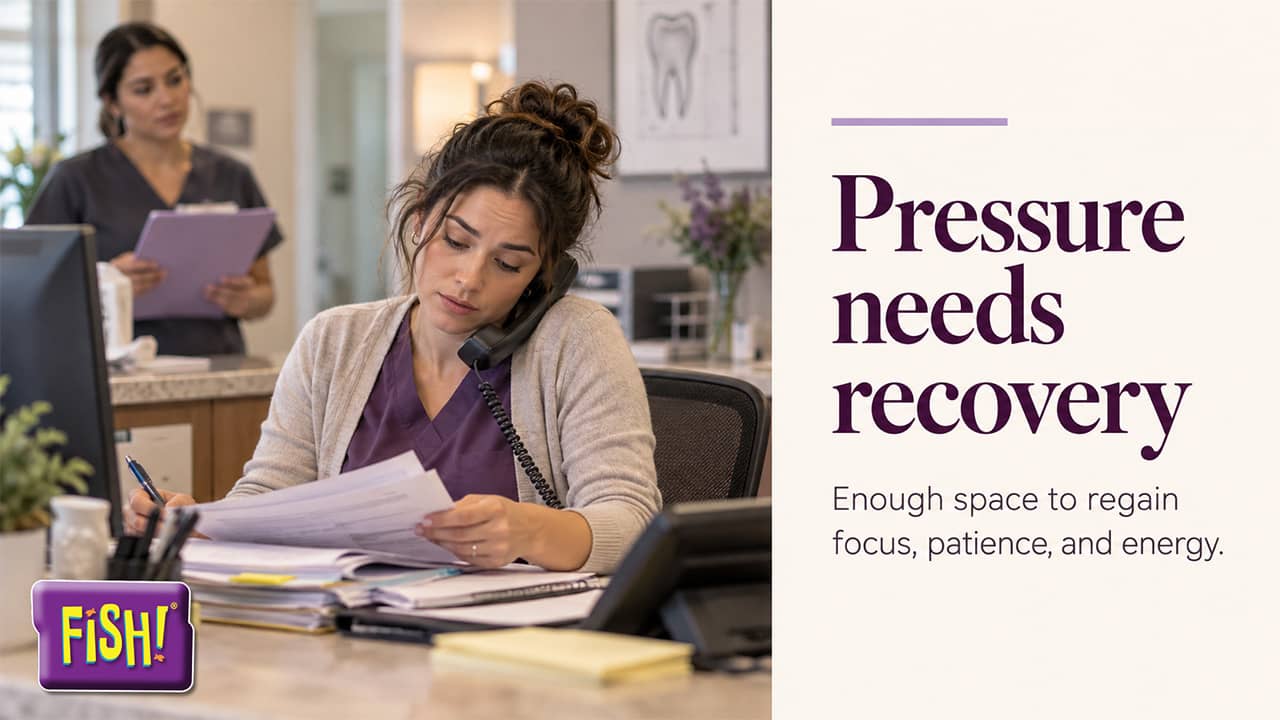
Busy teams need enough space to regain focus, patience, and energy.
Six ways managers can build recovery into the week
1. Protect real breaks
A break is not always a break. Eating lunch while answering the phone may change the task, but it does not give the mind much chance to reset. Drinking coffee while reviewing charts is not the same as stepping away from the work.
Build a coverage plan so someone can eat without monitoring every incoming call or message. Make sure employees have a realistic opportunity to step away from their work area. If the schedule is too full to support breaks, the problem is the schedule—not the employees’ lack of discipline.
Managers should model this behavior. Say, “I am stepping away for lunch and will respond afterward.” If the leader stays available every minute, employees may interpret every reminder about wellness as optional.
Breaks also need to be practical. A busy team may not be able to pause every responsibility at once, but it can rotate coverage and plan handoffs. The goal is not perfection. The goal is to stop treating recovery as something that happens only if the day goes unusually well.
2. Reduce schedule and meeting overload
A workplace may not have a calendar full of video meetings, but it can still have meeting overload in other forms. Team huddles, training sessions, status calls, vendor conversations, and end-of-day debriefs can consume the same time employees need to prepare, complete focused work, and recover.
Review recurring meetings and ask:
- Does this meeting still have a clear purpose?
- Does everyone invited need to attend?
- Could the update be shared in writing?
- Is the meeting scheduled during a protected break or focused-work period?
Keep meetings focused on the decisions the team needs that day. Move information that does not require discussion to a shared document. End when the purpose is complete.
A meeting should help the team work better, not create another task employees must finish after the workday ends. Give people a clear outcome and invite useful contributions without forcing every person to perform. The tone matters too. A short, respectful conversation can restore energy; a rushed meeting full of blame can drain more of it.
3. Create recovery after intense days and procedures
Some days genuinely require extra effort. An emergency case, a staff absence, a difficult procedure, or a sudden schedule change may temporarily stretch the team.
The mistake is treating the pressure as complete when the final deadline passes. Employees may have worked through breaks, handled emotionally demanding situations, and stayed late, only to return the next morning to a full workload with no chance to regain capacity.
Before an intense period begins, discuss what can be delayed afterward. Can a nonurgent administrative task move to the next day? Can the following morning’s meeting be shortened? Can a staff member start later after staying late for an emergency? Can the schedule include a quieter block for documentation and reset?
Do not describe this as a prize. It is part of the cost of the work. If employees spend their recovery time catching up on everything postponed during the rush, the pressure has not actually ended.
4. Protect focused work and transition time
Constant interruption is tiring even when the total number of hours looks reasonable. Employees need time to prepare, document, restock, process information, and finish important work without answering three new questions at once.
If these tasks can only be completed after the workday ends, the schedule is using employees’ personal time to create focus.
Protect short blocks for work that requires concentration. Avoid filling every open space with another request. Build transition time between demanding tasks when possible. Use a shared signal for when someone cannot respond to routine questions unless there is a genuine emergency.
Focused work is not isolation. It is protected attention. People can return to collaboration and service with more patience and better judgment when they have had time to finish a thought and complete an important task.
5. Make connection part of recovery
Recovery is not always solitude. People also restore energy through safe, supportive relationships.
A short conversation with a trusted coworker can help someone feel less alone after a difficult customer, client, or project interaction. A moment of humor can release tension. A private thank-you can remind an employee that their effort has been seen. These small human experiences do not remove the workload, but they can change how a person carries it.
Managers should make connection available without forcing social participation. Leave room for ordinary conversation before a meeting. Pair experienced staff with newer employees thoughtfully. Invite people to share ideas about improving the way work gets done. Acknowledge the help that often goes unnoticed, such as covering a break, calming a frustrated customer, or helping a colleague learn a new system.
Do not assume that a large staff event will create connection. Some employees may prefer a quiet check-in, useful collaboration, or private recognition. The goal is to create a team environment where people know who they can turn to and do not have to handle pressure alone.
6. Respect mental health days and time off
A person may have access to mental health days at work and still be afraid to use them. The formal benefit may be available, but the culture sends a different message: “Do not leave the team short.”
Managers can close that gap by treating approved time off as legitimate. Do not ask employees to monitor messages while they are sick, on vacation, or taking a mental health day. Make coverage clear before they leave. Decide what counts as a genuine emergency and what can wait until they return.
In any workplace, this may mean keeping a clear coverage plan, maintaining a straightforward call-out process, or adjusting the workload instead of pressuring one employee to work while unwell. Customers, clients, and coworkers all benefit when people are able to focus, and employees deserve the chance to recover.
Be thoughtful when someone returns. Do not welcome them back by handing them an impossible backlog and implying that they must make up every missed moment immediately. Prioritize the work and give them a manageable way to re-enter.
Time off is not a sign that someone lacks commitment. It is one of the ways people remain capable of contributing over time.
Common pitfalls when building recovery into the workweek
Treating breaks as a personal responsibility only. Telling employees to manage stress while filling every available hour does not create recovery. Managers must examine the workload, schedule, and staffing they control.
Protecting recovery only when the office is quiet. If breaks disappear whenever the schedule is full, employees learn that rest is the first thing to sacrifice. Build coverage into the plan before the busy period begins.
Replacing recovery with forced fun. A staff lunch or holiday event can be enjoyable, but it may feel like another obligation if employees have no choice or must attend after a long day. Offer different ways to connect and allow people to participate without pressure.
Assuming some roles are resting because they are not on the frontline. Administrative, support, and remote employees may be managing nonstop messages, complaints, coordination, and schedule changes. Recovery must include every role on the team.
Scheduling recovery but failing to protect it. A break on the schedule is not meaningful if the manager continues filling it with calls, walk-ins, or routine questions. Treat protected time as a real commitment.
Using wellness language to cover an impossible schedule. A breathing exercise cannot fix understaffing, overload, or unrealistic workload expectations. Supportive practices matter, but managers must address the conditions creating the strain.
Making recovery another performance measure. Do not track whether employees took a walk, joined a social activity, or used a wellness resource. Create conditions where people can make healthy choices without surveillance.
A practical recovery action plan for managers
Use this process during the next two weeks:
- Map the pressure. Review the team calendar, staffing levels, meeting load, late departures, and missed breaks.
- Find the missing margin. Identify where employees have no meal break, transition time, focus time, or recovery after demanding work.
- Remove one unnecessary demand. Shorten a meeting, reduce a report, pause a nonurgent task, or stop filling every open slot.
- Protect one recurring recovery block. Keep it free from routine calls, meetings, and nonurgent requests.
- Plan the aftercare. If an emergency, launch, deadline, or demanding project requires extra effort, decide what will be reduced afterward.
- Ask the team what helps. Use questions such as, “When does this week feel most draining?” and “What would make recovery more realistic?”
- Model the change. Take your own breaks, disconnect when you are off, and explain the choices you are making.
- Review the result. After two weeks, ask what improved, what did not, and what should change next.
The plan does not need to be elaborate. One protected lunch, one less meeting, or one honest conversation about capacity can show employees that recovery is allowed.
How to improve employee wellbeing without adding another initiative
If you are wondering how to improve employee wellbeing, start with the rhythm of the workweek. Do not begin by adding another platform that employees must remember to use. Look at the calendar, staffing plan, messages, meetings, and expectations already in place.
Ask whether the current system makes healthy behavior possible. Can employees take a break without being interrupted? Can they finish important work during working hours? Can they use mental health days at work without fear? Does the team recover after a difficult day, or does the next demanding schedule begin before anyone has caught their breath?
The answers will show you where to begin. Employee wellness grows when managers remove avoidable pressure and make room for people to return to their work with energy.
From recovery to a healthier employee wellness culture
Recovery is not a soft extra added after the real work is complete. It is part of how a team provides careful, consistent work.
A manager can be present enough to notice when someone is running on empty. They can make someone’s day by protecting a lunch break, removing an unnecessary meeting, or giving a nervous employee a few minutes to reset after a difficult appointment. They can bring appropriate energy and creativity to a hard week instead of making every conversation feel like another demand. They can choose a steady response when the schedule becomes overwhelming.
These choices help people feel seen and supported. They also make it easier for employees to be honest about their capacity before the only option left is a sick day.
Together, these practices reflect the FISH! Philosophy. Its language gives managers a simple way to talk about being present with people, bringing play and positive energy into the work, making someone’s day, and choosing the attitude they bring to pressure. In any workplace, that might mean listening after a difficult client interaction, finding a lighter way to solve a scheduling problem, recognizing the person who quietly helped the team, or responding to a packed day without passing panic to everyone else.
The FISH! Philosophy is not a replacement for realistic staffing, fair workloads, time off, or professional mental health care. It gives teams a shared language for making respect, connection, and support part of everyday work.
If you are ready to build these habits into your culture, sign up for the FISH! Philosophy upgraded trial at a discount. The trial includes the original FISH! film plus eight actionable guides and training videos to help jumpstart your culture transformation. Use the materials with your leadership team and employees to start practical conversations about how you work together, how you support one another, and how to make recovery, connection, and healthy energy part of the week.

A healthier workplace is not one where no one ever feels pressure. It is one where pressure is followed by recovery, where people can take a real break without fear, and where excellent work does not require sacrificing the health and life of the people providing it.
FAQ: Building recovery into the workweek
What is employee wellbeing?
Employee wellbeing is the quality of a person’s physical, mental, emotional, and social experience at work and in life. It includes rest, connection, psychological safety, purpose, and access to appropriate support.
Why is employee wellbeing important when recovery is missing?
Without enough recovery, employees may lose focus, become irritable, make more documentation or work errors, withdraw from coworkers, or use sick days as emergency rest days. Recovery helps people sustain their health and performance over time.
How do you improve employee wellbeing without adding another initiative?
Start by improving the rhythm of the workday. Protect breaks, reduce unnecessary meetings, create transition time, plan recovery after intense procedures, respect time off, and ask employees what would make recovery more realistic.
What are some examples of employee wellbeing at work?
Examples include taking a real lunch, having time to complete important work, using vacation without monitoring messages, taking mental health days at work when needed, feeling connected to coworkers, and being able to leave work without guilt.
How can managers build recovery into a busy week?
Begin with one visible change: protect a meal break, adjust an overloaded schedule, shorten a low-value meeting, create a focus block for important work, or plan recovery after an emergency or demanding project. Explain why the change matters and follow up to see whether it helped.