Learning how to reduce employee turnover starts with a simple truth: replacing a good employee usually takes more time, money, and energy than keeping that person. Retention improves when leaders address the reasons people leave and shape a daily workplace where people can do meaningful work, grow, and feel respected.
A retention goal is useful because it gives an organization a direction to work toward over time. In the FISH! Philosophy, that long view connects with Choose Your Attitude. Leaders decide how they want the organization to show up, then keep making that choice through busy seasons, hard conversations, and changing business needs.
What is employee turnover?
Employee turnover is the movement of employees out of an organization and the process of replacing them. A company may track turnover for the whole workforce, a department, a location, or a specific job. Looking at the pattern matters because a high rate in one team can point to a manager, workload, schedule, or role problem that a company-wide average hides.
To calculate an employee turnover rate for a period, divide the number of employees who left during that period by the average number of employees, then multiply by 100. For example, if 12 people leave during a year and the average workforce is 120, the annual turnover rate is 10%.
Use the same time period for both numbers and write down how your organization defines a departure. Then separate the results by voluntary and involuntary turnover. Voluntary turnover happens when an employee chooses to leave, such as for another job, a career change, or personal reasons. Involuntary turnover happens when the organization ends the employment relationship, including layoffs, performance decisions, or policy violations.
The rate alone does not tell you whether turnover is healthy. Some turnover can help when a poor fit leaves, a consistently weak performer is exited fairly, or employees move into opportunities that fit them better. Harmful turnover removes strong performers, people with hard-to-replace knowledge, or employees whose departure puts extra pressure on the team. Compare your results with your own history and with relevant industry benchmarks, since a good employee turnover rate depends on the type of work, local labor market, pay, seasonality, and workforce model. A single number, such as 12% or 20%, cannot define healthy turnover for every employer.
Why do employees leave?
The reasons people leave often overlap. A new job may offer more pay, but a manager relationship or an exhausting workload may have pushed someone to start looking.
Common turnover causes include:
- Limited career growth or no clear next step
- A poor relationship with a manager or a lack of coaching
- Too much work, unpredictable schedules, or long-term burnout
- Feeling overlooked, disrespected, or unrecognized
- Pay or benefits that do not match the role or the market
- Weak onboarding that leaves a new employee unsure how to succeed
- Work that feels disconnected from a purpose or from the customer
- A culture where people cannot speak honestly or try better ways to work
Gallup’s State of the Global Workplace: 2026 report found that 20% of employees worldwide were engaged at work in 2025; the remaining 80% included 64% who were not engaged and 16% who were actively disengaged. Engagement is not the same thing as turnover, yet the finding shows why the everyday experience deserves attention. People form their view of an employer through ordinary conversations, decisions, feedback, and moments when a manager either notices them or does not.
What does employee turnover cost?
The cost of employee turnover includes far more than a job posting and a new hire’s wages. Leaders spend time on recruiting, interviews, background checks, training, and scheduling coverage. The departing employee also takes knowledge of customers, systems, and unwritten workarounds, while teammates absorb extra work and a new hire learns the role. Service can slow, mistakes can rise, and customers may notice the change. Track these effects alongside hiring spend when deciding which retention problems deserve action.
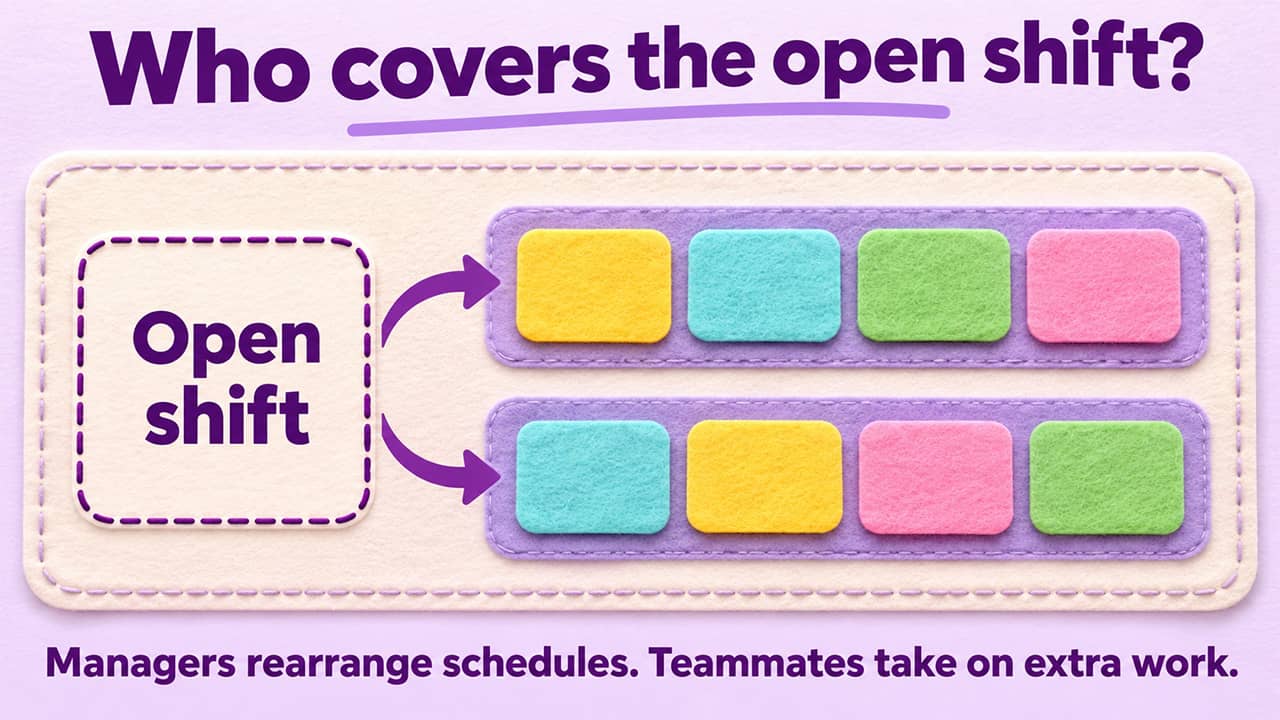
Every departure leaves a gap that the remaining team has to fill, so the cost of turnover shows up in rearranged schedules and heavier workloads long before it shows up in a hiring budget.
How do you reduce employee turnover?
The strongest employee retention strategies work together. Begin with the basics, then build trust through the daily experience of work.
Hire for fit and give people a clear start
Hiring for fit means looking at the abilities, values, work habits, and expectations that a role truly needs. It does not mean hiring people who all think alike. A strong process gives candidates an honest picture of the work, schedule, manager style, and standards, so both sides can make a better decision.
Onboarding then turns a good hiring decision into a workable relationship. Give new employees the tools, introductions, training, and early goals they need. Check in often during the first months, when small points of confusion can become discouragement. A thoughtful start helps people feel capable and connected before they are left to figure everything out alone.
Train managers to coach and hold regular one-on-ones
Managers have a large effect on why employees stay or leave. Train them to set clear expectations, give useful feedback, solve problems early, and coach instead of saving every concern for a formal review. A regular one-on-one creates protected time to discuss priorities, obstacles, development, and the employee’s experience.
The quality of the conversation matters more than the calendar invite. A manager who practices Be There gives the employee physical, mental, and emotional attention. That means listening without preparing a defense, asking a follow-up question, and remembering what the person said. When an issue needs more time, the manager can set a specific time to return to it and then be fully present.
Recognize people specifically and often
Recognition and retention connect when appreciation is timely, sincere, and specific. Tell someone what they did, how it helped, and what quality they brought to the work. A message such as “You stayed with that customer until the issue was clear, and your patience kept the handoff from becoming another problem” carries more meaning than “Good job.”
Make Their Day offers a useful way to think about this practice. It asks leaders to notice people’s efforts and create moments that leave them better off. Recognition should fit the person: a private thank-you may matter more than public praise, and leaders should notice people working different shifts or behind-the-scenes roles. A pizza party can be a pleasant gesture, but it cannot repair a weak culture or substitute for the basics. Small gestures support a healthy culture, while fair pay, good benefits, meaningful work, and room to grow remain the foundation.
Make career growth visible
People are more likely to stay when they can imagine a future with the organization. Show the skills, results, and experiences connected to the next role. Offer training, stretch assignments, mentoring, job shadowing, or project leadership, and discuss development before someone is ready to resign.
A visible path also helps managers have honest conversations. An employee may want advancement, deeper expertise, a different schedule, or a chance to move sideways into a better fit. Naming those possibilities gives the person choices and gives the organization a chance to keep valuable knowledge.
Watch workload and address burnout early
Track workload through regular conversations, staffing data, missed breaks, overtime, error rates, and work that keeps rolling from one week to the next. Ask what can be paused, simplified, reassigned, or staffed differently. Managers should model reasonable boundaries and explain tradeoffs when priorities change.
FISH! does not treat Choose Your Attitude as a command to ignore real problems. Leaders choose their own example while also fixing conditions that make good work difficult. Be There helps a manager notice when someone is struggling, and Play can bring curiosity and creativity to finding a better process. These practices support the work; they do not replace enough people, realistic goals, or recovery time.
Give people a voice and a safe playing field
Employees need a real way to share ideas, concerns, and different points of view. Suggestion boxes, surveys, open-door policies, and team meetings help only when leaders listen, respond, and explain what happens next. If every idea disappears into a silent inbox, employees learn that speaking up takes effort without producing change.
Play is a mindset of curiosity, energy, and creativity. In a workplace with clear boundaries and trust, people can test a better way to handle a task, learn from an attempt, and contribute beyond their job description. Leaders can ask, “What would make this process work better?” and then protect time to explore the answers. A playful workplace can still take results seriously; it gives people room to help create them.
Use stay interviews before people decide to leave
A stay interview is a short, recurring conversation about what helps an employee remain, what makes work harder, and what might cause them to look elsewhere. Ask what the person enjoys, where they feel stuck, what support they need, and what one change would improve their experience. Listen for patterns across teams instead of treating each answer as a promise to grant every request.
Stay interviews work because they move feedback earlier. A manager may learn about a career concern, a team conflict, or a workload problem while there is still time to act. Follow up on the commitments you make, and tell the employee when a requested change cannot happen so the conversation stays trustworthy.
Learn from exit interviews and turnover patterns
Exit interviews can reveal why employees leave, especially when the process makes it safe to be honest. Ask what influenced the decision, when the person first began considering a move, what the manager or team could have done differently, and what would have made staying more likely. Look for themes across several departures.
Pair those answers with turnover data. Compare voluntary and involuntary departures, tenure, manager, role, shift, location, and reason for leaving. Then choose a small number of actions and check whether the pattern changes. An exit interview is valuable when it improves the experience for the people who remain, not when it becomes a final form filed away.
What can managers do to keep good people?
Managers can start with three habits this week: schedule a real one-on-one with each direct report, give one specific thank-you tied to an observed behavior, and ask one stay-interview question. From there, review workload and growth goals with the team. Show up when life gets harder, while respecting professional boundaries, so work can feel like a stable place rather than another source of uncertainty.
Leaders also shape the team’s attitude through their own behavior. A manager who admits a mistake, listens to a concern, invites an idea, and follows through teaches employees what is safe and valued. The daily experience of being treated as a person is one of the reasons good employees choose to stay.
A practical way to measure progress
Set a retention goal that fits your workforce and track more than one result. Review overall employee turnover rate alongside voluntary turnover, regrettable turnover, new-hire turnover, tenure, absenteeism, engagement feedback, and internal moves. Ask whether the people you most want to keep are staying and whether the reasons for leaving are changing.
Share the goal and the actions with employees. That gives the work a shared purpose and lets people see whether leaders are acting on what they hear. In FISH! terms, Choose Your Attitude becomes a continuing organizational choice, while Be There, Make Their Day, and Play show up in the conversations and decisions that make the choice real.
Questions to reflect on
- When team members share frustration or anxiety, how can you make room for honest expression while keeping the work moving?
- What does your workplace do to build connection and positive feelings, and how could you Make Their Day in a way that feels personal and different?
- Where can your team safely share ideas, brainstorm, and learn from attempts that do not work, and how can you open that space to more people?
Start reducing staff turnover one conversation at a time
Employee retention grows through systems and moments. Competitive basics, good onboarding, manager coaching, career growth, manageable work, and useful feedback give people solid reasons to stay. Presence, specific recognition, and room to contribute make those reasons visible in daily life. Choose one team, listen carefully, and act on what you learn this week.
Try the FISH! Philosophy with your team
If you want a shared way to turn these retention ideas into daily habits, try the FISH! Philosophy upgraded trial. Your team gets 30 days of access to the FISH! film and its digital guides, giving you a practical starting point for conversations about how people want to work together, support one another, and create a workplace where good people want to stay.

Frequently Asked Questions
How often should a company review its turnover rate?
Review it monthly or quarterly if your workforce is large enough for the pattern to be useful, and complete a deeper review at least once a year. Frequent checks help you spot a sudden change, while a longer view accounts for seasonality and normal movement in your industry.
Should a company try to keep every employee?
Retention efforts should focus on a healthy, capable workforce and fair decisions. Some departures make room for a better fit or follow necessary performance action, so leaders should study who is leaving and why rather than treating every departure as a failure.
How can a small business improve retention with a limited budget?
Start with clear expectations, consistent check-ins, useful training, specific appreciation, and honest conversations about workload and growth. These practices require attention and follow-through more than expensive perks, although pay and benefits still need to be fair for the role and market.
What is the difference between retention and engagement?
Retention measures whether people remain with an organization over time. Engagement describes their connection to the work, team, and employer, so a team can have low turnover while people are disengaged and quietly planning their next move.
What should leaders do after an exit interview?
Group feedback into themes, protect confidentiality, and choose actions that address patterns rather than reacting to one comment. Tell current employees what you are improving when appropriate, then revisit the data to see whether the change helped.