Customer service scripts can help a team give clear, reliable answers, especially when employees are new or the same questions come up all day. The challenge is keeping a script from taking over the conversation. The best customer service scripts give employees a steady starting point while leaving room to listen, think, and respond to the person in front of them.
The story below shows that the words matter less than the attention behind them.
Would You Like A Cookie With That?
My friend Bob once stopped at a fast-food restaurant and placed an order that came with a cookie. The server responded, “And would you like a cookie with that?” The next time Bob returned to the restaurant, he placed the same order, cookie included, with a different server. Again the server politely asked, “And would you like a cookie with that?”
A month later, Bob visited the restaurant again and was met at the counter by a third server. This time Bob was feeling mischievous. He placed his order, adding, “I would like 200 cookies with that.” To which the server replied, “And would you like a cookie with that?”
Great customer service starts with being fully present. That’s not easy, especially when you sell the same product over and over, when the day grows long or when there are constant distractions.
Some companies use scripts as a reminder to stay focused (and sell more product) but as Bob’s experience showed, scripts don’t guarantee you will be more present. Frankly, scripts tend to turn service moments into robotic encounters; they may help you remember what to say but can leave the recipient feeling invisible.
By contrast, when I visited the Pike Place Fish Market, I noticed that when a fishmonger focused on a customer, despite all the commotion going on around them, it was like they were the only people there.
Later, when I was filming at the market, I asked Shawn, one of the fishmongers, how he managed to be so consistently present. “I started working here just as a job,” he admitted. “It was monotonous, hard labor. But something happened to me and I realized I was serving people and making people happy. This gave me a plus in my life, and made me want to do it even more.
“When you’re being present, everything else falls into place. It gives you an advantage, not just as a salesperson, but as a person enjoying life. See, people come to the market, they’re grouchy, they don’t want to buy fish, they don’t have any money, life is horrible. They come here, they’re walking away, they’re holding their wife, they’re playing with their baby. All they did was buy fish—and experience a little bit of who we are.”
That’s when I began to understand what great customer service is. It isn’t about doing certain things; it’s about being a certain kind of person. It’s a commitment that shifts your focus from “me” to others. When you are in that frame of mind, you see people not as transactions but as individuals with unique needs. You are more likely to recognize what they need from you.
This week, look for opportunities to be more present for the people you serve—whether it’s your customers, coworkers, family or friends. Be There by giving them your undivided attention. Make Their Day with a kind, helpful word. Play with ideas that solve their problems. Make the interaction fun for both of you. Choose an attitude that puts others first.
When you make a commitment to serve others, as Shawn the fishmonger did, your customers will be so delighted they return again and again to experience how you made them feel. Like Shawn, you’ll also experience a “plus” in your life—the satisfaction of seeing the impact that your commitment has on others.
-John Christensen, CEO and Playground Director of ChartHouse Learning
What does the cookie story teach us about customer service scripts?
The story points to a useful rule: a script can support service, but presence creates the connection. In the FISH! Philosophy, Be There means complete presence. That includes physical attention, mental attention, and emotional attention. An employee hears the customer’s words, notices the meaning behind them, and stays with the conversation instead of racing toward the next line.
Shawn’s example adds another lesson. Repeated work can feel ordinary, yet a person can choose to see the human value inside it. That choice changes the energy brought to each interaction. Choose Your Attitude asks employees to notice how they are showing up and to make that choice again when the shift gets hard.
The other FISH! practices belong here too. Make Their Day can mean recognizing a concern or making a confusing step easier. Play brings curiosity to problem solving, so an employee can look for a better way to help within the company’s boundaries. These practices invite more care and energy rather than a performed personality.
This week, try a few simple actions. Before a shift, choose one quality you want customers to experience, such as patience. During each conversation, listen for one detail that should shape your response. Afterward, ask whether your words helped that person feel respected. Those habits turn a script into a service tool.
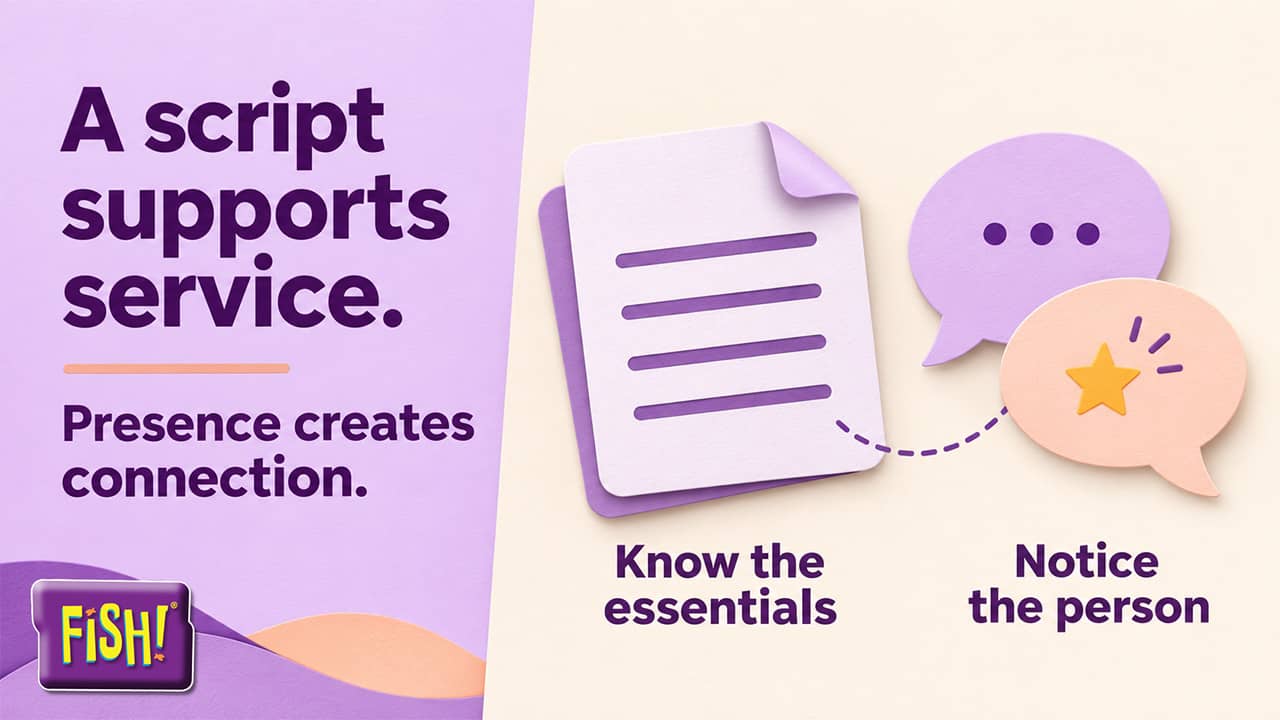
A good script covers the facts every customer needs, while the employee’s attention to the person is what makes the conversation feel personal.
What is a customer service script?
A customer service script is a prepared set of words, prompts, or talking points that helps an employee handle a common interaction. It may cover a greeting, product information, an apology, a sales suggestion, a transfer, or a closing. Call center scripts often appear in a knowledge base or on an agent’s screen, while other teams may use printed prompts or training cards.
Companies use scripts for consistency, accurate information, new-staff training, and legal or industry compliance. A script can also make a difficult moment easier because the employee does not have to invent every sentence under pressure.
A strong script protects the important points and leaves the conversation alive. A weak script treats every customer as if they arrived with the same question, mood, and need. That is when scripted responses begin to sound like robotic customer service.
Are customer service scripts a good idea?
They are useful when they reduce errors and give employees confidence. A clear framework can remind an employee to confirm the issue, explain the next step, protect private information, and close the loop. It can also help a team deliver the same basic promise across phone, chat, email, and in-person service.
Scripts hurt when speed matters more than understanding. A customer may use different words, reveal a bigger problem, or need reassurance before they are ready for a solution. If the employee keeps reading the planned response, the customer has to repeat themselves and may feel invisible. The FISH! practice Be There gives teams a way to spot this problem: generic answers, missed details, interruptions, and a tone that does not fit the customer’s situation all signal that attention has drifted.
Script the essentials and coach judgment around them. Give employees clear boundaries for pricing, refunds, privacy, and escalation, along with permission to use natural language and pause when the customer says something that changes the situation.
How do you write a customer service script that sounds natural?
Start with the customer’s goal, then build a short framework around moments that need consistency. A useful script has a purpose, key points, and a choice of language. Employees do not need to recite every line exactly.
Keep the key points clear
Write the facts that must be included, such as a time frame, safety notice, eligibility rule, or next action. Put them in a logical order so a new employee can follow them.
Use positive scripting
Positive scripting describes what the team can do and what will happen next. Move quickly to the available path: “I can check the order status and update you by three.” Positive phrasing stays honest and never promises an outcome the employee cannot control.
Leave room for the customer’s words
Add a prompt such as “What happened next?” or “Which part would you like me to explain?” Then tell employees to use the answer. A script sounds natural when the next sentence clearly belongs to the conversation that just happened.
Write for the ear
Read every line aloud. Short sentences, everyday words, and a calm rhythm usually work better than formal language. Include empathy statements, such as “I can see why that delay is frustrating,” and follow them with useful action.
Mark the choices and handoffs
Show where the employee can adapt the wording, ask a question, or involve a manager or specialist. Bold required information and place optional language in brackets so the framework stays useful without becoming a cage.
What are some customer service script examples?
The lines below are starting points. Employees should adapt the tone, detail, and next question to the person in front of them.
- Greeting: “Thanks for reaching out. What can I help you take care of today?” Adapt it by using the customer’s name when appropriate and matching the channel, pace, and reason for contact.
- Clarifying the issue: “Let me make sure I understand what happened.” Adapt it by briefly repeating the customer’s main concern in your own words, then invite a correction if you missed something.
- Upselling: “Since you’re choosing this option, would you like to hear about the add-on that may save you time later?” Adapt it only when the offer fits the customer’s stated goal, and accept a no without pressure.
- Delay: “I’m sorry this is taking longer than expected. I’m checking the next available update now.” Adapt it with the real reason and a realistic time for the next update.
- Angry customer: “I hear how frustrating this has been, and I’m going to focus on what I can do next.” Adapt it by naming the issue you heard and lowering your pace rather than matching the customer’s anger.
- A problem you cannot solve: “I can’t change that part from here, but I can explain the option that is available.” Adapt it by stating your limit plainly, then offering the most useful next step or escalation.
- Transfer: “I’m going to connect you with the team that handles this, and I’ll share what you’ve already told me.” Adapt it by explaining why the transfer helps and avoiding an unnecessary request for the customer to start over.
- Goodbye: “Thanks for working through that with me. Before we finish, is there anything about this issue we should cover?” Adapt it to the outcome, confirm any promised follow-up, and close with a sincere thank-you.
These customer service script examples work because each one leaves space for active listening. Employees keep the purpose while choosing words that fit the customer’s tone and information.
How can employees use a script and still connect with customers?
Keep your attention on the customer rather than on completing the script. Sound engaged, stop preparing the next line while the other person is speaking, and use the customer’s details in your reply. If the conversation moves somewhere unexpected, pause the framework and decide what the person needs now.
Presence also includes emotional awareness. A correct answer can still land poorly if the customer sounds worried and the employee sounds rushed. Choose Your Attitude gives employees a moment to reset before the next interaction, while Make Their Day encourages a small, sincere action that leaves the customer feeling noticed.
Play can help when a standard answer fails. Within the team’s boundaries, an employee might explain a complex process with a simple example, offer two ways forward, or ask a creative question that reveals the real obstacle. The goal is useful flexibility, not forced cheerfulness.
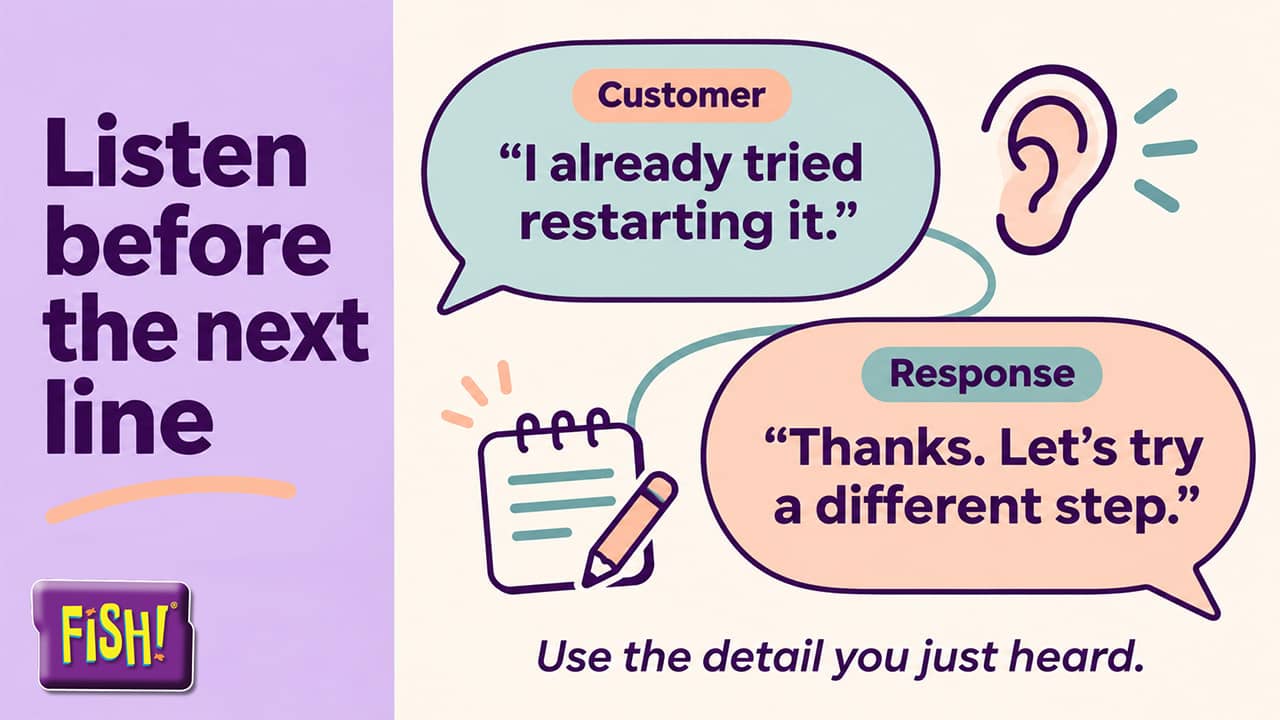
When a customer says they already tried something, the next scripted step no longer fits. Using the detail you just heard keeps them from repeating themselves.
How should managers train a team to use scripts while staying present?
Managers can introduce scripts as shared support, then practice the judgment that makes them work. Invite employees to identify where a framework helps and where it could sound stiff. Role-play common situations by following the key points, then adapting to a customer detail that was not in the original scenario.
During coaching, praise specific presence behaviors. A manager might say, “You noticed the customer had already tried that step, so you avoided making them repeat it,” or “You explained the limit clearly and stayed with the problem.” This reflects Make Their Day because the employee’s care and judgment were seen.
Review a small sample of calls or chats for accuracy and connection. Ask whether the employee included required information, addressed what the customer said, matched the tone to the moment, and gave a clear next step. Use the answers to improve the script and training together.
Managers also set the standard through their own behavior. When a team member raises a concern, Be There by giving it real attention or setting a specific time to talk without distraction. When a difficult shift ends, Choose Your Attitude alongside the team by naming what was hard and what the team can bring to the next interaction. FISH! works through ongoing conversation about who people want to be at work.
The words are only the beginning
A customer service script can steady a conversation, yet the customer remembers the experience created around those words. Give employees the facts, the boundaries, and the freedom to listen. Then invite them to Be There, Choose Your Attitude, Make Their Day, and Play with better ways to help.
Try the FISH! Philosophy with your team
If your team wants to bring more presence and flexibility to customer service scripts, try the FISH! Philosophy upgraded trial. Your team receives 30 days of access to the FISH! film and its digital guides, giving you a shared way to talk about attention, attitude, service, and creative problem solving. Use the trial to review one script together, practice it in real situations, and discover how the four practices can make each customer interaction feel more human.

Frequently Asked Questions
How often should a customer service script be updated?
Review a script when policies, products, systems, or customer questions change, and also look at it on a regular schedule. Feedback from employees and customers can reveal confusing wording or missing situations before those problems grow.
Should every employee use the exact same customer service phrases?
Employees should use the same required facts and safeguards, while their wording can remain personal. A shared framework protects consistency and accuracy; thoughtful adaptation helps the customer feel heard.
How do you measure whether scripted responses are working?
Combine quality checks with customer feedback, repeat-contact rates, resolution time, and employee input. A fast interaction that leaves the customer confused is not a complete success, so review both efficiency and the quality of the connection.
What should a team do when a script conflicts with a customer’s real need?
The employee should follow safety, privacy, and compliance requirements, then pause to understand the need and involve a manager when the situation falls outside the framework. That moment is useful feedback for improving the script.
Can scripts help employees who are nervous on the phone?
Yes. A short framework can reduce the pressure of finding an opening, asking for details, and closing the call. Practice should then help the employee look up from the words, listen closely, and respond naturally.