
Passion at work can seem reserved for people with dream jobs. Yet one of the clearest examples came from a Pittsburgh intersection, where traffic officer Vic Cianca turned a loud, repetitive task into a daily performance. His story shows that passion can grow from the choices we make about how we show up.
What can a dancing traffic cop teach us about passion for work?
Long before he discovered the energy and excitement of the Pike Place Fish Market, John Christensen looked for people who worked with passion. One example came when he saw the movie Flashdance in the early 1980s. It follows a welder, played by Jennifer Beals, who dreams of becoming a dancer.
For John, the most memorable scene was a real-life cop directing traffic in downtown Pittsburgh. Vic Cianca stood in the middle of the intersection, dramatically gesturing, waving, bowing, and even pleading as he kept traffic moving. When drivers took too long, he acted as if he were falling asleep. Sometimes he used a leg to point the way. He was completely into his job, having fun, and everyone who passed by loved it. In the movie, Beals’s character even brought some of the cop’s moves into her dance routine.
That scene was all about passion. Most of us have a passion for something, whether it is music, sports, art, gardening, or collecting stamps. Passion for directing traffic may be harder to picture, so John looked up the officer and learned that Cianca died in 2010 at age 92.
Why did Cianca bring so much energy to his job? Directing traffic serves an important purpose, while the task itself is loud, repetitive, and often thankless. We cannot know exactly what was happening inside him. His playful style may have helped him stay engaged as much as it entertained people passing through the intersection. That is Play in the FISH! sense: bringing curiosity, energy, and creativity to the way you work.
That possibility matters because passion at work brings energy, care, and personal commitment to the task and to the people affected by it. It can include excitement, curiosity, pride, meaning, or a willingness to make the experience better for someone else. Cianca may have been passionate about life, and he chose to bring that passion into his working day. That is the heart of the FISH! Philosophy: who are you being while you are doing what you are doing? You can bring that question to a customer call, a spreadsheet, a classroom, a repair job, or a traffic intersection.

Two people can do the same task and leave very different impressions, because passion shows up in the energy, creativity, and care someone brings to the work.
Why does passion at work matter?
Passion changes the experience of work for the person doing it. Care and creativity can make a routine task feel more purposeful, while helping you notice opportunities to improve, learn, serve, and connect. Your work can connect you to the person you want to be and to the duties in front of you.
Passion changes the experience of other people, too. Cianca made people smile during a part of the day they enjoyed least. Drivers still had to wait, yet the intersection felt different when he was there. His attitude gave them a brief moment of surprise and delight.
This is where Make Their Day and Be There matter most. Make Their Day means creating a moment that leaves someone better off by showing that their presence, effort, or experience matters. Be There means giving complete attention, including physical, mental, and emotional presence. In a difficult moment, a person who is fully there can notice what another person needs and respond with genuine care.
The effect can come through a small action. A receptionist who notices a worried visitor, an analyst who explains a confusing report patiently, or a coworker who thanks an overnight team can bring passion to work. The person receiving that care may carry a better experience into the rest of the day.
Passion can also help a team do better work. Curiosity encourages better processes, meaning connects people to those they serve, and enthusiasm can make collaboration easier. Over time, these choices shape how customers and coworkers experience the team.
Can you be passionate about a job you do not love?
Yes. You can be passionate about the way you work, the people it helps, or the values it lets you practice, even when parts of the job are frustrating. Passion can live in the care you bring to the next useful action.
Choose Your Attitude begins with noticing what is happening and deciding what attitude you want to bring before the day or the next conversation. The choice may happen again after a difficult customer, setback, or change of plans. It can include asking for support, naming a real problem, or taking a short reset so you can return with more attention.
Passion is a choice about who you are being, and it becomes visible through repeated choices. That is why a person can bring passion to ordinary work. The source of the energy may be a value such as service, learning, reliability, creativity, fairness, or kindness. The job gives you a place to express that value.
How do you find passion in your work?
Build passion by looking for connections already present in your work and creating new ones. Try these approaches during the next week.
Find the people your work helps
Start with the human result behind the task. A form may help a family receive care. A clean room may help a guest rest. A repaired system may keep a small business running. A carefully checked number may help a team make a sound decision.
If you rarely see the final customer, ask a teammate or leader to explain the chain. Read a customer note, join a handoff, or follow one request from beginning to end. Seeing who benefits gives effort a clearer purpose.
Add your creativity to routine tasks
Play, in the FISH! sense, means bringing curiosity, energy, and creativity to the way you work. Play includes games, jokes, and the way you solve problems. If work is what you do, Play is part of how you do it.
Look for one routine that feels unnecessarily hard, dull, or confusing. Ask, “What could make this smoother or more useful?” You might reorganize information, create a helpful template, change the order of steps, or find a clearer way to explain something. Test the idea within the boundaries of your role, learn from the result, and share what you discover. Play needs room for trial and error. A new approach may need adjustment, and learning from an attempt is part of the value. It stays respectful and useful alongside Be There, Make Their Day, and Choose Your Attitude.
Connect tasks to what you value
Write down three qualities you want people to experience from you at work, such as patience, courage, precision, warmth, or imagination. Choose one task on your calendar and decide how to express one quality while doing it.
If you value respect, give a colleague your full attention during a handoff. If you value learning, use a repetitive task to notice a pattern. If you value service, make the instructions easier for the next person.
Bring your personal spark into the day
Think about what gives you energy outside work: storytelling, solving puzzles, encouraging people, making things, or finding order in confusion. Let that strength guide a responsible way to enrich the work already in front of you.
Cianca brought his own style to an intersection. You can bring warmth, wit, precision, or inventiveness to a meeting, shift, or quiet afternoon.
Stay present for one person at a time
Distraction drains passion because it separates you from the real moment. During your next conversation, put away the competing task, listen until the other person finishes, and notice what they may be feeling. Be There is a practical way to reconnect with meaning because it puts you in contact with the person your work affects.
From there, look for a sincere way to Make Their Day. Thank someone for a specific contribution, explain why it helped, or make a difficult handoff easier. Recognition works best when it is genuine and connected to what the person actually did.
How can leaders make room for passion on a team?
Leaders influence whether people feel free to bring their energy and ideas to work. The first step is example. A leader who practices Choose Your Attitude in front of the team shows how to respond to uncertainty, criticism, and setbacks without ignoring real problems. People learn most from what a leader consistently does, so actions carry more weight than a slogan about enthusiasm.
Leaders make room for passion by inviting ideas. Ask where a process gets in the way of good work. Give people a clear playing field: explain standards, safety needs, customer commitments, and boundaries, then allow room for judgment and creativity. When the team helps define how it works, people develop more ownership.
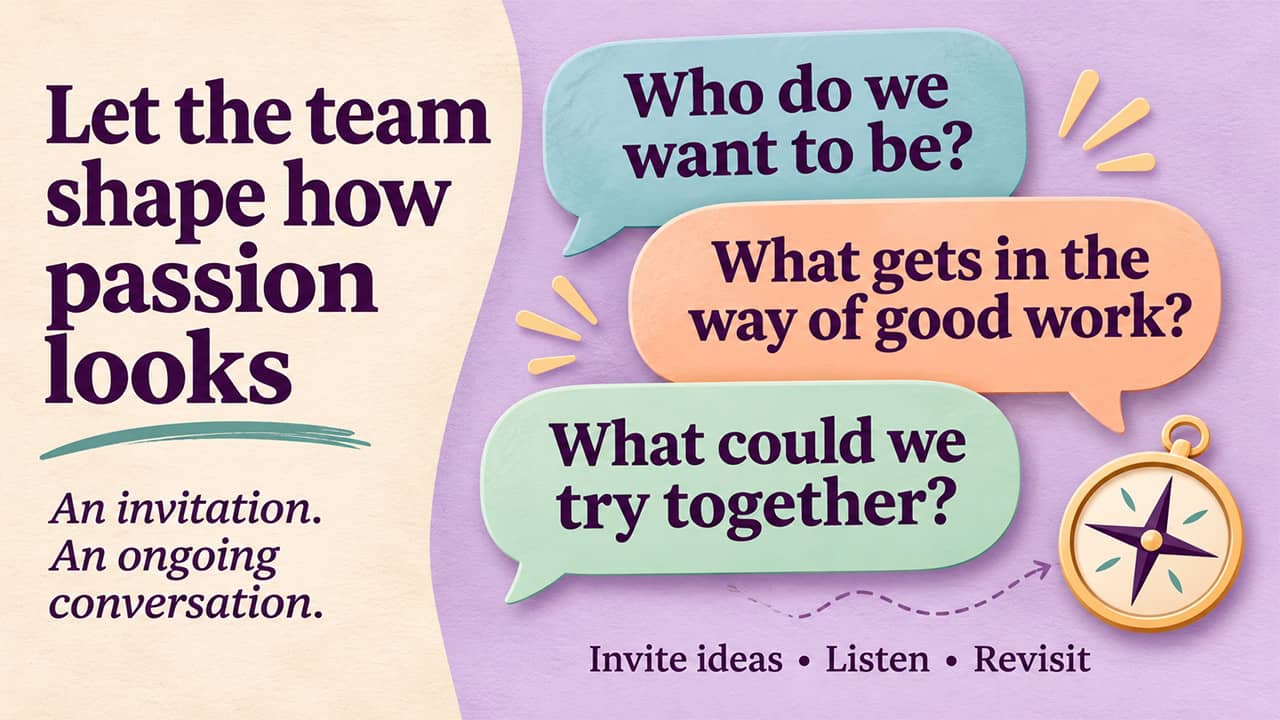
Leaders make room for passion by asking the team who it wants to be, what slows good work down, and what to try next, then coming back to those questions over time.
Notice effort that numbers miss. A person who calms an upset customer, helps another department, catches an error, or improves a handoff may have made a large difference without producing a dramatic metric. Specific recognition shows that someone is paying attention. Offer it in a form that suits the person, privately or publicly, and make sure appreciation reaches every shift and role.
Leaders should also protect healthy limits. Passion grows through purpose, connection, creativity, and choice. It becomes harmful when people feel they must be available all the time, prove their worth through exhaustion, or tie their entire identity to performance. A passionate workplace respects rest, workload boundaries, honest feedback, and the need for help. It gives people room to care deeply without asking them to spend themselves completely.
Finally, invite the team into an ongoing conversation about who it wants to be while doing its work. The FISH! Philosophy is an invitation and a journey. A healthcare team, warehouse, school, office, or public agency will express passion in its own way.
Questions to reflect on
- What gives you an inner spark, and how could you bring one part of it into a routine task this week?
- Which people benefit from your work, even when you do not see them directly?
- Where could Play help you test a more creative or useful way to handle a recurring problem?
- When work becomes difficult, how can you Be There for a colleague or customer?
- What attitude do you want people to experience from you during your next busy day?
A small choice can change the whole day
Vic Cianca made a memorable impact from the middle of an intersection. His example reminds us that passion at work can live in a choice, a gesture, a moment of attention, or a better way to serve. You do not have to wait for a perfect role to begin. Choose one ordinary task, connect it to someone who benefits, and bring a little more of who you want to be into the way you do it.
Try the FISH! Philosophy with your team
Invite your team to try the FISH! Philosophy upgraded trial, which gives you 30 days of access to the FISH! film and its digital guides. Use the film and guides to start conversations about passion at work, explore Choose Your Attitude, Be There, Make Their Day, and Play in your own setting, and turn one small idea into a shared practice.

Frequently Asked Questions
How can I describe my passion for work in an interview?
Describe a kind of contribution you care about, then give a specific example of how you bring it to life. Explain the people or result your work helps, the choices you make when a task is difficult, and what you learned from the experience.
What if my workplace gives me no freedom to be creative?
Start with a small improvement that stays within your responsibilities, such as a clearer handoff or a better way to organize information. If the larger limits keep blocking good work, bring a specific example and a practical request to your manager or consider whether the environment fits the way you want to work.
Can passion at work grow after I have been in the same role for years?
Yes. Familiar work can reveal patterns, people, and problems that were harder to see at first. Choose one process to study, one relationship to strengthen, or one value to express more deliberately, and let fresh attention reopen the work.
How do I keep passion from turning into burnout?
Keep passion connected to purpose and sustainable habits. Protect recovery time, share the load, ask for help early, and notice whether your commitment is helping you serve well or pushing you past your limits.
What is one practice I can try tomorrow?
Before work begins, choose the attitude you want to bring and name one person your work will help. During the day, give that person or a coworker your full attention, then look for one genuine way to make their day better.