Relational leadership is the daily work of building trust, knowing your people, and helping them do meaningful work together. It turns leadership from a title into a relationship that gives people room to grow while keeping the team responsible for strong results.
A story about Coach Tony shows what this looks like over time. His example offers a useful question for any manager: who are you being while you are leading people through the work?
The Best Game Plan
Some thoughts from our own Phil Strand, co-author of FISH! Tales and Schools of FISH!:
Recently I heard a football coach talking about the off-season work that had led to his team’s success. He mentioned early morning lifting sessions, voluntary summer workouts, long hours of studying game film. But the biggest key, he said, was developing trust with his team.
It reminded me of a high school football coach, named Tony, that I met a few years ago at a FISH! For Schools event. Tony said he put in a lot of hard work on the field, but his most important focus was on building relationships.
“When I look back at my time as a player and student, I wish my coaches had gotten to know me better as a person, not just for what I did on the field,” he says. “I try to remember that, because now I’m in their shoes.”
Tony said “you never know when you’re going to be needed, so you have to always be focused on being there.” As an example, he told me about a player whose mother died of cancer in the off-season. “His dad loved his kids,” Tony said, “but he was kind of a hard-nosed guy and I’m not sure he was able to talk real openly with them about what had happened.”
“I told this young man, ‘If you ever need to talk how you’re feeling or just cry a little bit, whatever, just stop by my office, you’re always welcome.” We spent a lot of time talking and I did a lot of listening.”
The student told Tony he really wanted to start on the football team the next year. “He wasn’t a real naturally gifted athlete, and had never started. I told him, “I understand you want to do this for your mother, but I can’t just give it to you. Your mother wouldn’t want it that way. You’re gonna have to earn it.’ You know what, he worked really hard, and he earned that starting spot. He had a nice season and we had a good team.
“On graduation day, my wife and I were getting ready to go the ceremony. This kid pulls up in my driveway. He was wearing his cap and gown, came running up and he hugged me. I said, What are you doing?” He said. “I just wanted you to know I’m gonna miss you . . .”
Tony’s growling voice—normally used to bark out plays—softened and his stern eyes filled with tears. “I tried to be there for that young man,” he said, “and he was there for me. And I told my wife, ‘That’s why I do this work.’”
What does the story show about relational leadership?
Coach Tony’s example brings the FISH! Philosophy into one relationship over time. He remembered wishing his own coaches had known him “as a person, not just for what I did on the field,” and he carried that lesson into his work with students. His approach shows how relational leadership grows through attention, patience, and clear standards.
Be There is the clearest practice in Tony’s choices. He believed “you never know when you’re going to be needed,” so he offered a grieving student a welcome place to talk. Tony said, “We spent a lot of time talking and I did a lot of listening.” In the FISH! Philosophy, being present means physical, mental, and emotional attention. For a manager, that means putting down the task for a moment, giving the conversation full attention, and staying open when the topic is difficult. A person can feel the difference between being heard and being managed through a conversation as quickly as a customer can.
Make Their Day appears in the care Tony offered across the relationship. He opened his office, listened when the student needed support, and recognized the work behind the student’s goal. He also understood the meaning of the graduation-day visit and the student’s words, “I’m gonna miss you . . .” Recognition and encouragement can be quiet and personal. They tell people that their effort and presence have been seen, especially when the response fits the person.
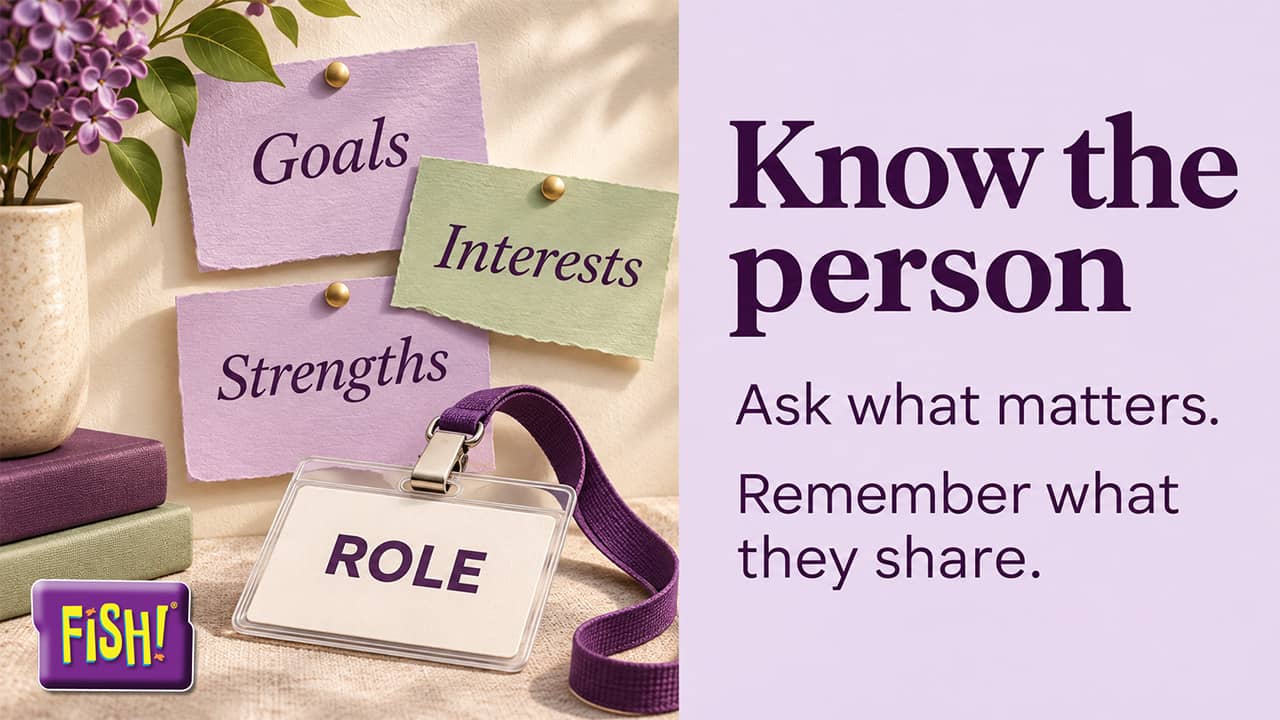
A role badge says what someone does, while their goals, interests, and strengths tell you who is doing it, and remembering those details is how trust begins to build.
Tony also held a high standard with care. When the student wanted to start, Tony explained that he would have to earn the spot. That decision kept the opportunity meaningful while giving the student a clear path to work toward. Relational leadership includes this kind of honest support.
You can try these practices this week by choosing one person to know beyond a job title, scheduling one undistracted conversation, offering one specific acknowledgment, and following up on what you hear. Small actions become credible when they happen repeatedly.
What is relational leadership?
Relational leadership is a relationship-based leadership style built on trust, shared purpose, and attention to the people doing the work. Results come through people, with relationships shaping how the work gets done. A relational leader still sets direction, makes decisions, and measures performance, while recognizing that the quality of the relationships shapes how well those responsibilities can be carried out.
A transactional approach often centers on exchanges: goals for rewards, instructions for compliance, or problems for correction. Those tools have a place in every workplace.
Relational leadership adds the human connection that helps people speak honestly, use judgment, learn from mistakes, and take ownership of the result.
Relational leadership can overlap with servant leadership, coaching, people-first leadership, and caring leadership. Across these approaches, leadership is practiced with people through trust, purpose, and shared responsibility.
What are the elements of relational leadership?
A commonly described relational leadership model includes five connected elements. They give managers a useful way to examine everyday choices.
Inclusion
People need a real way to contribute, especially when a decision affects their work. Inclusion means making space for different views and taking those views seriously. A manager can ask who has useful experience, who has not been heard, and what information the team needs before moving forward.
Empowerment
Empowerment gives people appropriate authority, support, and room to act. It includes coaching, clear expectations, and permission to make choices within agreed boundaries. Trust grows when a manager follows up on commitments and lets capable people own their part of the work.
Purposefulness
Purpose connects a task to a reason that matters. A team can understand what it is doing and why the work helps customers, coworkers, or the wider mission. Relational leaders return to that purpose during change because shared meaning helps people make better decisions when the plan shifts.
Ethics
Ethics means treating people with honesty, dignity, and fairness, including when a decision is uncomfortable. It also means matching words with behavior. People notice whether a leader keeps promises, shares credit, tells the truth about constraints, and protects the standards the team depends on.
Attention to process
Relational leadership pays attention to how results are produced. A target reached through fear, confusion, or favoritism can damage the team that reached it. Managers should examine the meetings, handoffs, feedback, and daily habits that shape the work, because process teaches people what the organization truly values.
Why does relational leadership matter?
Trust makes honest information easier to share. When employees believe a manager will listen and respond fairly, they are more likely to raise a concern early, ask for help, and offer an idea. That improves learning and gives the team a better chance to solve the real problem.
The same conditions support employee engagement. People bring more energy to work when they feel connected to the team, the purpose, and the person leading them. Engagement also grows when recognition is specific and when people can see how their choices affect others.
Performance benefits from this connection because people can use judgment instead of waiting for every answer. A trusted team can adapt, coordinate, and recover more quickly. Relational leadership also supports accountability. High standards are easier to accept when people know the manager sees their effort, understands their context, and will help them improve.
How can a manager practice relational leadership every day?
1. Know people beyond their role
Learn what each person cares about, what they are learning, and what helps them do their best work. Remember the details they choose to share, then use them with respect. This is a way to see the whole person who is contributing to the team while honoring their privacy.
2. Listen more than you talk
In a one-on-one, ask a clear question and let the silence do some work. Keep your attention on the speaker instead of preparing your reply. Be There requires complete presence, so notice when your mind wanders and bring it back. Before offering advice, ask, “What would be most useful from me right now?”
3. Be available before a crisis
Create regular openings for conversation so support does not begin only after something goes wrong. A short check-in, open office hour, or walk between meetings can make it easier for someone to speak. If you cannot give full attention, name a specific time when you can and then honor it.
4. Recognize the behavior and its impact
Say exactly what you noticed and why it helped. “You stayed with that customer until the handoff was clear, and the next team could start without losing time” carries more meaning than “Good job.” Make Their Day depends on awareness and sincerity, so match the form of recognition to the person.
5. Hold high standards with care
Care includes telling the truth about what a role requires. A manager can support someone through a setback while still asking for preparation, practice, and follow-through. Coach Tony’s example includes that balance: he cared about the person and held the opportunity to a real standard. Relational leadership makes the path clearer, then helps the person walk it.
6. Invite coaching in both directions
Ask your team what they need from you and what you could do better. Respond without defending every choice. When a leader accepts useful coaching, feedback becomes part of the relationship instead of a once-a-year event. The team learns that improvement belongs to everyone, including the person with the title.
What does relational leadership look like outside sports?

Routine work gains meaning when a leader notices it, explains who it helps, and recognizes the people doing it, which keeps purpose visible during ordinary days.
The setting changes, but the habits travel well.
- A hospital unit manager checks in with a new nurse after a difficult shift, listens to what happened, and then reviews the safety standard that still must be followed.
- A retail supervisor learns which employees prefer private recognition and leaves a specific note after they help a customer solve a problem.
- A project manager invites the person closest to a technical issue into the decision, explains the purpose, and gives them authority over the next test.
- A school principal keeps regular time for teachers before a crisis, so concerns about students or workload can surface early.
- An IT leader asks an anxious employee to explain a system failure without interruption, then works with them to build a stronger process.
- A nonprofit director connects a routine task to the people served and celebrates the behind-the-scenes work that makes the mission possible.
Each example combines relationship and responsibility. The leader pays attention to the person, the purpose, and the way the work gets done.
How do you start leading through relationships this week?
Choose one relationship that deserves more attention and make a small, specific commitment. Have a conversation with no phone or open laptop competing for your attention. Ask what is helping, what is getting in the way, and what support would make the next week better. Then follow up on what you heard.
From there, look at one team habit. Does it help people speak honestly, recognize one another, and do quality work? Choose Your Attitude can help you enter that review with openness. Be There can help you hear the answer. Make Their Day can guide the appreciation that follows, and Play can help the team imagine a better way forward.
A better game plan for leaders
Relational leadership grows through ordinary moments: a manager who listens, a standard explained with care, a contribution noticed, and a promise kept. Over time, those moments create the trust people need to learn, contribute, and stay connected to the work.
Try one of those moments this week. Your team may remember the conversation long after the task is finished.
Try the FISH! Philosophy with your team
The FISH! Philosophy upgraded trial gives your team 30 days of access to the FISH! film and its digital guides. Use the film and guides to start a shared conversation about presence, attitude, recognition, and energy, then connect those ideas to the relationships and standards your team wants to build at work.

Frequently Asked Questions
Is relational leadership the same as being friendly?
Friendliness can help a relationship, but relational leadership also requires clarity, fairness, accountability, and sound decisions. A manager can care about people deeply while giving direct feedback and addressing poor performance.
Can relational leadership work in a remote team?
Yes. Remote managers can create presence through focused video or phone conversations, dependable follow-up, clear communication, and thoughtful recognition across distance. The medium changes, while the need for attention and trust remains.
How can a manager measure relational leadership?
Look for practical signals such as whether people raise issues early, understand the purpose of their work, receive useful feedback, and follow through on commitments. Team conversations, one-on-ones, and carefully designed pulse questions can reveal patterns that a single score may miss.
What should a manager do when trust has already been damaged?
Start with ownership and consistent behavior. Name what happened, listen to the impact, make a specific change, and keep the change long enough for people to believe it is real. Trust returns through repeated evidence and dependable follow-through.
How does relational leadership affect accountability?
It makes accountability more human and more useful. Expectations are clear, progress is discussed early, and feedback focuses on the work and its impact, so people have a fair chance to improve while the standard stays visible.