Psychological safety in the workplace grows through small moments: how a manager receives a new idea, how a coworker responds to a mistake, and whether people feel heard when they raise a concern. One careless sentence can close that door, while a thoughtful response can keep learning, creativity, and trust moving.
The story below shows why leadership behavior matters in a meeting. Read it, then use the questions and practices that follow to look at your own team.
“That’ll Never Work!”
The director of organizational development for a large corporation shared the following story with us:
***
Recently we were in a brainstorming meeting. The ideas were coming fast and furious until our newest employee, a young man we hired two weeks prior because of his energy and creativity, threw out an idea. Almost before the idea had even left his lips, one of the senior people in the meeting said sarcastically, “That’ll never work.”
There was a moment of uncomfortable silence and the meeting continued. I noticed that our new employee had slunk down in his chair and never said another word during the meeting. He didn’t say a word in meeting we had two days later either. I wondered if he would ever feel free to contribute the creative spirit we had seen in him.
This incident transported me back to fifth grade. My teacher had placed a basket of fruit at the front of our class and asked us to sketch it. I worked hard at my drawing, and when it was complete, I proudly strode up to my teacher to show her my work of art. My teacher glanced down at my sketch and said, “You used the wrong paper.” She then turned her attention to another student. Dejected, I shuffled back to my seat and slunk down in my chair. I never tried to do anything artistic again.
***
Our words and actions can heal or hurt, build or undermine another person’s self-confidence, improve relationships or sow distrust. This is true for managers, supervisors and leaders at any level.
What does this story show about the FISH! practices?
The account shows how quickly a person can decide whether it is safe to participate. That decision may happen silently, but it affects the whole team. When people hold back, the group loses information, ideas, and early warnings that could improve the work.
The FISH! Philosophy gives teams a useful language for responding to that moment. Choose Your Attitude asks each person, especially a leader, to decide how they want to show up before and during a difficult exchange. A leader who pauses, stays curious, and protects the conversation is choosing an attitude that supports the team’s future.
Be There means complete presence. That includes physical attention, mental attention, and emotional attention when someone sees a situation differently. In a meeting, being there can look as simple as putting aside a device, listening to the whole idea, and noticing the effect of a sharp response on the room.
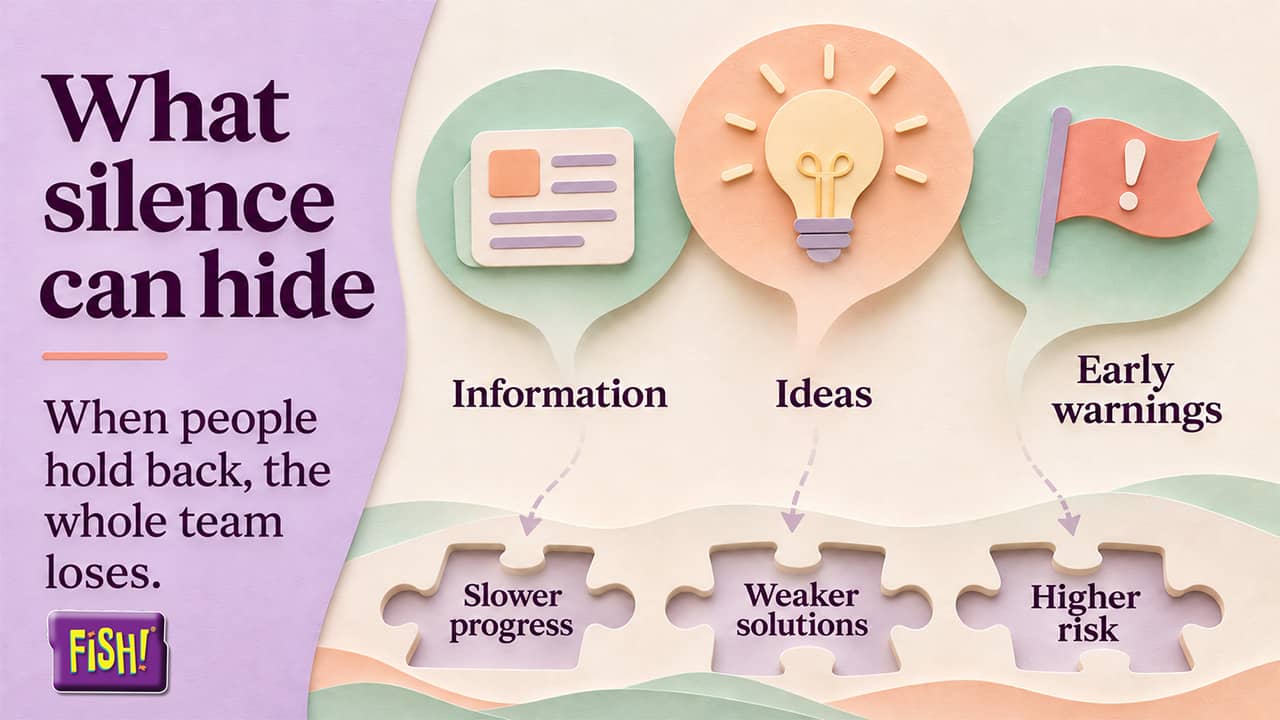
When people stop speaking up, a team loses the information, ideas, and early warnings it needs, and the cost shows up later as slower progress, weaker solutions, and higher risk.
Make Their Day means creating a moment that leaves another person better off. That does not require praise for every idea or agreement with every suggestion. It can mean thanking someone for the effort, asking them to explain more, or recognizing the courage it took to speak up. Sincere recognition tells people their contribution matters.
Play gives a team room for energy, experimentation, and possibility. In a work setting, that may mean making brainstorming lighter, welcoming a rough first idea, or treating curiosity as useful. Play does not lower the quality of the work. It helps people explore before the team decides what deserves more time.
Together, these practices help a team make a different choice after a hard moment. Someone can repair the exchange, invite the person back into the conversation, and make it easier for the next person to speak. This week, try one small action: ask for an unfinished idea, thank a coworker for naming a problem, or say, “Let’s stay with that for a minute.” Then notice what becomes possible.
What is psychological safety in the workplace?
Psychological safety is a shared belief on a team that people can speak up, ask questions, offer ideas, and admit mistakes without being embarrassed or punished. It does not mean every idea will be accepted or every decision will go someone’s way. It means people can take the interpersonal risk of contributing and still expect to be treated with respect.
Harvard Business School professor Amy Edmondson developed influential research on psychological safety through her studies of teams and learning. Her work helped show that teams can perform better when members feel able to discuss errors, ask for help, and share information that others may need to hear. The idea is about the team climate, so it cannot be created by telling employees to be more confident. Leadership behavior and everyday coworker responses shape it over time.
Psychological safety at work also works with high standards. A safe team can expect careful work, meet deadlines, and challenge weak proposals while keeping people’s dignity intact. Clear expectations give people direction; psychological safety makes it more likely they will speak early when they need help or see a risk.
Why does psychological safety matter?
People learn faster when they can ask questions before confusion becomes a larger problem. They also catch mistakes earlier when employees can say, “I may have missed something,” or “This process could create a problem,” without fearing a public put-down. That employee voice gives a team access to facts that hierarchy and politeness might otherwise hide.
Psychological safety supports innovation because new ideas often arrive incomplete. Brainstorming depends on sharing possibilities before anyone knows which ones will work. If every suggestion is judged too soon, people learn to offer only safe ideas, and the team loses variety.
FISH! adds an important human question: Who are you being while you are doing what you are doing? A leader may be under pressure and still choose to be present, respectful, and curious in the next conversation. Those choices become part of the team culture, especially when others see them repeated.
What are signs a team lacks psychological safety?
A team may lack psychological safety when people stop offering ideas unless a senior person has already approved them. Meetings become quiet, the same few voices do most of the talking, and employees wait until after the meeting to share concerns privately. Silence can look like agreement while hiding confusion or disagreement.
Other signs include:
- Questions are treated as evidence that someone is unprepared.
- People avoid admitting mistakes until the problem is impossible to hide.
- Brainstorming ends quickly because suggestions receive instant criticism.
- Employees use private messages and side conversations to discuss risks.
- The team looks for a person to blame before it understands the process.
- A leader reacts defensively to bad news or asks who caused it.
- Newer employees rarely speak, even when they have useful expertise.
- People agree in the room and resist the decision later.
These patterns can point to a team climate that needs attention. Leaders can learn more by asking what made participation difficult and watching whether their response encourages honest answers.
How can leaders create psychological safety?
Psychological safety is built through repeated leadership behavior, so begin with the moments that happen every week. The goal is to make speaking up a normal part of doing good work.
Respond to new ideas with curiosity
When someone offers an idea, slow down before judging it. Ask what problem it could solve, what assumptions it depends on, or how the team might test it on a small scale. You can decide later that the idea needs work. The first response should leave room for thought.
Here are eight alternatives to shutting an idea down:
- “Tell me more about how you see this working.”
- “What problem would this help us solve?”
- “What would we need to learn before trying it?”
- “Which part of this idea feels strongest to you?”
- “How could we test a small version of it?”
- “Who else sees a possibility here?”
- “What concerns should we work through together?”
- “Thank you for putting that forward. Let’s look at it carefully.”
These responses do not promise approval. They create enough space for the team to understand the suggestion before evaluating it. That is where Play and Be There can work together: the team explores with energy while the speaker receives full attention.
Invite voices that have not been heard
Inclusive meetings need more than an open invitation at the start. After a few people have spoken, ask, “Who have we not heard from yet?” Give people time to think, and let them pass without pressure. In a hybrid meeting, watch the chat and the people who may be hesitating before unmuting.
A leader can also ask for written ideas before a discussion, rotate who opens a topic, or invite someone with relevant experience to comment first. These choices reduce the advantage held by the fastest or most senior speakers. They also show that employee voice is part of the work, not a special favor.
Thank people for raising problems
When someone points out a risk, start with appreciation. “I’m glad you caught that,” or “Thank you for telling us while we can still act” helps the team connect honesty with responsible work. Then ask what support or next step would help.
The response should fit the seriousness of the issue. A warm tone does not replace action, and appreciation becomes hollow if leaders ignore the concern. Choose Your Attitude asks leaders to bring steadiness so the team can focus on learning and repair.
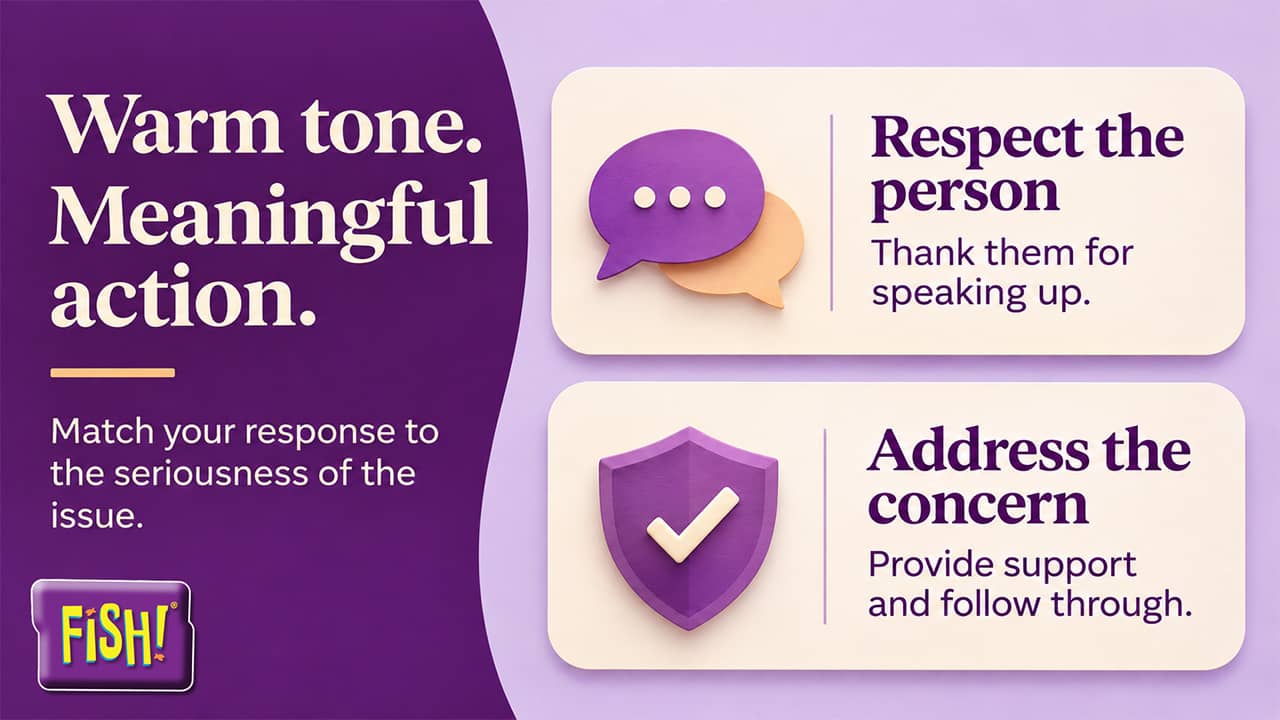
When someone raises a problem, thank them first, then show that speaking up mattered by acting on the concern in a way that fits how serious it is.
Repair a moment after “That’ll never work”
Every team will have a sharp exchange at some point. Repair matters because people notice whether a leader protects status or protects learning. If a dismissive sentence lands in a meeting, address it soon and directly: “I responded too quickly. Please finish your thought.” You might add, “We may decide not to use the idea, but we owe it a fair look.”
The person who spoke may need a private check-in as well. Ask how the moment felt and what would make it easier to contribute next time. If you were the person who made the comment, take responsibility without explaining it away. A short, sincere apology can reopen a conversation that silence would close.
Set high standards with clear, respectful feedback
Psychological safety needs candor. Teams should know what good work requires, how decisions will be made, and which risks cannot be ignored. Give feedback about the work, the evidence, and the next action, while treating the person as someone who can learn and improve.
For example, say, “The test results do not support this approach yet. Let’s review the assumptions and decide what evidence we need,” rather than attacking the person’s judgment. This keeps standards visible and makes improvement possible.
Model learning from mistakes
Leaders can share what they missed, what they learned, and what they will do differently. They can ask, “What did we expect to happen?” “What actually happened?” and “What should we change?” Those questions help the team study the work instead of hiding the event.
Be There is especially important here. Listen without preparing a defense, notice when someone is withdrawing, and give the conversation your full attention. People learn from the leader’s response as much as from the formal review.
How can a team practice psychological safety at work this week?
Choose one meeting and make its purpose explicit: explore ideas, identify risks, or decide between options. Tell the team which mode you are using so people know whether a suggestion is being developed or evaluated. During exploration, keep asking questions before making judgments.
At the end, ask two quick questions: “What is one concern we should not carry forward?” and “What is one idea we should explore?” Thank people for answers and record the follow-up. In the next meeting, report what happened with those points. Follow-through is one of the clearest ways to build team trust.
A safer team begins with the next response
Psychological safety is made visible in ordinary conversations. A team learns whether speaking up is welcome by watching what happens after a question, a concern, an imperfect idea, or an honest mistake. The FISH! Philosophy offers practices that help people choose their attitude, be there, make someone’s day, and bring play into the work in a way that supports learning.
Try changing one response this week. Ask one more question before judging, invite one quieter voice, or thank someone for making a problem visible. Small choices can change the conversation, and repeated conversations shape the culture.
Try the FISH! Philosophy with your team
If you want a shared way to keep practicing these ideas, try the FISH! Philosophy upgraded trial. Your team gets 30 days of access to the FISH! film and its digital guides, giving you a simple starting point for conversations about presence, attitude, recognition, play, and psychological safety at work.

Frequently Asked Questions
How long does it take to build psychological safety?
There is no fixed timeline because team history, leadership habits, and the work itself all matter. People often notice change when leaders respond consistently, follow through on concerns, and repair mistakes instead of treating one meeting as a complete solution.
Can a team have psychological safety during conflict?
Yes. Safety makes it easier to name disagreement and work through it with clear standards and respect. The team still needs boundaries for harmful behavior, but disagreement about ideas can be part of healthy learning.
What should a manager do if employees do not trust them yet?
Start by listening and asking what would make it easier to speak honestly, then avoid defending yourself during the first conversation. Keep small promises, acknowledge your own mistakes, and show through repeated actions that difficult information will receive attention rather than punishment.
How can remote teams build psychological safety?
Remote teams can use agendas, written idea collection, inclusive turn-taking, and clear follow-up so quieter members have more than one way to contribute. Leaders should also give full attention on calls and make space for private check-ins when a public meeting is not the right setting.
Is psychological safety the same as being comfortable?
Comfort can be part of a healthy team, but psychological safety also supports the courage to raise a hard issue or challenge a popular idea. A strong team combines respect with enough candor to improve the work.