Learning how to be more present can change an ordinary conversation into a moment of real connection. It starts with giving your full attention to the person and the moment in front of you, even when your schedule is full and the moment seems small.
Larry Alexander’s story about seeing FISH! through the eyes of an eye doctor and a grandfather offers a useful way to think about presence. Read the original story first, then use the questions and practices below to bring its lesson into your work and home life.
A FISH! Tale: Eye Lessons with Larry Alexander
From a FISH! Fan, Larry Alexander, OD FAAO:
I have been a fan of The FISH! Philosophy for years, applying it successfully in my practice to create an engaging and caring environment for our patients and each other. FISH! first emerged from Pike Place Fish, in Seattle, Washington, when a group of fish mongers chose to act on the following principles in their daily work: (I’ve been to Pike Place Fish and it’s incredibly inspiring to see the fish mongers in action!)
- BE THERE – BE PRESENT (IN THE MOMENT) FOR OTHERS SO THEY HAVE YOUR FULL ATTENTION
- PLAY – DEMONSTRATE LIGHTHEARTEDNESS AND CREATIVITY
- MAKE THEIR DAY – FOCUS ON LIFTING OTHER’S SPIRITS
- CHOOSE YOUR ATTITUDE – WHATEVER YOUR ATTITUDE IS AT THE MOMENT, YOU CHOSE IT
As an eye care doctor I feel I have been granted a gift – the gift of helping people to see, to minimize vision loss, and to comfort people when they need reassurance. So it was wonderfully ironic when I began to “see” that FISH! was not just for the work place, but that it applied just as powerfully to my personal life. So the question posed by Ronnie (a Pike Place fish monger featured in the FISH! training video,) “Who are you being while you’re doing what you’re doing?” took on a whole new dimension. Recently what I was “doing” was being a Grandpa, and the following story illustrates how FISH! can influence your choices, your actions, and how you impact others.
Early in November 2012 my wife and I had committed to attending our grandson’s 4th grade class, as each student was going to read aloud their compositions. However, on the morning of the composition reading I found myself searching for an excuse for not going. After all, my Grandson’s reading would take all of two minutes, and I’d have to sit through all the other kid’s readings. I had lots of work to do, and missing two minutes of my Grandson’s life couldn’t hurt. In the midst of this rationalizing I felt The FISH! Philosophy welling up from deep inside of me. An attitude of accountability took hold and my excuses evaporate. So off we went to my grandson’s elementary school.
My wife and I sat in tiny chairs near my grandson, who was totally frightened about public speaking. We gently encouraged him and I could tell that he was emboldened by our words and our presence. He straightened in his chair, took off his hoody and mentally prepared himself. When called on, he walked confidently to the front of the class, stood straight, read in a loud and clear voice, and walked back to his seat brimming with self-confidence. The act of overcoming fear and succeeding at this was an important stepping-stone in his life. I was so glad to be there for him and I couldn’t have been more proud of him. Thank goodness for FISH!, otherwise I would have missed this priceless experience.
As eye doctors (or grandpas, or teachers, or moms, or friends, etc…,) we have been endowed with divine favor to reach into lives and make them better. When you “see” through the lens of The FISH! Philosophy, this reality is in sharper focus.
I SHALL PASS THIS WAY BUT ONCE. ANY GOOD, THEREFORE, THAT I CAN DO, ANY KINDNESS I CAN SHOW ANY HUMAN BEING LET ME DO IT NOW, FOR I SHALL NOT PASS THIS WAY AGAIN. –Henry Drummond
Larry J Alexander, OD FAAO
What does this story teach about being present?
The story shows that presence is a choice we make in real time. A person can be physically near someone while the mind is somewhere else, already planning the next task or weighing whether the moment deserves attention. Being present means choosing to give the person in front of you your eyes, your mind, and your care.
That is the heart of Be There, one of the four practices in the FISH! Philosophy. Be There asks for complete presence in three connected ways: physical, mental, and emotional. Your posture, eye contact, and attention send one message. Your listening sends another. Your willingness to stay open when someone sees things differently completes the picture.
The story also brings the other practices into view. Choose Your Attitude helps you decide how you want to show up. Make Their Day grows from noticing what matters to another person, then taking an action that leaves them better off. Play can bring lightness and creativity to an interaction, although presence itself can be quiet and serious. The practices work together without following a required order.
This gives you a simple question to carry into the week: “Who are you being while you’re doing what you’re doing?” Ask it before a patient enters the room, before a coworker begins to speak, or before you walk through your front door. The answer can guide your next choice.

Being present takes more than being in the room. It means turning toward the person, listening without planning your reply, and staying open to how they see things.
What does it mean to be present?
To be present means giving your full attention to the current moment and the person in front of you. You notice what is happening instead of letting your mind run ahead to a later task or loop back through an earlier one. You listen for meaning, emotion, and the details that make this conversation different from the last.
Being fully present also includes your emotional response. You may feel impatient, worried, tired, or eager to fix a problem. Notice that reaction so it does not take over the conversation. From there, stay curious, let the other person finish, and respond to what they actually said.
Presence is a skill of returning. Your mind will wander. You will notice a notification, remember an errand, or start composing your reply. The useful move is to catch that drift and bring your attention back without scolding yourself. General research on attention and mindfulness supports this practical idea: focused attention can be strengthened through repeated practice, and noticing distraction is part of the practice.
Why is it so hard to be present?
Modern work rewards quick responses, constant access, and the feeling of handling several things at once. Phones, alerts, open tabs, busy schedules, and unfinished tasks keep offering your mind somewhere else to go. Even a quiet conversation can feel like an interruption when you are measuring every minute.
There is also a personal obstacle. We decide that a small moment can wait. A child’s question, a teammate’s concern, or a customer’s extra explanation may look minor beside larger demands. That judgment can make us miss the meaning the moment holds for someone else.
Multitasking adds another layer. When attention is split, you may hear words without understanding the person’s point, miss a change in tone, or give a fast answer that creates more work later. The other person can feel the difference. Presence communicates that they matter, and divided attention can make an interaction feel merely transactional.
How can you be more present in daily life?
Notice when your mind has wandered
Use the moment of noticing as a reset. Feel your feet on the floor, look at the person speaking, and identify the next sentence or question you need to hear. A short return, repeated many times, is more useful than waiting for a perfect state of concentration.
Put the phone away
Place your phone out of reach during conversations, meals, and short windows of quality time. Silence alerts when you need to focus. If you are expecting an urgent message, say so clearly and agree on what will happen if it arrives. This small act removes a strong competitor for your attention.
Do one thing at a time
Choose the task or person in front of you, then finish a reasonable portion before switching. Close extra tabs, pause the email draft, or write down the thought pulling you away. A simple capture list reassures your mind that the task will still be there later.
Listen fully before you respond
Let the other person finish. Keep your attention on their words instead of rehearsing your answer, and ask one question that shows you understood. Active listening can be as simple as saying, “Tell me more about that,” or reflecting the concern you heard before you offer a solution.
Show up for what matters to someone else
Ask what this moment means to the person who invited you into it. Their milestone, worry, or request may carry more weight for them than it appears to carry for you. Showing up can take five minutes, a careful note, or a promise to talk at a time when you can give your full attention.
How can you be more present at work?
Dr. Alexander’s eye-care practice offers a helpful model because every patient arrives with a person behind the appointment. A patient may need clear information, reassurance, patience, or room for a question they have been holding back. Presence helps you notice which kind of care the interaction calls for.
Before meeting a patient or customer, take one breath and set aside the previous interaction. Look up when the person enters. Use their name when appropriate, explain what you are doing, and leave room for their questions. When they speak, watch for the details that a standard script might miss. If you need to check a screen or step away, tell them what you are doing so they remain included.
The same approach helps with customers. Give the specific problem your attention, acknowledge the frustration or confusion you hear, and bring in a teammate when helpful. Make Their Day can appear in a sincere act of recognition: thanking someone for a detail, noticing their patience, or following through on a promise.
Coworkers need this attention too. In a meeting, close unrelated work and listen for the idea beneath the words. In a one-to-one conversation, notice whether a teammate needs advice, encouragement, or simply room to speak. If you are unavailable, make a clear plan for later: “I want to give you my full attention. Can we talk at two?” Then protect that time and be there when you said you would.
Remote work calls for the same care. Prepare your space, silence notifications, and use your voice and facial expression to show engagement. Asking someone to repeat information or giving a generic answer can signal divided attention.
Teams can build presence through a short weekly question: “Where did we make someone feel seen this week?” This turns an invisible habit into a shared conversation and invites people to practice the FISH! Philosophy in their own way.
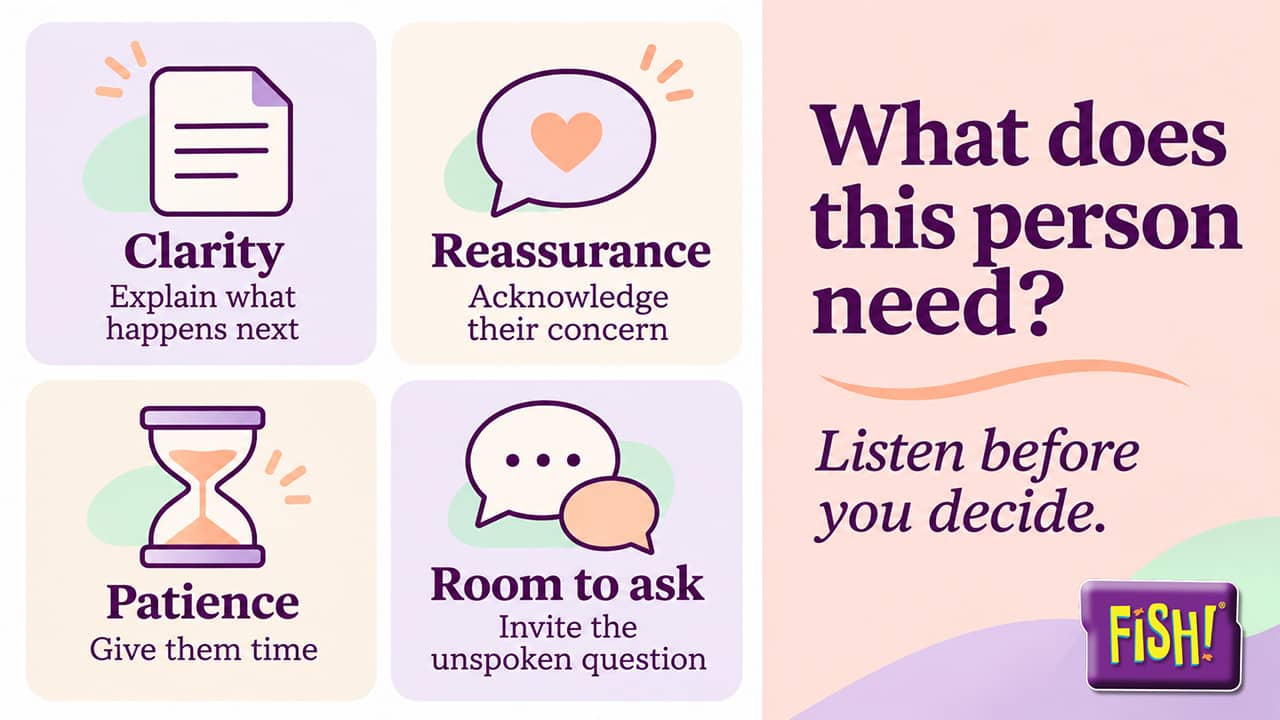
Before you answer a patient, customer, or coworker, take a moment to notice whether they need clear information, reassurance, extra time, or space to ask the question they have been holding back.
How can you be more present with family?
Home is often where people expect your attention and receive your leftover energy. Create small rituals that make presence easier: put phones away during dinner, sit beside a child after school, or make eye contact when your partner begins an important story.
Listen for the request beneath the request. A family member who asks you to look at a drawing, hear a story, or attend a small event may be asking for connection. You can show that the moment matters by asking a follow-up question, remembering a detail later, or telling them what you enjoyed seeing.
Presence also requires honest boundaries. You cannot give deep attention to everyone at every second. When you are tired or occupied, name that kindly and set a real time to return. Children and adults can both handle a pause more easily when they trust that your attention will come back.
Choose Your Attitude can help at the doorway between work and home. Take a short walk, breathe before entering, or say out loud that you are leaving one part of the day and entering another. Arrive with enough awareness to notice the people who are already there.
How can you practice being present this week?
Pick one setting where your attention often slips. For one week, remove one distraction, make one clear promise about your attention, and notice the result. You might put your phone away during the first conversation of each shift, give one coworker an uninterrupted five minutes, or ask a family member what they most want you to hear.
At the end of the day, ask three questions: When did I feel most present? What pulled me away? Where can I choose Be There tomorrow? Keep the answers short. The point is to learn from your own experience and return to the practice in the next moment.
A small choice can change the day
Being present grows through ordinary decisions. Look up, listen longer, pause before reaching for the phone, and give a small moment the respect it has in someone else’s life. When you practice Be There, you create room for trust, clearer work, and stronger relationships.
Try it with your team by choosing one conversation this week and giving it your complete attention. Then invite people to share what they noticed. A culture of presence begins when someone makes that choice and gives others permission to make it too.
Try the FISH! Philosophy with your team
Invite your team to try the FISH! Philosophy upgraded trial, which gives you 30 days of access to the FISH! film and its digital guides. Use the materials to start conversations about Be There, Choose Your Attitude, Make Their Day, and Play, then connect those ideas to the moments when your team serves patients, customers, coworkers, and one another. It is a practical way to turn presence from a good intention into a shared habit.

Frequently Asked Questions
How long does it take to build a habit of presence?
There is no single timetable because attention habits vary. Start with one repeatable moment, such as the first customer conversation of the day, and review your progress weekly.
What should I do if I realize I have missed part of a conversation?
Acknowledge it without making the other person carry the blame: “I lost track for a moment. Could you say that last part again?” Repairing your attention quickly is more respectful than pretending you heard everything.
How can I stay present during a difficult conversation?
Slow your response, notice your own reaction, and focus on understanding before solving. If emotions are too high for a useful conversation, suggest a specific time to continue and return with the same commitment to Be There.
Can I practice presence when I am working online?
Yes. Prepare your space, reduce notifications, keep the relevant window open, and respond to the details of the conversation. When cameras make eye contact awkward, your words, timing, tone, and follow-through can still show that you are engaged.
What is one way to help children practice being present?
Give them short periods of undivided attention and describe what you notice about their interests. Shared reading and device-free questions can make focused attention feel natural.